
The Story:
In its newly released October 2026 Livestock, Dairy, and Poultry Outlook (Report No. LDP-M-364), the U.S. Department of Agriculture's Economic Research Service (USDA ERS) announced substantial downward revisions to national milk production forecasts for both the 2026 and 2027 marketing campaigns. Digesting updated production parameters from the benchmark World Agricultural Supply and Demand Estimates (WASDE) report, the agency lowered its 2026 U.S. milk production projection by 300 million pounds from the previous month to 236.9 billion pounds, while concurrently trimming the 2027 milk production forecast by 200 million pounds to 238.4 billion pounds. The cumulative 500-million-pound supply contraction reflects a confluence of foundational structural constraints across the domestic dairy production complex, most notably lower expected dairy cow inventories and reduced milk-per-cow productivity during the second half of 2026. Rather than indicating declining consumer appetite for dairy foods, the downward revisions underscore persistent physical bottlenecks in herd expansion, where steady commercial slaughter rates monitored by USDA NASS have consistently outpaced the influx of fresh replacement heifers into lactating strings across key Upper Midwest and Western production basins.
The primary driver behind this multi-year production cap is the unprecedented shortage of dairy replacement heifers across North America, a direct consequence of widespread beef-on-dairy crossbreeding strategies adopted over the past four seasons. Commercial dairy producers, seeking lucrative immediate cash revenues from $900 to $1,200 day-old crossbred beef calves, aggressively bred lower-tier Holstein and Jersey cows to Angus and SimAngus sires, drastically curtailing the pipeline of purebred female replacement heifers entering domestic herds. With replacement heifer prices surging to historic peaks between $2,600 and $3,100 per head at regional livestock auctions, commercial operations face prohibitive capital costs to expand cow inventories or replace older cull cows. Furthermore, lingering physiological impacts from late-summer heat stress across the Central Valley and Southwest, combined with rigorous biosecurity measures and quarantine protocols surrounding Highly Pathogenic Avian Influenza (H5N1) detections in dairy herds, have tempered national milk-per-cow growth rates to 24,310 pounds per head, keeping aggregate production well below early-year expectations.
In response to this structurally constrained milk supply, the USDA adjusted its dairy price trajectory sharply higher, establishing an exceptionally favorable financial backdrop for commercial herd management. While the agency maintained its baseline 2026 all-milk price estimate at $19.90 per hundredweight (cwt), it raised the 2027 all-milk price forecast by $0.65 to $20.45 per cwt, driven by tightening commercial butter and cheddar stocks alongside steady domestic retail demand. Crucially for animal feed compounders and dairy nutritionists, this price escalation arrives at a moment of severe deflation across primary feed grains and co-products. Following the USDA's 16.034-billion-bushel corn crop upgrade, benchmark CBOT corn futures have settled near $4.74 per bushel, distillers dried grains (DDGS) spot prices have slid to $193 per ton, and regional soybean meal basis has softened. This divergence between rising milk check revenues and dropping ration ingredient costs has pushed benchmark milk-to-feed price ratios well above 2.25, driving dairy income over feed cost (IOFC) margins to their most attractive operational levels of the current production season.
Why It Matters:
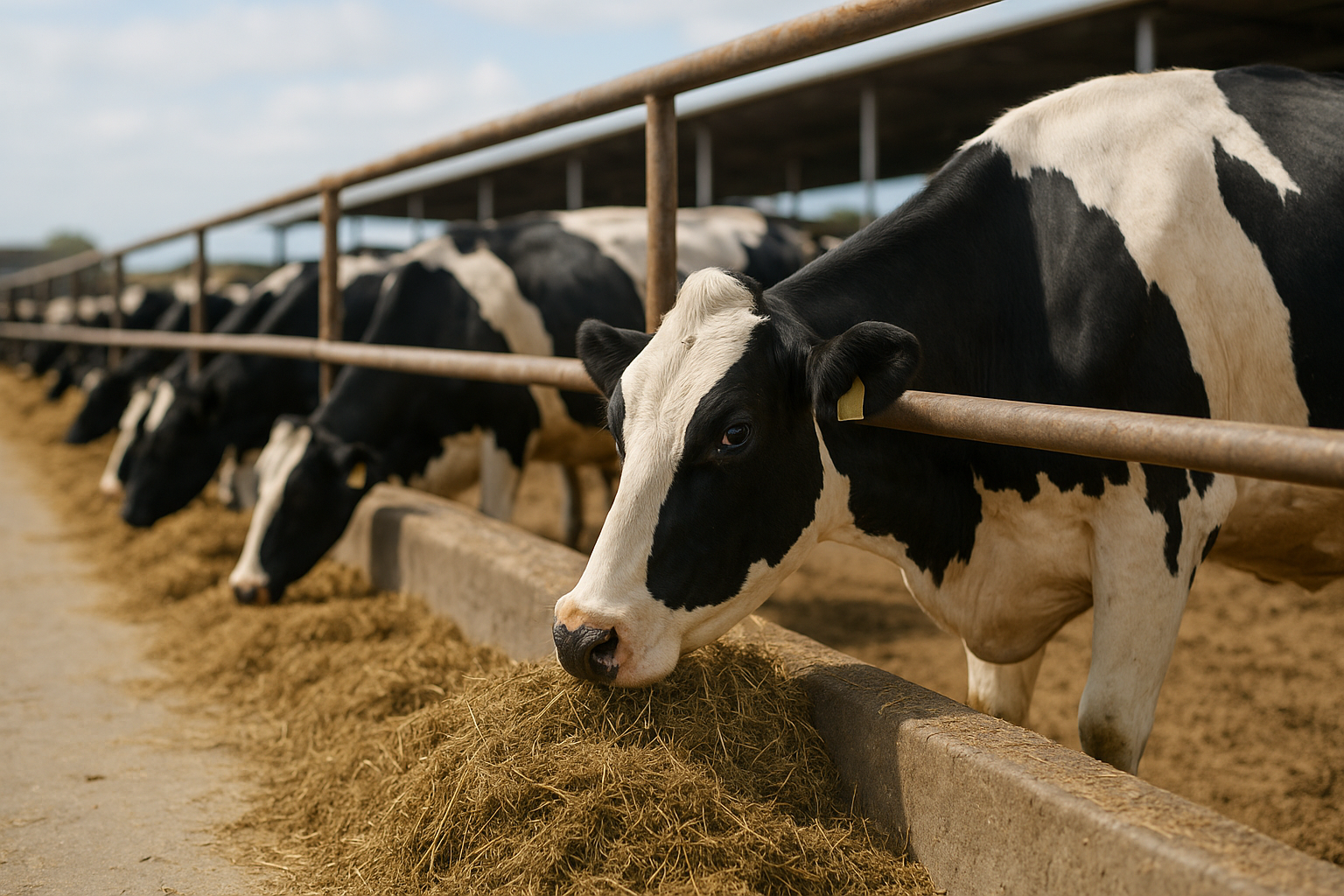
For commercial dairy producers, herd managers, and consulting dairy nutritionists, the USDA's projection of $20.45 per cwt milk against falling feed grain costs creates a compelling mandate to optimize herd feeding density and maximize component yield efficiency. Because producers cannot simply purchase replacement cows to capitalize on favorable margins due to the heifer shortage, the only viable pathway to expanded profitability lies in extracting greater milk solids—specifically butterfat and true protein percentages—from every cow in the parlor while maintaining dry matter intakes between 55 and 60 pounds per cow daily. In total mixed ration (TMR) formulation, nutritionists are swiftly recalibrating diets: substituting cheaper $4.70/bu corn and $193/ton DDGS into lactation rations to deliver cost-effective digestible starch and rumen-undegradable protein (RUP), while strategically allocating ration cost savings into high-efficiency rumen-protected amino acids, particularly synthetic L-lysine and DL-methionine. This precision balancing ensures lactating cows maintain peak milk component synthesis without inducing subacute ruminal acidosis (SARA) or degrading milk fat percentages in commercial herds.
For commercial feed manufacturers, grain elevators, and specialty feed additive suppliers, the expanding dairy margin serves as a crucial economic anchor during a period of harvest-time commodity volatility. With swine and cattle feedlot margins pressured by weak cash livestock prices and high feeder calf costs, commercial feed compounders are increasingly relying on the dairy sector's steady, daily feed pull to absorb regional coarse grains, oilseed meals, and wheat mill-feeds. Furthermore, dairy operations enjoying robust positive cash flows are actively maintaining premium nutrition programs rather than cutting corners. Suppliers of protected fats, rumen buffers, direct-fed microbials, and yeast cultures are experiencing stable order books as dairymen prioritize metabolic health, transition cow success, and reproductive longevity to keep high-producing cows in the herd for additional lactation cycles, mitigating the costly need to enter the inflated open heifer market.
What to Watch:
Over the next two to four weeks, dairy procurement desks, nutritionists, and commodity risk managers should closely monitor the forthcoming USDA National Agricultural Statistics Service (NASS) monthly Milk Production report to verify whether regional cow culling and milk output per cow confirm the ERS supply reductions. Particular scrutiny must be directed toward major Western and Upper Midwest dairy states—including California, Idaho, Wisconsin, and Texas—where late-season forage quality variability presents an immediate operational challenge. Commercial testing data from regional forage laboratories reveals considerable variation in whole-plant corn silage dry matter, starch content, and neutral detergent fiber digestibility (NDFD) across newly opened bunker silos, requiring feed mill nutritionists to conduct weekly wet chemistry analyses and adjust supplemental grain and bypass protein levels to ensure lactation consistency across peak milking strings.
Simultaneously, feed industry executives and dairy market participants must track animal health developments and export logistics through the remainder of the fourth quarter. As wild waterfowl embark on their autumn migratory flights along the Pacific and Central Flyways, state agricultural agencies and USDA APHIS have heightened biosecurity alerts; feed mills and commercial dairies must observe strict vehicle sanitation, feed bunk bird netting, and pre-movement testing to prevent localized disease interruptions. On the commercial marketing front, participants must follow CME Class III and Class IV futures spreads, butter inventory accumulation in cold storage, and nonfat dry milk (NDM) export commitments to Mexico and Southeast Asia to gauge whether international buying will support the USDA's bullish $20.45 per cwt price target through early 2027.
The Bottom Line
The USDA's 500-million-pound downward revision to combined 2026 and 2027 U.S. milk production and the concurrent increase in projected 2027 all-milk prices to $20.45 per cwt mark a defining operational moment for the North American dairy complex and its allied feed manufacturing industries. With national herd expansion severely constrained by the tightest replacement heifer inventory in decades, commercial profitability hinges not on cow numbers, but on precision nutrition that maximizes butterfat and protein yield per stall. As domestic harvest pressure drives corn down to $4.70 per bushel and DDGS spot prices to $193 per ton, commercial dairy producers and feed manufacturers hold a prime window to capture expanding income over feed cost margins. Navigating this cycle successfully demands proactive execution: fine-tuning TMR energy and amino acid density, rigorously monitoring new-crop forage digestibility, and locking in attractive fourth-quarter co-product feed supplies before winter demand surges.