
The Story:
In its newly published October 2026 Livestock, Dairy, and Poultry Outlook (Report No. LDP-M-364) and companion World Agricultural Supply and Demand Estimates (WASDE), the U.S. Department of Agriculture (USDA) further tightened domestic beef balance sheets, reducing its 2026 annual beef production forecast by 75 million pounds from the previous month to 24.8 billion pounds. This revision marks the eighth consecutive month of downward revisions by federal analysts, cumulatively slashing annual output expectations by roughly one billion pounds since the start of the year and establishing a 4.6 percent year-over-year production contraction compared to 2025 volumes. At 24.8 billion pounds, projected domestic beef output represents the smallest annual total recorded by the North American cattle sector since 2015. Extending the restrictive supply trajectory, the USDA concurrently reduced its 2027 commercial beef production projection by 160 million pounds to 24.7 billion pounds. The persistent downward adjustments reflect foundational physical constraints across the fed cattle complex, characterized by reduced steer and heifer slaughter volumes, lighter average dressed carcass weights in the second half of the year, and a structurally depleted fed cattle inventory that more than offsets localized seasonal increases in cull cow slaughter across drought-affected regions.
The foundational catalyst underlying this protracted supply contraction is the multi-year liquidation of the U.S. beef cow herd, which has shrunk total breeding inventory to its lowest point in more than 75 years following consecutive seasons of punishing pasture drought across the Southern Plains and elevated operational cost pressures. Despite sharp declines in harvest-time feed grain costs, commercial feedlot placements during late summer and early autumn have remained constrained by an acutely limited domestic calf crop. Feedyard intake data indicates that cow-calf producers are exhibiting early, highly cautious signals of heifer retention, diverting young breeding females away from feedlot arrival queues and back into regional pasture development. This retention pull has intensified fierce competition for commercial feeder steers and calves, pinning CME feeder cattle futures near historic highs between $250 and $265 per hundredweight at regional livestock auctions across Kansas, Nebraska, Oklahoma, and Texas. With cattle feeders forced to commit record capital outlays simply to populate yard pens, commercial operations are entering the fourth quarter burdened by extraordinarily high initial feeder cattle breakevens.
This supply squeeze arrives alongside distinct macroeconomic and trade dynamics that are fundamentally reshaping domestic meat and feed markets. While the USDA trimmed aggregate beef production figures, the agency maintained its firm 2026 and 2027 fed steer price forecasts between $188 and $192 per hundredweight, supported by steady domestic retail consumer demand and tight wholesale boxed beef availability. To bridge the widening processing gap at domestic packing plants, the USDA raised its 2026 beef import projections, absorbing higher volumes of lean manufacturing trimmings from Australia, New Zealand, and South America. Crucially for cattle feeders and custom feed mills, this historic livestock scarcity coincides with an unprecedented supply surge in feed grains. Following the USDA's upward revision of the national corn yield to 181.2 bushels per acre and a 16.034-billion-bushel crop estimate, CBOT December corn futures have settled near $4.18 to $4.25 per bushel, while distillers dried grains with solubles (DDGS) spot prices have dropped to $193 per ton. This dramatic divergence between record calf acquisition costs and plunging feed grain prices has forced feedlot managers to overhaul their traditional operational models, turning to high-intensity feeding strategies to capture enterprise margin.
Why It Matters:
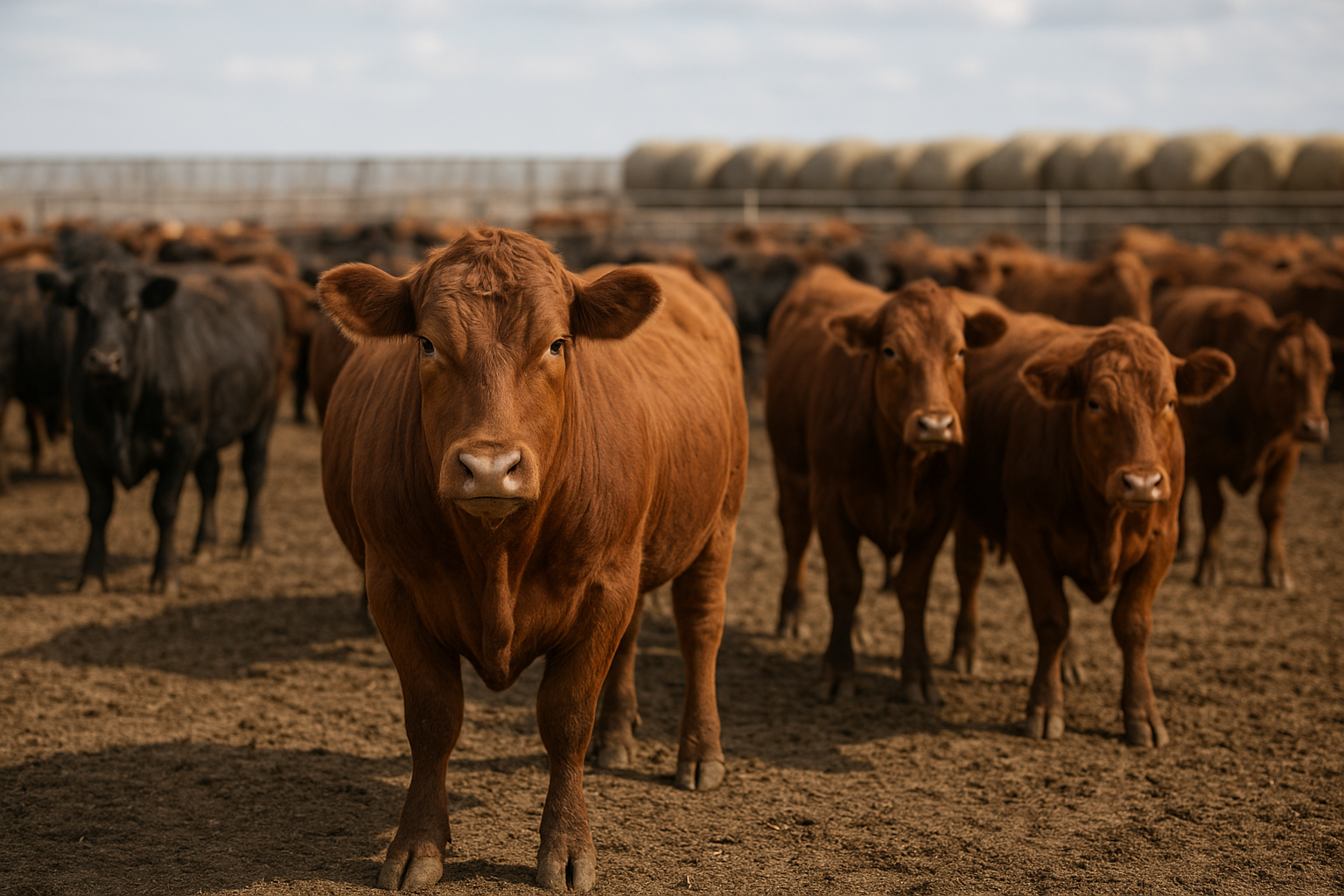
For cattle feedlot operators, consulting ruminant nutritionists, and custom feed manufacturers across the High Plains and Western Corn Belt, the USDA's 24.8-billion-pound production cap and exorbitant calf costs mandate an immediate operational pivot toward extending days on feed and maximizing carcass weight per animal. Because feedyards cannot source sufficient feeder cattle to maintain standard pen turnover rates, the only economically viable strategy to dilute sky-high feeder purchase costs and yard overhead is to manufacture more pounds of beef within the feedlot itself. Feedyards are extending feeding durations from standard 140-to-160-day cycles out to 180 to 220 days, utilizing cheap $4.20/bushel corn and discounted $193/ton DDGS to push finished steer slaughter weights toward record territory above 925 to 940 pounds dressed. However, pushing cattle to heavier finishing endpoints introduces severe biological conversion inefficiencies, as feed conversion ratios (FCR) deteriorate from an efficient 6.0:1 during mid-turnout to more than 8.5:1 during late finishing. To prevent late-stage cost of gain from eroding profits, ruminant nutritionists are aggressively fine-tuning high-energy finishing rations: maximizing starch digestibility through precision steam-flaking, maintaining optimal roughage inclusion between 6 and 9 percent dry matter to support rumen motility, and strategically deploying metabolic modifiers, including ionophores (monensin) and beta-agonists (ractopamine), during the final 30 to 45 days.
For regional commercial feed mills, grain elevators, and animal health and additive suppliers, the structural shrinkage of the fed cattle inventory creates a critical shift in volume dynamics and product mix. With fewer total head occupying feedlot pens across major feeding hubs, aggregate commercial beef feed tonnage faces natural volume headwinds, tightening throughput margins for regional feed manufacturing facilities. To counteract this volume contraction, feed manufacturers and distributors are focusing on higher-margin, value-added nutritional technologies and comprehensive health packs. Because an individual heavy feeder steer in late 2026 represents a total capital investment exceeding $2,400 to $2,600, feedlot managers have zero tolerance for digestive upsets, lameness, or mortality. Consequently, commercial mills are seeing heightened demand for precision micro-ingredient premixes, rumen buffers, direct-fed microbials, digestive enzymes, organic trace minerals, and liver abscess control medications (tylosin). Feed suppliers that deliver tailored nutritional solutions to support rumen integrity, liver health, and consistent daily dry matter intake (DMI) through extended finishing schedules are successfully protecting mill profitability despite lower overall head counts.
What to Watch:
Over the next two to four weeks, feedlot risk managers, cattle buyers, and feed procurement executives must closely evaluate the forthcoming monthly USDA NASS Cattle on Feed report for authoritative confirmation of herd retention trends and feedyard occupancy. Analysts must focus on total net feedlot placements and, most critically, the quarterly steer-versus-heifer breakdown on feed. A measurable decline in heifer placements relative to historical averages would provide concrete statistical proof that cow-calf ranchers are actively retaining heifers for breeding replacements, signaling that feeder calf supplies will tighten even further through 2027 and reinforcing the necessity for extended feeding durations. In parallel, feedyard managers must track USDA AMS weekly national slaughter reports and steer carcass weights to observe whether packing plants encounter slaughter scheduling disruptions or whether packers push chain speeds lower in response to tightening market-ready cattle supplies, which would risk backing up heavy cattle in feedlot pens.
Simultaneously, feed ingredient purchasing directors and commodity merchandisers must actively track interior grain basis dynamics and regional roughage availability as the Midwestern harvest surpasses the 60 percent completion threshold. With country elevators across the Corn Belt managing intense commercial grain receipts, interior cash corn basis remains under temporary harvest pressure, providing feedlots and feed mills an optimal procurement window to lock in winter grain needs and secure fourth-quarter distillers grains supply contracts before river barge movements and export terminal demand tighten interior co-product availability. Concurrently, feedlot managers in the Southern Plains and Southwest must closely monitor regional forage and roughage balances. Following severe late-summer dry conditions that restricted hay yields across Texas, Oklahoma, and parts of Kansas, sourcing adequate supplies of quality corn silage, alfalfa hay, and effective fiber alternatives will be paramount to prevent subacute ruminal acidosis (SARA) and digestive failure as feedlots transition large strings of heavy cattle onto high-concentrate winter finishing rations.
The Bottom Line
The USDA's downward revision of 2026 U.S. beef production to 24.8 billion pounds and 2027 output to 24.7 billion pounds underscores a historic structural contraction in the North American cattle complex, anchoring domestic beef supply at its lowest level in over a decade. While a record 16-billion-bushel domestic corn crop and deflated DDGS spot values provide essential ration cost relief, feedlot margins remain fiercely challenged by historic feeder calf replacement costs. For feedlot operators, cattle nutritionists, and allied feed manufacturers, navigating this supply-constrained environment requires disciplined operational execution: extending days on feed to maximize finished carcass weight per head, leveraging high-efficiency steam-flaked grain and precision feed additive matrices to control late-stage feed conversion drag, locking in favorable autumn corn and co-product basis values, and securing critical winter roughage inventories to protect animal health and financial performance across a profoundly reshaped cattle feeding landscape.