
The Story:
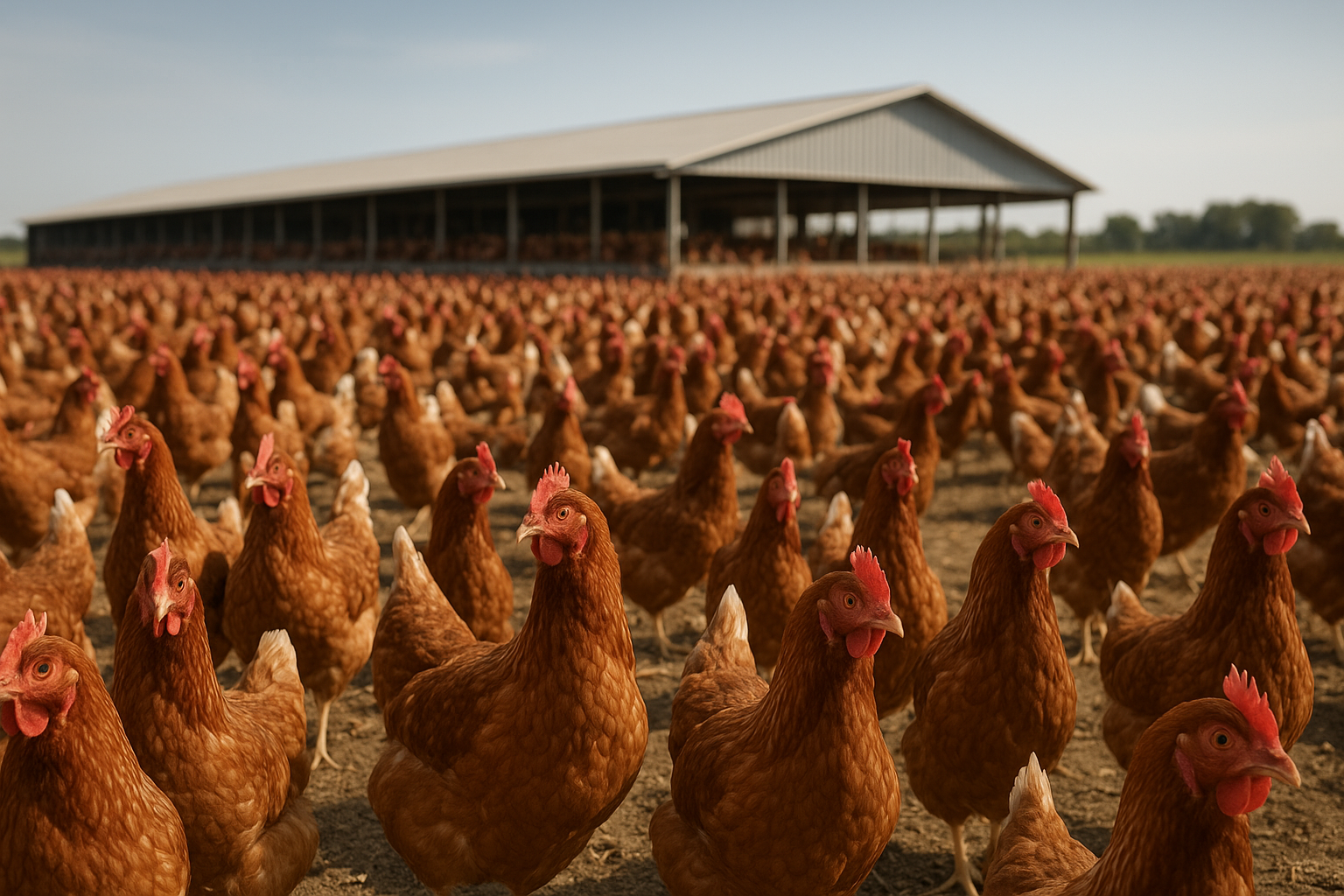
On Tuesday, October 20, 2026, the United States Department of Agriculture's National Agricultural Statistics Service (USDA NASS) officially released its monthly Chickens and Eggs report, detailing a substantial expansion across the domestic egg production complex. United States egg production totaled 9.20 billion eggs during September 2026, representing a 6 percent increase compared to the 8.68 billion eggs produced in September 2025. Table egg production reached 7.93 billion eggs, surging 6 percent year-over-year as commercial layer operations successfully completed multi-month flock rebuilding cycles following historical avian disease interruptions. Hatching egg production rose 4 percent to 1.27 billion eggs, driven by 1.17 billion broiler-type hatching eggs and 104 million egg-type hatching eggs. Total laying hens on hand across all U.S. farms on October 1, 2026, stood at 385 million birds, advancing 4 percent from 370 million birds on the corresponding date in 2025. Average layers during the month of September also reached 385 million head, up 5 percent from year-ago levels, with table egg layers accounting for 319 million birds (a 4 percent gain) and broiler-type hatching layers climbing 3 percent to 61.0 million head.
Flock productivity metrics mirrored this numerical expansion, establishing strong operational momentum as commercial complexes entered the fourth quarter. The average rate of lay on October 1, 2026, stood at 79.6 eggs per 100 layers, up from 78.8 eggs per 100 layers on October 1, 2025. For the full month of September, the average rate of lay reached 2,390 eggs per 100 layers, reflecting a 1 percent efficiency gain over the September 2025 rate of 2,367 eggs. Production gains were led by key layer complexes across the Midwest and Mid-Atlantic feeding corridors, including Iowa, Indiana, Ohio, Pennsylvania, and Georgia, where integrators have brought newly modernized, biosecure cage-free facilities into full commercial production. Simultaneously, commercial hatchery figures reinforced the broader avian production pipeline: broiler-type chicks hatched during September reached 849 million head, holding slightly above 2025 volume, while broiler-type eggs in incubators on October 1 totaled 740 million eggs, up 2 percent year-over-year. In addition, leading primary breeders placed 8.81 million broiler-type pullet chicks for future domestic hatchery supply flocks, up 1 percent from September 2025, confirming sustained multi-month production capacity across the broader poultry complex.
The official confirmation of a 385-million-bird layer inventory and a 6 percent surge in monthly egg volume marks a pivotal structural normalization for the poultry industry after extended periods of tight supply and extreme wholesale price volatility. Commercial wholesale egg values have stabilized toward long-term historical trading ranges, replenishing retail carton channels, food service pipelines, and industrial egg breaking inventories across North America. For commercial animal feed manufacturers, grain elevators, and protein merchandisers, this 15-million-bird inventory expansion represents a critical, inelastic baseline of domestic feed grain consumption. Unlike commercial broiler or hog operations that can adjust slaughter schedules or manipulate turnarounds during market dislocations, laying hen facilities operate under rigid, uninterrupted daily feeding schedules, providing feed mills and grain origination desks with a predictable, high-volume disappearance anchor throughout the winter feeding cycle.
Why It Matters:
For animal feed manufacturers, ingredient merchandisers, and commercial poultry nutritionists, a standing national flock of 385 million laying hens constitutes one of the domestic agricultural economy's largest and most consistent demand drivers. Commercial table egg layers consume an average of approximately 0.25 pounds (113 grams) of balanced complete feed per bird each day. Across a 385-million-head flock, daily feed disappearance reaches 96.25 million pounds—or approximately 48,125 short tons—of finished ration every 24 hours. Over a 30-day feeding cycle, this translates to more than 1.44 million short tons of complete feed consumption, which expands beyond 1.75 million monthly tons when accounting for growing pullet replacements and broiler breeder stock. This structural demand arrives at an ideal juncture for the commercial feed complex, as the rapid U.S. autumn harvest pushes cash corn prices down to $4.35 to $4.60 per bushel across interior elevators and pulls benchmark CBOT December soybean meal back to $348.70 per ton. Because typical commercial layer diets consist of 60 to 65 percent ground corn and 20 to 25 percent dehulled soybean meal, plummeting ingredient costs have substantially reduced cost of production per dozen eggs, expanding producer profit margins and ensuring full feed rations without dietary dilution.
At the nutritional formulation desk, managing a 385-million-bird flock with an elevated lay rate of 79.6 eggs per 100 birds requires intense dietary precision, particularly regarding macro-minerals and synthetic amino acid inclusions. Laying hens metabolize vast quantities of dietary calcium to support shell formation, with typical rations requiring 8 to 10 percent calcium carbonate, generating monthly industry consumption of more than 140,000 tons of coarse and fine feed-grade limestone alongside supplemental dicalcium phosphate. Concurrently, poultry nutritionists are leaning heavily into supplemental crystalline amino acids to optimize standardized ileal digestible (SID) amino acid ratios while controlling overall crude protein overhead. Synthetic DL-methionine—the first limiting amino acid in corn-soybean meal poultry diets—is formulated at strict inclusion rates of 0.15 to 0.25 percent (3 to 5 pounds per finished ton) to maintain egg size and albumen density while limiting dietary nitrogen excretion. With spot synthetic methionine supplies stable and crystalline L-lysine and L-threonine pricing attractive relative to intact crude protein, feed compounders are maximizing least-cost linear formulation efficiencies, pairing abundant harvest-season starch with targeted micro-ingredient supplementation to sustain peak flock performance.
What to Watch:
Over the next 30 to 60 days, commercial egg producers, feed mill managers, and poultry risk executives must maintain heightened vigilance regarding autumn wild waterfowl migration corridors. The seasonal southern flight across the Mississippi, Central, and Atlantic flyways traditionally elevates Highly Pathogenic Avian Influenza (HPAI) environmental viral loads. Bulk feed distribution trucks represent one of the primary physical vectors connecting commercial feed mills to multi-house production sites; mills servicing layer operations must enforce strict vehicle disinfection wash racks, tire sanitization, and driver cabin biocontainment protocols at every facility gate. Any localized biosecurity breach triggering mandatory quarantine and depopulation would instantly disrupt regional feed grain disappearance, impacting local basis levels in heavy production states like Iowa, Ohio, and Indiana. Furthermore, risk managers should monitor the November USDA Chickens and Eggs release to determine whether the 8 percent year-over-year contraction in September egg-type chick hatchings (51.3 million head) signals an intentional moderation in future flock expansion as barn space reaches capacity.
Simultaneously, feed procurement directors and grain merchandisers must monitor cash ingredient delivery velocity, river terminal basis, and rail freight tariffs as the harvest nears completion. While heavy field cutting has temporarily depressed interior cash corn and soybean meal values, powerful baseline domestic poultry feed disappearance—reinforced by recent international export sales surges, including 911,000 metric tons of soybeans booked to China and Spain over the past 48 hours—will gradually establish an unyielding floor beneath cash grain markets. Feed buyers and integrated egg complexes should utilize the ongoing harvest window to lock in physical corn basis and forward soybean meal contracts through the first quarter of 2027 before winter freeze restrictions constrict river navigation and escalate freight premiums. In addition, feed purchasing teams must monitor commercial supplies of feed enzymes (phytase and xylanase), vitamin premixes, and synthetic amino acids, ensuring that delivery schedules are contracted and secured ahead of potential winter transportation bottlenecks.
The Bottom Line
The expansion of the U.S. layer flock to 385 million birds and the 6 percent surge in monthly egg production to 9.20 billion confirm that commercial egg producers have fully restored production capacity, establishing a massive, non-negotiable domestic feed consumption baseline of more than 48,000 tons per day across Midwestern and Mid-Atlantic mills. This sustained layer grind coincides with substantial harvest-driven ingredient cost relief, as cash corn softens to $4.35 to $4.60 per bushel and CBOT December soybean meal retreats to $348.70 per ton, providing livestock operations and feed compounders with their strongest margin environment in over two seasons. To maximize this strategic window, commercial feed buyers should leverage current harvest basis weakness to secure forward physical grain and soybean meal coverage through the first quarter of 2027, fine-tune least-cost diets with targeted synthetic DL-methionine and coarse limestone inclusions, and enforce rigorous biosecurity protocols across feed delivery fleets to protect laying flock productivity through the upcoming winter feeding cycle.