
The Story:
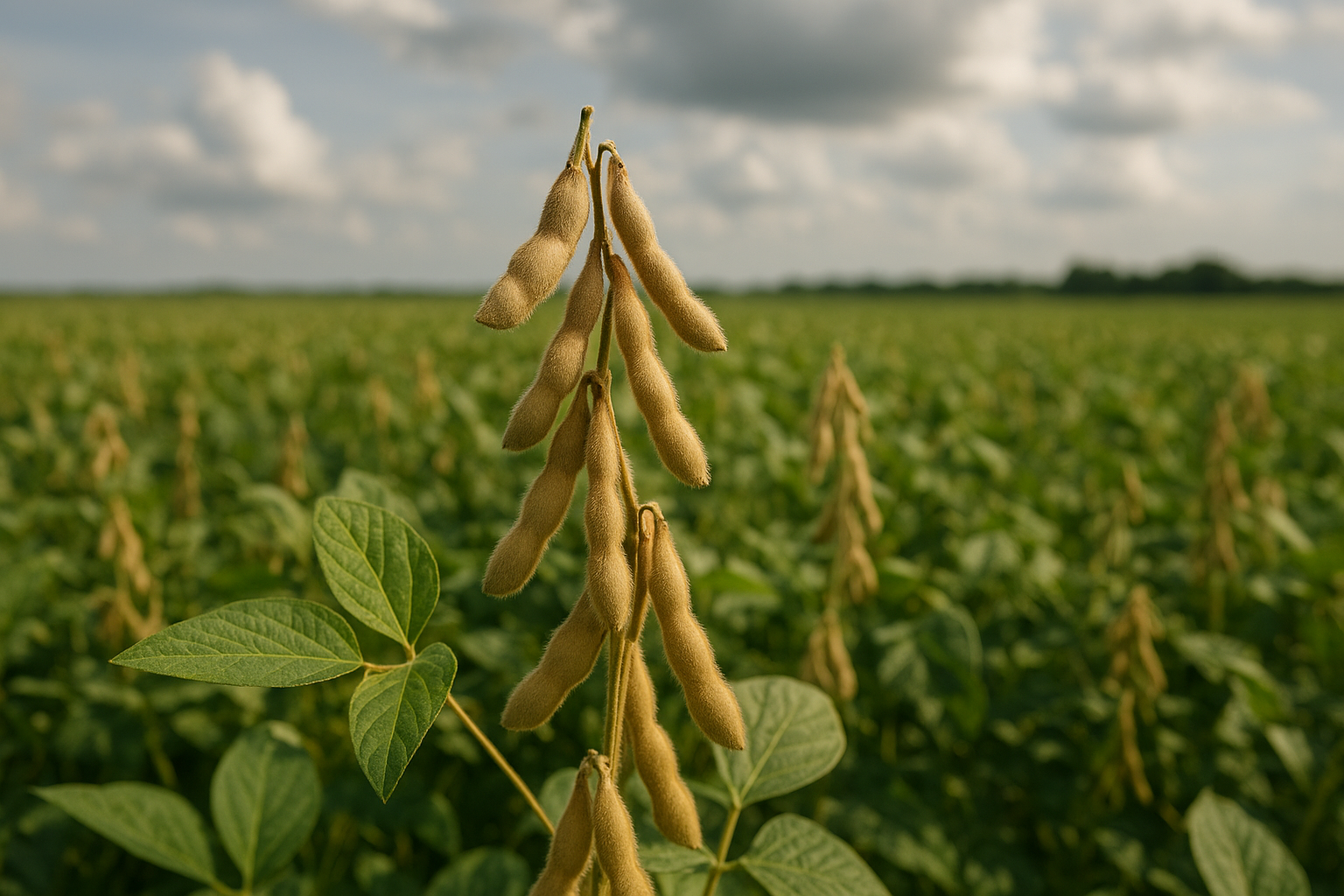
On Monday morning, October 26, 2026, benchmark Chicago Board of Trade (CBOT) soybean futures suffered an abrupt opening gap-down, tumbling 14 to 15 cents per bushel during early electronic trading sessions as international agricultural commodity markets absorbed the financial shockwaves of weekend presidential election results in Brazil. The active November soybean contract plunged beneath psychological support to test $12.41 per bushel, while deferred 2027 delivery contracts registered synchronized losses of 12 to 14 cents across the board. The primary catalyst driving the sharp opening sell-off was a sudden, precipitous devaluation of the Brazilian Real, which tumbled more than 1.8 percent against the U.S. dollar in overnight currency trading. For global oilseed supply chains, a weakening Brazilian currency instantly enhances the local-currency revenue realized by South American farm producers, triggering an immediate wave of aggressive farmer forward hedging, elevator commercial selling, and export port originations across Mato Grosso, Paraná, and Goiás. By effectively cheapening Brazilian FOB port export offers at Paranaguá and Santos relative to U.S. Gulf and Pacific Northwest delivery points, the currency retreat abruptly eroded North American export competitiveness at the exact seasonal moment when U.S. export terminals require heavy foreign vessel loading to clear interior harvest volume.
The aggressive liquidation across the soy complex generated immediate cross-commodity spillover pressure throughout the broader agricultural trading pits, pulling active feed grain and wheat benchmarks into synchronized retreat. Early-morning electronic trade saw benchmark December corn futures drop 2.5 to 3.5 cents per bushel toward $4.58 per bushel, while December Chicago soft red winter wheat dropped 1.5 cents and December Kansas City hard red winter wheat lost 3.0 cents. This broad-based weakness arrives at an exceptionally vulnerable technical juncture for row crops, which have endured steady downward drift over the preceding four weeks following the U.S. Department of Agriculture's (USDA) bearish October Crop Production report that pegged national corn yields at an unprecedented 181.2 bushels per acre and national soybean yields at a record 53.1 bushels per acre. As active board futures approach critical long-term chart support, commercial algorithmic trading desks and speculative investment managers stepped up automated sell orders, compounding the pressure on interior cash markets across the rural Midwest where commercial country elevators are already operating under peak physical space constraints and high commercial borrowing interest rates.
Crucially, the morning sell-off unfolded as commercial combining crews achieved rapid weekend progress across the central and western Corn Belt, taking advantage of dry, stable autumn weather to advance the national soybean harvest past the 70 percent completion milestone and push corn combining beyond 48 percent. With country elevators, commercial river terminals, and processor grinds inundated by physical crop receipts, interior basis levels have widened substantially, posting deep spot discounts ranging from 35 to 55 cents under December futures across major river shipping corridors. Compounding the physical volume pressure, inland logistics bottlenecks along the Lower Mississippi River system—where the Memphis gauge has dropped into negative territory, prompting the U.S. Coast Guard and inland barge carriers to enforce mandatory 11-foot-6-inch draft limits and tow-size reductions—have constrained southbound export barge throughput. With export channels facing physical draft curbs and South American currency dynamics dampening international destination demand for North American origins, flat cash prices across interior feeding belts have plunged to their most attractive procurement levels of the entire 2026 autumn marketing campaign.
Why It Matters:
For commercial animal feed manufacturers, integrated broiler and turkey complexes, table-egg producers, swine integrators, and High Plains cattle feedyards, this Monday morning futures gap-down delivers substantial immediate relief to feed manufacturing budgets and reshapes fourth-quarter protein procurement economics. Over the preceding two months, domestic livestock nutritionists have struggled against an intensely distorted least-cost ration environment: while abundant domestic corn supplies drove dietary energy values lower, benchmark CBOT soybean meal held stubbornly firm near $348 to $352 per short ton, stretching the soybean meal-to-corn price ratio beyond an onerous 2.3 to 1. This pricing distortion penalized livestock enterprises with high dietary crude protein requirements, particularly young broiler chick starter rations, nursery pig diets, and lactating dairy cows. The currency-driven futures decline in soybeans directly breaks this logjam, exerting sharp downward pressure on Decatur processor meal basis and forward meal futures, pulling cash soybean meal closer to the $338-to-$342 range. Commercial feed procurement directors should capitalize on this morning's board weakness to begin scaling into physical meal basis coverage for November through January, capturing long-awaited protein cost relief without chasing extended, high-priced contractual commitments.
Simultaneously, feed mill operations managers and animal nutritionists must dynamically recalibrate least-cost formulation matrices to exploit the simultaneous weakness across corn, soybean meal, and secondary grain co-products. With active board corn testing $4.58 per bushel and interior cash basis widening, starch energy costs have established a highly favorable baseline, enabling commercial mills to lower finished ration manufacturing costs by $14 to $20 per ton compared to late-summer benchmarks. To extract maximum margin performance, nutritionists should couple this softening protein baseline with precision synthetic amino acid fortification. By maintaining targeted inclusion of feed-grade L-lysine hydrochloride, DL-methionine, and L-threonine alongside cost-effective dry-mill distillers dried grains with solubles (DDGS)—currently pricing between $185 and $195 per ton across the Midwest—feed formulators can safely lower dietary crude protein inclusion targets by 1.5 to 2.0 percentage points. This tactical formulation adjustment protects standardized ileal digestible (SID) amino acid balances, sustains broiler feed conversion efficiency (FCR) and swine average daily gain (ADG), and shields livestock enterprises from residual volatility across physical delivery corridors.
What to Watch:
Over the next two to four weeks, feed procurement directors, grain merchandisers, and livestock risk managers must closely monitor the pace of commercial farmer selling in both Brazil and the United States, alongside the afternoon release of the USDA's weekly Crop Progress report. Agribusiness executives should track whether Brazilian agricultural producers aggressively accelerate forward-sales of their projected record 181.6 million metric ton 2026/27 crop to lock in depreciated Real revenues, which would cement heavy early-2027 export competition and limit any potential post-harvest rally in North American oilseed futures. In domestic markets, commodity buyers must analyze this afternoon's USDA harvest progress percentages to gauge whether combining operations in foundational states such as Iowa, Illinois, Minnesota, and Indiana are nearing completion, as the transition from peak field harvest deliveries into disciplined commercial on-farm bin storage typically sets the seasonal bottom for interior cash basis.
In addition, feed industry executives and grain originators must scrutinize weekly Commitments of Traders (COT) telemetry from the Commodity Futures Trading Commission (CFTC) and monitor daily river draft notices along the Mississippi inland waterway. Market participants should observe whether institutional managed-money investment funds—who recently liquidated 82,002 net-long corn contracts while tenaciously defending an elevated net-long position of 200,878 contracts in soybean meal—begin aggressively dismantling their meal length in response to Brazilian currency weakness and softening board futures. Concurrently, logistics directors must track low-water navigation restrictions near Cairo and Memphis, evaluating whether persistent draft limits force additional grain and feed co-products onto regional Class I rail lines, thereby tightening freight hopper availability and driving secondary railcar tariff premiums higher heading into late November.
The Bottom Line
The sharp 15-cent Monday morning gap-down in CBOT soybean futures—sparked by a post-election plunge in the Brazilian Real and reinforced by broad selling across corn and wheat—marks a pivotal market reset that decisively accelerates downward pricing momentum across agricultural feeding complexes. For commercial feed manufacturers, swine integrators, poultry complexes, and cattle feedlots navigating peak autumn harvest, this currency-driven sell-off transforms speculative market volatility into an actionable procurement opportunity. By scaling into forward meal basis coverage at discounted price levels, rebalancing least-cost feed rations with synthetic amino acids and economical DDGS, and locking in historically depressed interior corn values before post-harvest storage charges set in, livestock producers and feed compounders can decisively reduce operational feed costs, defend production margins, and secure enduring economic resilience heading into 2027.