
The Story:
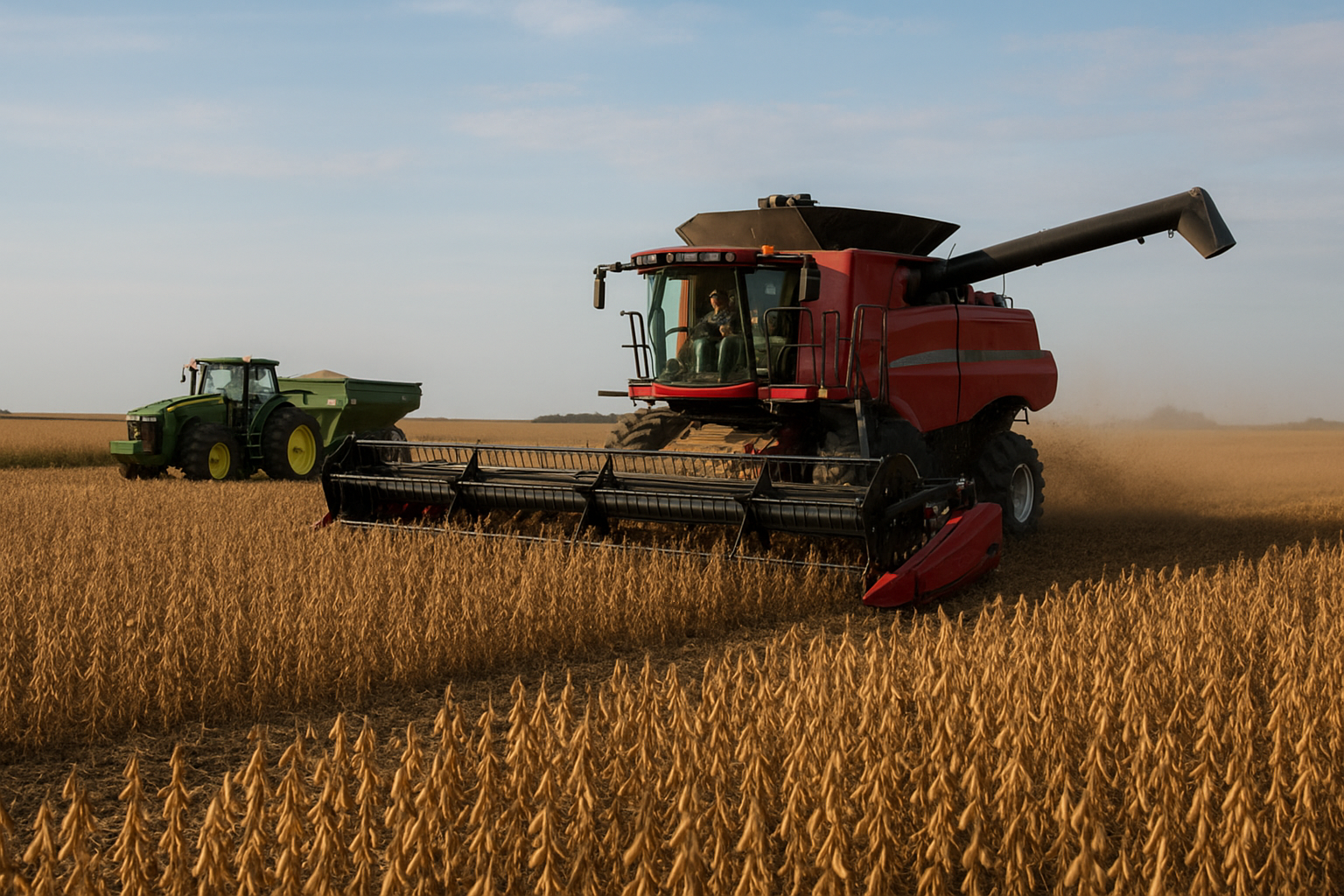
On Monday afternoon, October 19, 2026, at 4:00 PM Eastern Time, the U.S. Department of Agriculture's National Agricultural Statistics Service (USDA NASS) officially issued its weekly Crop Progress report for the week ending October 18, 2026. The empirical field data revealed a massive, nationwide acceleration in soybean combining, with national soybean harvest surging 18 percentage points in seven days to reach 64 percent complete. This substantial progress brings the 2026 soybean harvest within a single percentage point of the five-year historical average of 65 percent and represents a dramatic leap from the 46 percent recorded during the preceding week. Broad swaths of the primary Corn Belt capitalized on an uninterrupted window of dry, clear autumn weather throughout mid-October, allowing commercial custom cutting crews and farming operations to operate combines nearly around the clock. Producers aggressively prioritized their mature soybean acreage—now 96 percent dropping leaves—to avoid late-season pod shatter risks and secure premium early delivery slots at country elevators and processing facilities. In sharp contrast, the national corn harvest advanced at a more measured pace, climbing from 33 percent to 44 percent complete with 95 percent of standing acreage rated mature. While advancing 11 percentage points week-over-week, national corn combining remains substantially behind the five-year historical average of 52 percent, as growers deliberately sidelined corn harvesting equipment in favor of rapid oilseed clearance. Elsewhere in the agricultural sector, winter wheat planting reached 63 percent complete with 39 percent emerged, while grain sorghum harvesting advanced to 47 percent complete.
The pronounced operational divergence between rapid soybean completion and lagging corn harvest triggered an immediate, decisive repricing across benchmark agricultural commodity futures during the closing minutes of Monday's trading session on the Chicago Board of Trade (CBOT). Benchmark December 2026 corn futures broke decisively through critical technical support levels, sliding 7 1/4 cents to settle at $4.67 per bushel—hitting multi-week lows as commercial hedging by country elevators and systematic fund liquidation expanded late in the day. Concurrently, December 2026 soybean meal futures, which had rallied above $362.00 per short ton earlier on Monday morning following robust export inspections, surrendered their entire intraday premium during the afternoon session to settle $2.30 lower at $354.80 per short ton. Benchmark November 2026 soybeans followed suit, shedding 7 3/4 cents to settle at $12.53 1/2 per bushel. The realization that nearly two-thirds of the nation's projected 4.56-billion-bushel soybean crop is already safely harvested and moving through commercial pipelines immediately undercut the origination squeeze that domestic crushers faced earlier in the day. The rapid harvest pace reassures domestic soybean processing plants across Illinois, Iowa, and Indiana of an immense, reliable wave of physical raw oilseed deliveries arriving at processing facility gates throughout the coming week.
Across the Midwestern agricultural interior, this sudden wave of freshly combined soybeans is fundamentally altering regional basis structures and commercial storage dynamics. Country grain elevators, river loading terminals, and processor receiving pits throughout the Illinois, Mississippi, and Ohio River corridors—which had spent the morning raising cash basis bids by 3 to 5 cents to compete with deepwater Gulf export terminals—quickly paused aggressive bidding as farmer-delivered haul trucks began stacking up at elevator scale pits. Commercial merchandisers report that on-farm bin capacity across heavy-yielding sectors of the Western Corn Belt is filling rapidly with beans, compelling growers who lack redundant on-farm storage to haul freshly harvested grain directly to commercial elevators rather than storing it. Conversely, because the corn harvest remains delayed at 44 percent, interior cash corn basis in key livestock feeding pockets of the central and northern Corn Belt has held relatively defensive, resisting an immediate basis collapse even as CBOT futures dropped to $4.67. For commercial animal feed manufacturers, integrated swine production systems, and commercial poultry complexes, this late-day market shift fundamentally changes the procurement calculus: the severe intact protein price spike that complicated morning feed formulation matrices has begun to retreat, while baseline dietary energy supplies are now pricing at the most economical futures valuations of the entire 2026 harvest cycle.
Why It Matters:
For animal feed compounders, commercial swine integrators, and broiler production executives, the afternoon USDA Crop Progress report and subsequent CBOT market close mark a critical pivot in least-cost ration economics. Earlier on Monday, feed mill procurement directors faced an acute margin squeeze as the price ratio between high-protein soybean meal ($362/ton) and country elevator cash corn ($4.35/bu, or ~$155/ton) stretched to an unsustainable 2.3:1. The late-session retreat in December soybean meal futures to $354.80 per ton—combined with an easing in interior processor delivery basis—begins to restore balance to formulation sheets. In commercial poultry operations and high-volume swine grow-finish barns, a $7.60-per-ton drop in wholesale soybean meal provides immediate, tangible relief, lowering raw feed manufacturing costs by approximately $1.50 to $2.25 per finished ton of feed across mid-grower and late-finisher feeding phases. Furthermore, with December corn futures breaking down to $4.67 per bushel, dietary energy remains extraordinarily cheap, giving feed compounders expanded economic latitude to construct balanced, cost-effective diets utilizing an optimal blend of local cash corn, regional distillers dried grains with solubles (DDGS), and newly discounted domestic soybean meal.
At the feed mill formulation desk, this narrowing price relationship requires animal nutritionists to recalibrate least-cost linear matrices and evaluate synthetic amino acid replacement thresholds. While supplemental crystalline amino acids—including L-lysine hydrochloride, L-threonine, and DL-methionine—remain highly economical against $354.80 soybean meal, the aggressive displacement of the final 1.0 to 1.5 percentage points of intact soybean meal must be handled with heightened nutritional precision. Nutritionists must ensure that diets maintain essential dietary electrolyte balance (dEB), meet minimum crude protein guidelines, and satisfy required ratios of secondary branched-chain amino acids, specifically isoleucine and valine, to prevent growth stalls or reduced breast meat yield in heavy broilers and late-finishing market hogs. From a commercial procurement perspective, the revelation that the U.S. soybean harvest has already achieved 64 percent completion strongly indicates that the seasonal peak in soybean meal basis pressure is occurring right now. Feed mill purchasing managers who deferred locking in fourth-quarter 2026 and first-quarter 2027 meal coverage should prepare to execute forward basis contracts over the next 10 to 14 days as crushing plants absorb peak bean deliveries and process raw oilseeds at maximum capacity.
What to Watch:
Over the next seven to ten days, commercial feed grain merchandisers, livestock risk managers, and ingredient procurement directors must closely track Midwest weather systems and regional machinery deployment as custom combining crews pivot from harvested soybean ground into standing corn fields. With 56 percent of the U.S. corn crop still standing in the field—and with 95 percent of the crop already fully mature—an extended run of dry, warm weather through the end of October could trigger an unprecedented surge in weekly corn combining, potentially pushing national harvest progress past 60 percent by next Monday's USDA report. If combining accelerates rapidly across Iowa, Illinois, Nebraska, and Indiana, interior country elevators will face severe storage capacity constraints, forcing commercial handlers to widen local cash basis bids to historic harvest discounts of 50 to 60 cents under CBOT December futures. Feed mill purchasing teams must stay in daily communication with regional elevators to capture these distressed harvest bushels, capitalizing on spot delivery discounts to lock in physical corn coverage through year-end.
Simultaneously, feed ingredient buyers must monitor domestic soybean processing plant operating margins and the pace of ocean export demand. Following Monday morning's massive 2.00-million-metric-ton export inspections report and 375,000 MT of fresh flash sales disclosures, feed buyers must observe whether river terminal elevators continue to pull raw soybeans aggressively into export channels, or whether escalating elevator receipts will fully satisfy domestic processor requirements and generate a sustained slide in meal basis. Additionally, feed compounders must monitor inland river logistics along the Mississippi River navigation system, where seasonal low-water conditions could restrict barge drafts and bottle up grain tows, leaving larger volumes of grain trapped in the domestic interior. Finally, commodity risk managers must evaluate international developments, including early soybean planting velocity across central and northern Brazil, where expanding seasonal monsoon rains could reinforce a bearish global supply outlook and keep long-term downward pressure on benchmark North American feed ingredient valuations into early 2027.
The Bottom Line
The USDA's October 19, 2026 Crop Progress report confirming that national soybean harvest surged to 64 percent complete—while corn harvest lagged behind normal at 44 percent—instantly altered market momentum, driving CBOT December corn futures down 7 1/4 cents to $4.67 per bushel and dragging December soybean meal down $2.30 to $354.80 per ton as harvest bushels flood Midwestern processing pipelines. For animal feed manufacturers, commercial swine producers, and integrated poultry complexes, this rapid harvest surge relieves the morning's intense protein basis squeeze and narrows the distorted soybean-meal-to-corn ratio, creating an exceptional economic window for diet optimization. To maximize feeding margins, livestock operations must execute a synchronized two-step strategy: consulting nutritionists should immediately recalibrate linear feed matrices to capture the dual benefit of cheap dietary energy and softening intact protein alongside precision amino acid supplementation, while ingredient procurement directors should aggressively leverage the upcoming 10-to-14-day harvest peak to secure forward soybean meal basis contracts and lock in widening cash corn discounts before field combining concludes.