
The Story:
According to the latest weekly transportation and market data released by the U.S. Department of Agriculture's Agricultural Marketing Service (USDA AMS), spot downbound grain barge freight rates across the Mississippi River System have dropped significantly, falling roughly 29 percent below their five-year seasonal benchmark. In the key central shipping corridor of St. Louis, spot barge freight rates settled at 723.2 percent of benchmark tariff, equating to $28.86 per short ton—representing a notable $1.42 per ton reduction from the previous week and settling well below the historical five-year early October average of $40.69 per ton. This downward trajectory extends across the entire inland waterway network, with freight out of the Twin Cities registering at 832 percent of tariff ($51.50 per ton), Mid-Mississippi originating rates at 839 percent ($44.63 per ton), Illinois River loadings at 814.3 percent ($37.78 per ton), and Lower Ohio River terminals at 839.3 percent ($37.43 per ton). South of Cairo, spot rates tumbled by $3.14 to settle at 621.4 percent of tariff ($19.51 per ton). The pronounced weakness in barge freight rates marks an extraordinary contrast to the severe low-water navigation crises that disrupted autumn grain movements in recent harvest seasons, establishing exceptionally fluid logistical conditions as Midwest combines accelerate harvesting across the Corn Belt.
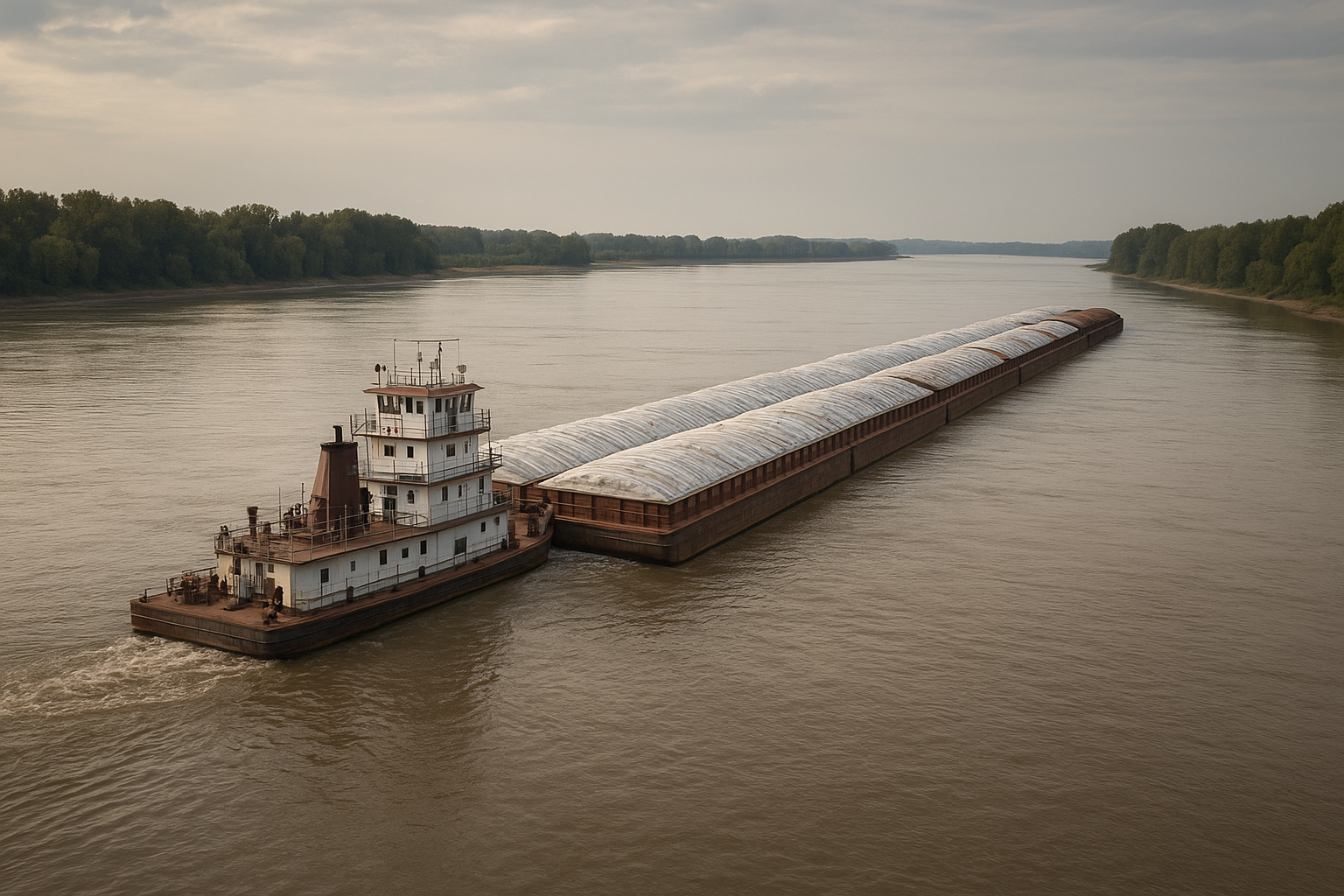
The primary driver behind this freight market collapse is favorable hydrology combined with an abundant supply of empty barge equipment positioned throughout the inland river system. Widespread early autumn precipitation events across the Upper Mississippi, Missouri, and Ohio River basins stabilized river stages and prevented the severe low-water groundings and shallow draft restrictions that severely hindered commercial navigation during previous drought years. Continuous maintenance dredging conducted by the U.S. Army Corps of Engineers has maintained commercial nine-foot channel depths, permitting tows to operate with standard 11-to-12-foot draft allowances rather than the severely restricted nine-foot drafts that reduced barge carrying capacities by 20 to 30 percent in past autumns. Furthermore, tow operators below St. Louis are pushing maximum flotilla configurations of 30 to 36 covered hopper barges without experiencing transit bottlenecks. Because each individual 1,500-ton covered hopper barge transports approximately 50,000 to 52,500 bushels of grain—the equivalent carrying capacity of roughly 70 commercial semi-trucks—the absence of draft and tow-size limits has maximized physical transport throughput, enabling commercial carriers to move massive volumes of bulk commodities toward Center Gulf export terminals without charging harvest-time freight premiums.
This deflation in downbound river transportation costs is fundamentally altering cash grain basis relationships and competitive dynamics between interior processors and river export terminals. With the USDA's recent WASDE projections establishing a massive 16.034-billion-bushel domestic corn crop and a 4.58-billion-bushel soybean harvest, country elevators are handling intense farmer delivery pressure. Cheaper barge freight reduces the transport margin penalty required to deliver interior bushels to deepwater ocean vessels at the Gulf of Mexico, prompting Gulf exporters to post aggressive cash bids. This dynamic is pulling physical grain away from interior processors toward river terminals situated along the Mississippi, Illinois, and Ohio rivers, where river basis bids have firmed relative to interior truck markets. Consequently, interior animal feed compounders, wet-mill processing facilities, and regional dry-grind ethanol plants located beyond direct water access must actively defend their intake pipelines, narrowing local basis discounts and bidding competitively to secure adequate inventory against aggressive river-terminal buying.
Why It Matters:
For animal feed manufacturers, commercial livestock nutritionists, and ingredient procurement directors, the collapse in barge freight rates transforms regional supply chains and ingredient availability across both ruminant and monogastric sectors. For commercial swine operations, broiler integrators, and cattle feedlots located across the Southeast and Southern Plains, fluid river logistics ensure uninterrupted bulk movements of whole yellow corn, high-protein soybean meal, and co-products without overburdening Class I rail networks or regional trucking fleets. However, for feed manufacturing mills situated within a 50-to-100-mile radius of navigable river loading ports, low barge rates represent a sharp source of local procurement friction. Because export terminals can afford to pay higher spot cash prices to farmers and grain handlers while still preserving their merchandising margins, domestic feed mills cannot rely on wide harvest-time basis discounts to depress ingredient costs. Commercial procurement managers must closely calibrate daily bids against nearby river elevator scales, offering delivery flexibility or modest cash premiums to prevent quality heavy-test-weight corn from bypassing mill bins.
Beyond raw grain logistics, the plunge in river barge freight creates immediate ramifications for the distillers dried grains with solubles (DDGS) market. With CIF New Orleans (NOLA) barge bids softening to $262 per metric ton, international ocean buyers—most notably in Mexico, Vietnam, Indonesia, and South Korea—are capitalizing on cheaper delivered export values to book substantial fourth-quarter co-product volumes. With Midwest ethanol biorefineries running at full post-turnaround grind rates of 1.05 million barrels per day, this brisk export clearance absorbs surplus co-product production that might otherwise saturate local truck markets. For commercial swine and poultry nutritionists balancing least-cost diets amidst tight livestock margins and CME lean hog contract lows, this active export draw means that local DDGS spot discounts may prove short-lived. To protect dietary margins, feed formulators must actively evaluate current DDGS protein unit economics ($7.15 per unit versus $7.57 for 48 percent soybean meal) and lock in forward truck and rail commitments before heavy barge movements to the Gulf siphon off accessible regional co-product inventories.
What to Watch:
Over the next two to four weeks, feed procurement directors, grain merchandisers, and commercial livestock risk managers must closely track the weekly USDA AMS Grain Transportation Report alongside National Oceanic and Atmospheric Administration (NOAA) inland river stage projections at critical gauge locations, including St. Louis, Cape Girardeau, and Memphis. While current channel depths remain fully supportive of deep-draft navigation, late autumn weather patterns can shift abruptly. Furthermore, merchandisers must monitor the seasonal operational timeline on the Upper Mississippi River, where commercial navigation above Lock and Dam 19 near Keokuk, Iowa, typically concludes by late November or early December due to winter ice accumulation. A pre-freeze rush by northern grain handlers to float remaining grain inventories southward before river lock closures could trigger localized spot barge shortages and temporary freight rate spikes across Upper Mississippi gathering pools.
Simultaneously, feed ingredient purchasing desks and logistics directors must monitor secondary rail freight markets and Class I railroad cycle times. As major western and eastern rail carriers compete against fluid river corridors to capture autumn harvest tonnage, any localized locomotive shortages or railcar dwell time expansions could abruptly shift shipping volumes back toward river gateways, altering regional basis spreads. In parallel, procurement teams should monitor weekly USDA Federal Grain Inspection Service (FGIS) export inspection totals and FAS weekly export sales reports for both corn and soybeans. If international buying interest accelerates in response to low U.S. Gulf export values, interior river elevators will maintain aggressive cash bids, requiring domestic feed manufacturers to maintain disciplined forward procurement strategies and execute winter storage contracts to insulate operations against unexpected basis volatility.
The Bottom Line
The 29 percent drop in downbound Mississippi River grain barge freight rates to $28.86 per ton out of St. Louis marks a pivotal logistical development for the 2026 North American harvest, providing fluid, cost-effective transport to Gulf export gateways while fundamentally reshaping interior animal feed procurement dynamics. By averting the low-water draft restrictions that paralyzed river commerce in previous years, unconstrained barge navigation has unleashed rapid export clearance for record autumn grain supplies and ethanol co-products. For commercial feed manufacturers, livestock producers, and ingredient merchandisers, successfully navigating this market requires agile execution: defending local grain origination against aggressive river-terminal basis bids, locking in favorable freight and co-product supplies before seasonal northern lock closures, and balancing least-cost feed rations to safeguard enterprise margins across a rapidly evolving commodity logistics landscape.