
The Story:
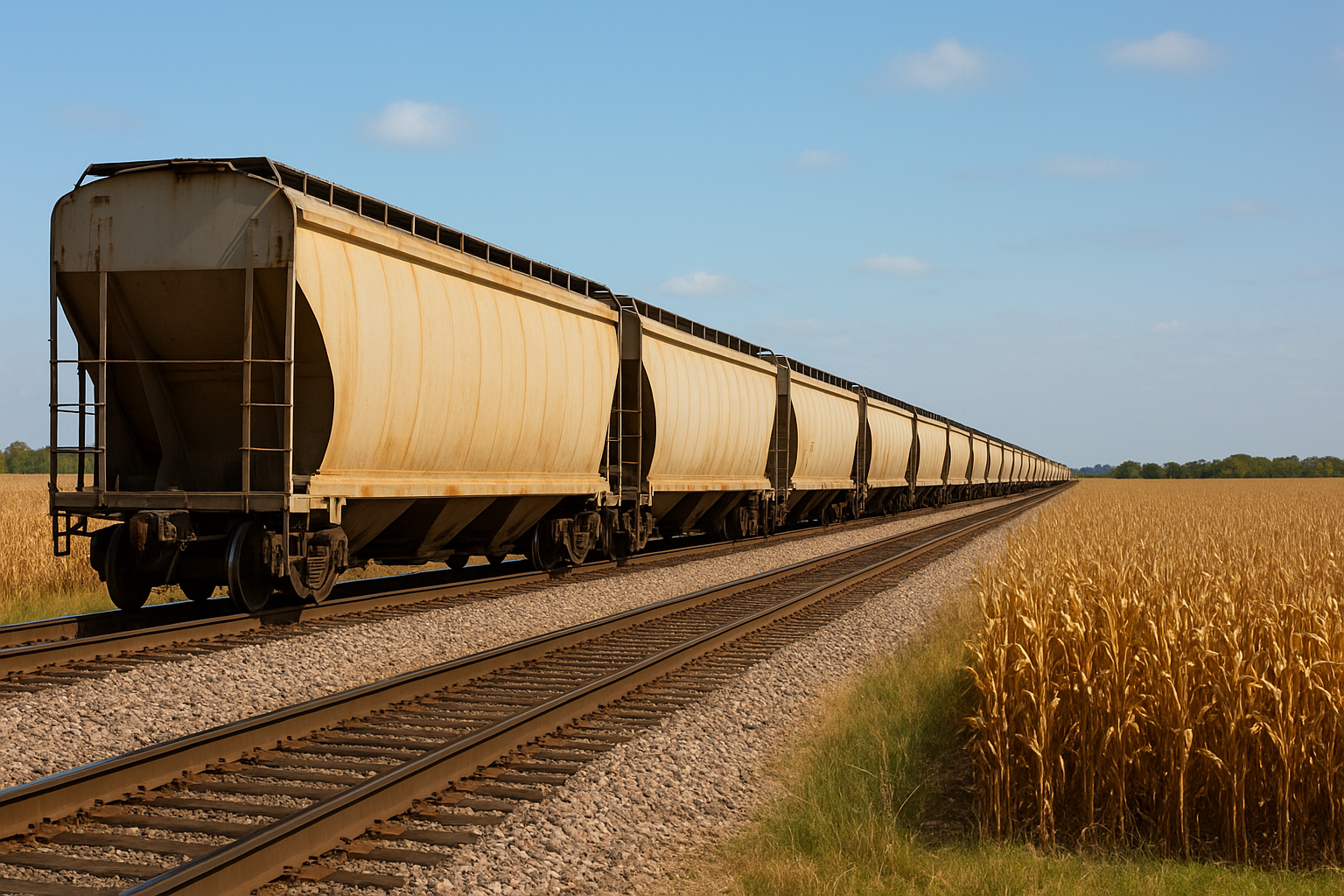
On Thursday, October 15, 2026, the U.S. Department of Agriculture’s Agricultural Marketing Service (USDA AMS) officially issued its weekly Grain Transportation Report (GTR), detailing significant freight rate shifts across North American agricultural supply chains for the newly commenced 2026/27 grain marketing year. Central to the federal report are new published rail tariff schedules implemented by Class I carriers, led by BNSF Railway, which instituted across-the-board tariff increases of $200 per railcar for shuttle-train corn movements originating across the Midwest and destined for both Pacific Northwest (PNW) export gateways and Hereford, Texas—the undisputed commercial cattle feeding and grain processing hub of the Texas Panhandle. At an average loading capacity of 3,600 to 3,800 bushels per modern covered hopper car, this mandatory carrier adjustment directly adds between 5.3 and 5.6 cents per bushel to baseline rail linehaul transportation expenses. Prior to this tariff escalation, commercial feedyards in the Southern Plains benefited from a $200-per-car freight discount relative to Mexican export border crossings; BNSF’s restructured tariff schedule kept rates to Mexican ports of entry largely unchanged, effectively erasing the historical domestic rate advantage previously enjoyed by High Plains cattle feeding operations.
The federal transportation assessment highlights that these primary tariff hikes arrive at a moment of acute seasonal strain across domestic interior rail logistics, as the massive autumn harvest of 16.034 billion bushels of corn and 4.562 billion bushels of soybeans accelerates toward peak field progress across the Western and Central Corn Belt. With country elevators in Iowa, Illinois, Minnesota, and Nebraska experiencing heavy harvest receipts and commercial bin congestion, demand for immediate rail capacity has surged, spilling over into secondary railcar markets. GTR transaction tables indicate that secondary shuttle-car auction values for October and November delivery have escalated to premiums of $300 to $500 per car over tariff, compared to negative or neutral secondary bids recorded during the late summer. Concurrently, regional origin dwell times and terminal switching delays have lengthened slightly across key interchange points, as Class I railroads balance unit-train positioning between West Coast export corridors and high-volume domestic feeding routes, compounding transit cycle times and testing the physical loadout limits of regional origin elevators.
Compounding the rail freight escalation, river logistics along the central Mississippi River basin offer little relief for grain merchandisers attempting to bypass railroad routes, according to the AMS weekly report. While late-season precipitation provided temporary stabilization to river gauges below St. Louis, seasonal draft restrictions and persistent lock queue delays—particularly around Upper Mississippi Lock and Dam 25—have constrained barge tow configurations to 12 to 15 barges rather than standard 16-to-20 barge flotillas. This physical restriction has held Illinois and St. Louis spot barge freight tariffs stubbornly elevated between 580 and 640 percent of benchmark tariff. With barge freight remaining costly and river terminal bids aggressively competing for spot grain to fulfill ocean vessel commitments at the Center Gulf, interior feed manufacturers and integrated livestock operations in the Southeast and Southern Plains are left largely captive to Class I rail networks, unable to divert grain volume to water routes without incurring prohibitive drayage and transloading premiums.
Why It Matters:
For commercial cattle feedlot operators, integrated swine and poultry feed mills, and compound feed manufacturing desks, BNSF’s $200-per-car tariff increase and the accompanying secondary car market surge deliver an immediate inflationary shock to delivered feed grain basis. While the USDA’s latest WASDE and Feed Outlook reports projected lower farm-gate cash corn values and a reduced national season-average price of $4.70 per bushel, the rising freight wedge ensures that commercial feeders in feed-deficit livestock belts will not fully capture those harvest-time savings. In the Texas Panhandle, western Kansas, and the poultry belts of the Southeast, commercial feeding rations rely almost entirely on railed Midwestern corn and soybean meal. An additional 5.5 to 10.0 cents per bushel in linehaul and secondary freight costs rapidly accumulates across high-volume feeding complexes; for a 50,000-head commercial feedlot consuming roughly 15,000 bushels of corn daily, this freight escalation translates directly into an additional $25,000 to $45,000 in monthly operating expense, tightening cattle feeding margins at a time when live cattle breakevens remain acutely vulnerable to beef demand fluctuations.
Beyond the feedlot sector, escalating rail delivery costs alter least-cost feed formulation economics and relative ingredient pricing spreads for commercial poultry integrators and swine operations across the country. As the delivered replacement cost of bulk corn climbs, nutritionists and procurement directors are forced to re-evaluate inclusion thresholds for alternative energy and co-product ingredients, most notably distillers dried grains with solubles (DDGS), wheat middlings, and hominy feed. Because ethanol bioprocessing plants located along Midwestern rail lines are equally subject to rising railcar tariffs when shipping DDGS to Southeastern broiler and swine complexes, delivered co-product prices will firm in tandem with whole grain. To preserve finished ration cost targets without sacrificing dietary caloric density, commercial feed formulators must optimize supplemental synthetic amino acid inclusion—utilizing crystalline L-lysine HCl, DL-methionine, and L-threonine to balance lower-crude-protein dietary formulations and reduce the total volume of expensive railed intact protein meals required per ton of complete feed.
What to Watch:
Over the next four to six weeks, feed procurement directors, livestock feedlot managers, and grain merchandisers must rigorously monitor secondary railcar auction markets and weekly Class I railroad velocity reports published by the Surface Transportation Board (STB) and USDA AMS. Tracking weekly shuttle-train bids will reveal whether secondary car premiums ease once the peak Midwest combining window concludes in early November or whether persistent export demand into the Pacific Northwest keeps rail equipment tightly constrained through the end of the year. Merchandisers should also scrutinize weekly train speeds and terminal dwell figures for BNSF and Union Pacific to anticipate potential transit bottlenecks in major interchange yards such as North Platte, Kansas City, and Fort Worth, which could disrupt just-in-time feed mill ingredient inventories and force facilities to draw heavily on costly emergency truck supplies.
Simultaneously, feed quality control personnel and procurement specialists must adjust their risk management and physical contracting strategies to navigate the widening basis spread between origin elevators and destination feed mills. Feedlot operators in the High Plains should consider locking in delivered basis contracts through the first quarter of 2027 to protect against further freight spikes as winter weather creates traditional operational headwinds across Northern rail corridors. In parallel, mill superintendents must maintain heightened quality surveillance on railed grain shipments, checking incoming hopper car deliveries for uniform moisture levels, test weight consistency, and physical kernel breakage, as rapid elevator throughput during peak harvest can accelerate mechanical grain damage during high-speed shuttle loading operations.
The Bottom Line
The USDA Agricultural Marketing Service’s October 15, 2026 Grain Transportation Report underscores a critical market reality for North American animal feed and livestock producers: abundant farm-level grain supplies cannot offset escalating transportation frictions when carrier tariffs and secondary railcar premiums surge. BNSF’s $200-per-car tariff increase on corn shuttles to Hereford, Texas and PNW export terminals, combined with secondary car premiums reaching $500 over tariff and restrictive Mississippi barge capacity, directly inflates delivered feeding costs across the Southern Plains, Southeast, and Pacific export corridors. Feedlot operators, commercial swine and poultry integrators, and feed mill nutritionists who actively hedge delivered basis, recalibrate ration matrices around synthetic amino acids to minimize freight-inflated bulk ingredients, and optimize physical siding logistics will successfully shield livestock margins from the autumn freight squeeze.