
The Story:
In an exhaustive autumn 2026 economic analysis published this week by the Purdue University Center for Commercial Agriculture, agricultural economist and center director Dr. Michael Langemeier revealed that commercial swine finishing feed costs are projected to climb approximately 10 percent higher in 2027 compared to 2026 baselines. Utilizing early-autumn corn and soybean meal benchmark futures alongside historical feeding budget matrices, the Purdue baseline swine finishing feed cost index is forecast to surge from an estimated 103.8 in 2026 to 113.9 in 2027, calibrated against a base index of 100 established in 2025. Dr. Langemeier underscored that while the 10 percent increase serves as the central baseline forecast, the actual trajectory of swine feeding expenses will remain exceptionally volatile. Driven by historically tight domestic and global stocks-to-use ratios across major coarse grains and oilseeds, realistic year-over-year cost adjustments for pork producers could range anywhere from a modest 5 percent increase under optimal crop scenarios to an onerous 15 percent surge if secondary weather shocks, global trade disruptions, or domestic yield adjustments constrain available feed supplies heading into the 2027 feeding year.
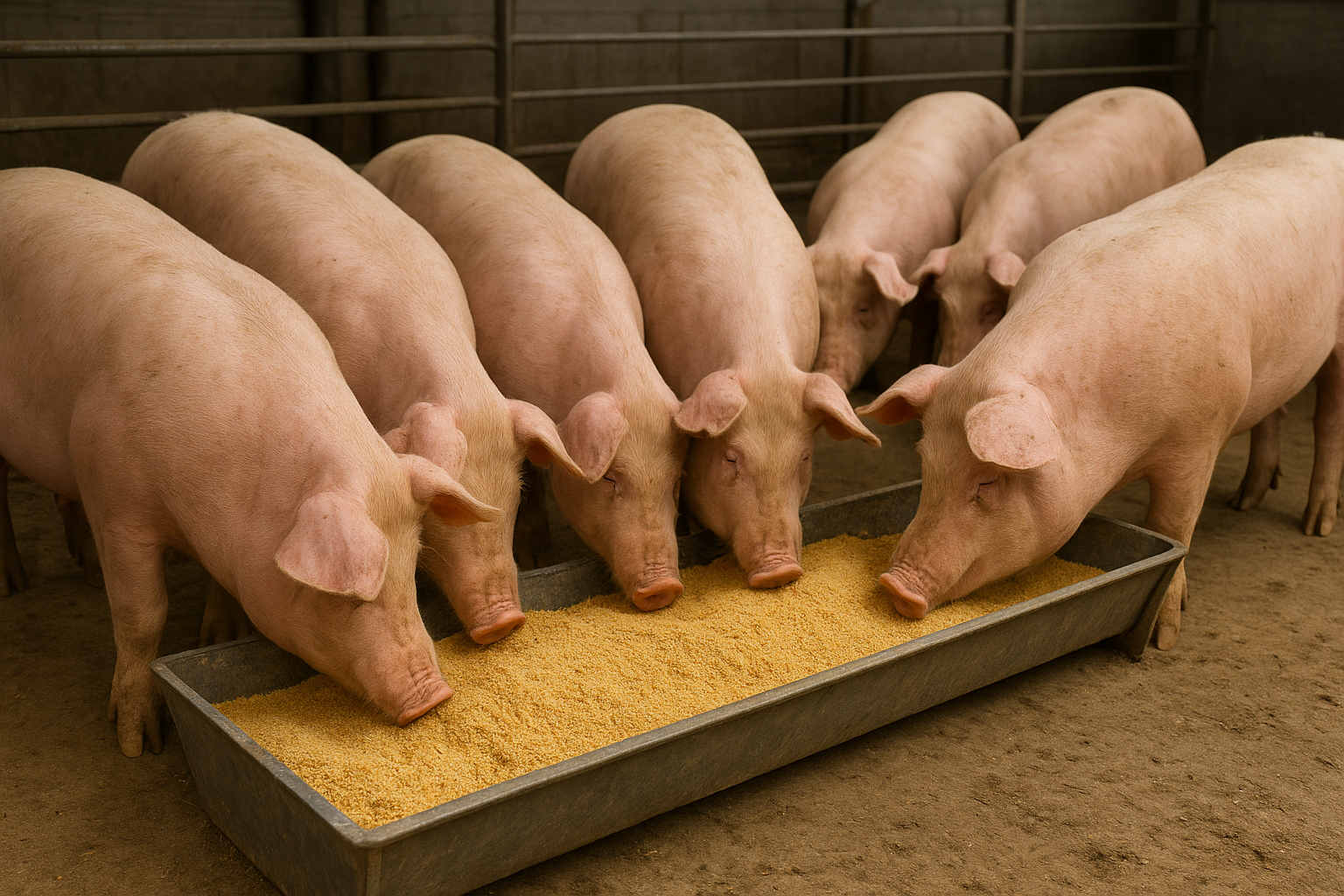
The mathematical linchpin of the Purdue analysis centers on the extreme sensitivity of modern commercial hog diets to cash corn price fluctuations. In standard early-weaned and feeder-to-finish production systems, corn represents the overwhelming majority of total dietary volume—consistently comprising between 55 and 65 percent of the complete finishing ration alongside soybean meal, distillers dried grains with solubles (DDGS), and synthetic amino acid premixes. According to Langemeier's sensitivity modeling, every 10-cent-per-bushel change in cash corn prices directly shifts swine finishing feed costs by approximately 43 cents per hundredweight ($0.43/cwt). When evaluating wider commodity swings, a 75-cent-per-bushel movement in corn translates to an enormous $3.25 per hundredweight fluctuation in finished hog production costs. For a commercial producer marketing standard 285-pound finished market hogs, that 75-cent price movement equates to a variance of more than $9.25 per head—a margin swing large enough to completely erase annual enterprise profitability in an operational climate where live hog slaughter prices already face intense consumer demand headwinds and packing plant margin compression.
Crucially, this warning of impending 2027 cost inflation arrives at a deceptive operational juncture for domestic swine and feed manufacturing sectors. With national corn harvest reaching 60 percent complete and soybean combining hitting 79 percent, interior Midwest country grain elevators are currently saturated with physical grain, widening cash basis discounts and temporarily dragging spot cash corn bids down to between $4.10 and $4.25 per bushel across major feeding corridors. Simultaneously, benchmark Chicago Board of Trade (CBOT) soybean meal has plunged nearly $6.00 to trade near $340.20 per short ton, lulling some livestock procurement desks into a complacent, hand-to-mouth purchasing stance. However, the Purdue analysis makes clear that current spot harvest discounts represent a fleeting seasonal window rather than a permanent structural reset. Because long-term coarse grain balance sheets remain uncomfortably tight both domestically and internationally, commercial grain handlers expect interior basis to rapidly rebound once field harvest concludes and growers securely lock physical bushels into on-farm steel storage, exposing unhedged pork producers to aggressive cost spikes as early as the first quarter of 2027.
Why It Matters:
For commercial swine integrators, independent farrow-to-finish operators, feed compounders, and nutrition managers, the Purdue finishing cost outlook signals an urgent strategic pivot from short-term spot buying to disciplined forward risk management. Feed expenses represent between 65 and 70 percent of total live hog production costs, making dietary energy and protein procurement the single largest determinant of swine enterprise solvency. In a commercial landscape where packers are operating under tight slaughter margins and retail pork demand is sensitive to macroeconomic inflation, pork producers cannot count on higher live hog cash bids to offset higher ration expenses. Relying on an uncommitted, spot-market feed procurement strategy throughout 2027 introduces intolerable margin exposure. Feed mill executives and commercial swine directors must recognize that the ongoing 2026 harvest deluge—which has temporarily depressed cash corn values and widened elevator basis bids—offers an optimal strategic window to scale into delivered-mill basis contracts and forward futures hedges through the spring and summer of 2027 before harvest-induced cash market discounts dissolve.
At the feed manufacturing and dietary formulation level, the Purdue sensitivity data elevates precision ration optimization from a technical preference to a bottom-line survival requirement. Because every 10-cent jump in corn inflates finishing costs by 43 cents per hundredweight, swine nutritionists must actively re-engineer ration profiles to blunt their vulnerability to starch pricing spikes. Nutritionists and feed compounding specialists can achieve immediate cost insulation by maximizing the strategic inclusion of feed-grade synthetic amino acids—specifically L-lysine hydrochloride, DL-methionine, L-threonine, L-tryptophan, and L-valine. By precisely balancing standardized ileal digestible (SID) amino acid ratios, feed formulators can safely reduce intact dietary crude protein by 1.5 to 2.0 percentage points, significantly trimming high-priced soybean meal inclusion without penalizing average daily gain (ADG) or feed conversion ratios (FCR). Furthermore, systematically blending high-energy distillers dried grains with solubles (DDGS)—which continue to price attractively as ethanol biorefineries maintain heavy grind volumes—enables mills to substitute corn starch cost-effectively while anchoring ration margins against grain market volatility.
What to Watch:
Over the next 30 to 60 days, swine enterprise executives, commercial grain originators, and feed procurement directors must closely track interior farmer selling behavior and post-harvest grain movement across foundational production states, including Iowa, Illinois, Minnesota, Nebraska, and Indiana. Agribusiness professionals should monitor weekly USDA Crop Progress reports to determine when field combining officially terminates, while cross-referencing country elevator daily basis sheets to identify the seasonal inflection point where spot delivery pressure subsides. Market participants should observe whether Midwest producers, dissatisfied with flat cash prices under $4.25 per bushel, aggressively shut bin doors and halt commercial sales, as this withdrawal of commercial pipeline liquidity will promptly trigger an aggressive widening of processor bids and tighten rail shuttle freight values across BNSF and Union Pacific delivery corridors. In parallel, logistics managers must monitor Mississippi River draft telemetry, assessing whether persistent low-water restrictions continue to disrupt southbound barge export flows and trap surplus grain within interior feeding belts.
Looking into early 2027, commodity procurement teams and livestock risk managers must scrutinize global macroeconomic indicators, Southern Hemisphere weather developments, and weekly USDA Foreign Agricultural Service (FAS) export sales data. Agricultural executives should evaluate whether speculative managed-money funds resume aggressive short-covering across CBOT corn and soybean complexes, which would rapidly accelerate futures price appreciation. Additionally, weather patterns in South America warrant constant vigilance: while early soybean planting in Brazil has progressed at an accelerated pace, any emergence of mid-season drought across central Brazil or Argentine corn belts would instantly spark a fierce international rationing rally, driving world export buyers back to U.S. ports and shifting Purdue's 10 percent cost projection toward the severe 15 percent upper boundary. Furthermore, feed compounders should monitor synthetic amino acid manufacturing supply chains and ocean container freight rates to safeguard micro-ingredient availability ahead of projected 2027 dietary reformulation shifts.
The Bottom Line
Purdue University's latest economic analysis delivers a stark, data-driven wake-up call to the livestock industry: swine finishing feed costs are poised to escalate by 10 percent in 2027, with every 10-cent move in corn driving an immediate 43-cent per hundredweight swing in feeding margins. While the ongoing 2026 harvest deluge has temporarily depressed cash corn and soybean meal prices across the Midwest interior, this seasonal supply cushion is transient and vulnerable to fast-moving global supply shocks. Commercial pork integrators, feed manufacturers, and animal nutritionists cannot afford to navigate the coming production cycle on unhedged spot purchases. By seizing current harvest-time basis discounts to establish foundational forward grain coverage, maximizing dry-mill co-product inclusion, and fortifying diets with precision synthetic amino acid supplementation, swine enterprises can insulate their balance sheets against grain price volatility, defend enterprise profitability, and establish a resilient operational posture for 2027.