
The Story:
On Monday afternoon, September 28, 2026, at 4:00 PM Eastern Time, the U.S. Department of Agriculture's National Agricultural Statistics Service (USDA NASS) officially issued the weekly Crop Progress report for the week ending September 27, 2026. The empirical harvest data established that national corn harvest operations reached 18% complete, edging slightly ahead of last year's 17% pace and precisely aligning with the established five-year historical average of 18%. Crop maturation metrics showed 96% of the U.S. corn acreage in the dent stage, with 72% officially rated mature, compared to 69% at this juncture in 2025 and a five-year average of 71%. The national condition rating for standing corn held steady at 57% in the good-to-excellent category. Concurrently, national soybean combining reached 17% complete, tracking just behind last year's 18% pace while matching the five-year average of 17%, with 75% of the soybean canopy dropping leaves and 58% of the remaining crop rated good-to-excellent. In the sorghum belt, harvest progress advanced to 29% complete—slightly ahead of last year's 28% but trailing the historical average of 31%—with 67% of sorghum mature and 93% showing full coloring.
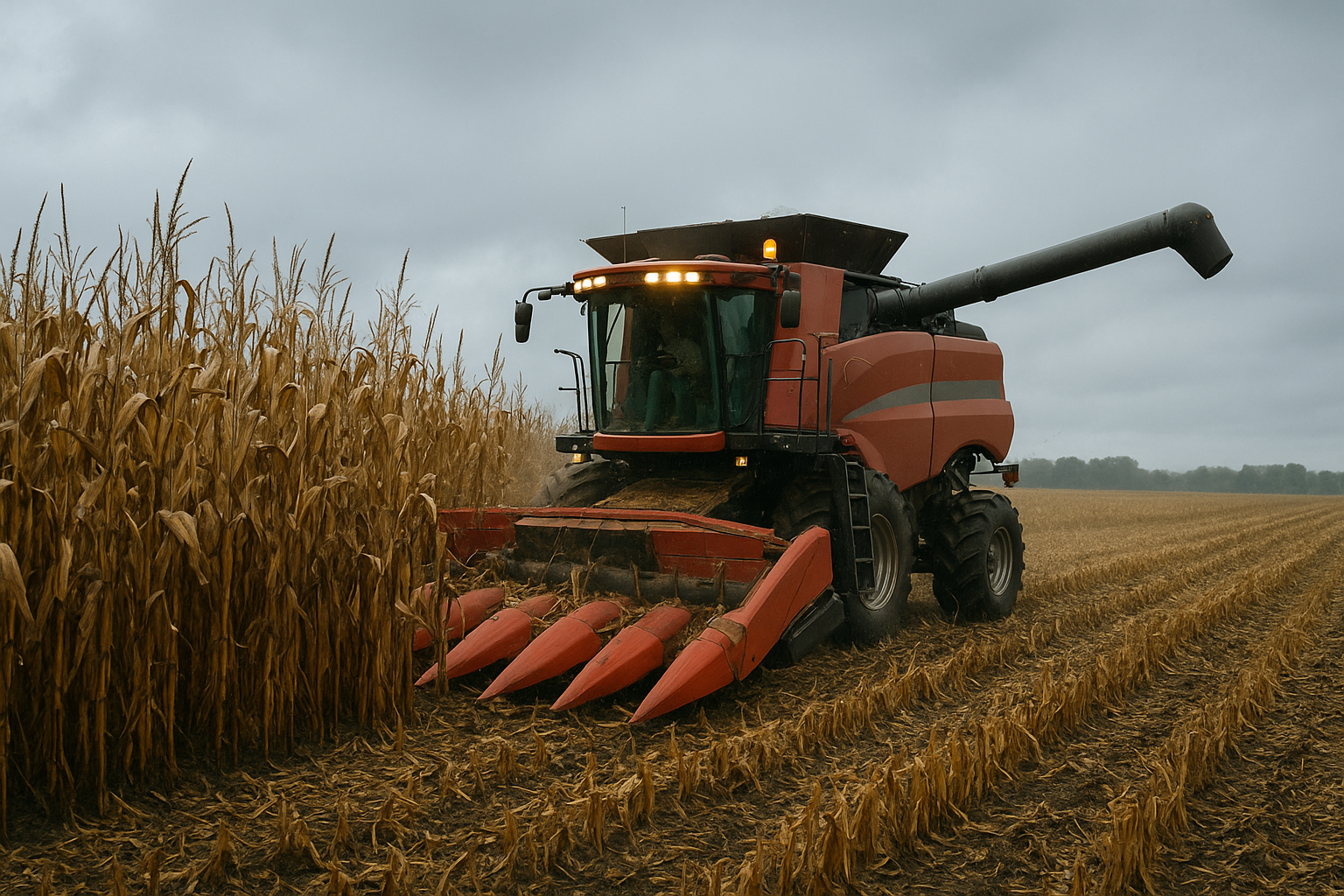
While aggregate national percentages appear nominally in line with historical seasonal benchmarks, the defining operational reality across the primary Midwest production belt is an abrupt and widespread deceleration in daily field combining. Multiple waves of persistent, soaking rainfall swept across the western and central Corn Belt during the final ten days of September, saturating topsoils and halting machinery access across Iowa, northern Illinois, southern Minnesota, and portions of Missouri. In Iowa—the epicenter of American corn production—nearly daily precipitation events generated standing water in low-lying fields, leaving heavy Class 8 and 9 combine harvesters parked at field edges to avoid severe rutting and soil compaction. Simultaneously, the expansive circulation and outer rain bands from the remnants of Hurricane Helene dumped intense, localized tropical deluges across the Ohio River Valley, eastern Kentucky, and parts of Indiana and Ohio, saturating unharvested stands, accelerating stalk rot vulnerability, and bringing eastern field work to an abrupt standstill.
This weather-induced harvest bottleneck arrives at a highly sensitive logistical moment for the agricultural supply chain, colliding directly with an aggressive drain of dry-bulk commodities toward coastal deepwater export berths. As documented in Monday morning's USDA export inspections report, ocean export facilities inspected more than 3.03 million metric tons of major grains and oilseeds last week, including a massive 49.4% week-over-week surge in whole soybeans to 1.15 million metric tons and sustained corn shipments of 1.57 million metric tons. With river terminals and export elevators pulling dry grain aggressively out of interior river corridors to load contracted bulk vessels ahead of the looming October 1 East and Gulf Coast dockworkers contract expiration, the wet field conditions have effectively cut off the flow of newly combined harvest bushels into country elevators. Instead of the anticipated late-September flood of cheap, dry cash grain replenishing pipeline reserves, interior merchandisers and commercial processing facilities are grappling with immediate origin delivery bottlenecks.
Why It Matters:
For commercial animal feed manufacturers, swine integrators, poultry feeding operations, and commercial cattle feedyards, this unexpected harvest pause fundamentally disrupts procurement budgets and dismantles expectations for seasonal cash basis relief. Traditionally, late September triggers a sharp seasonal collapse in interior cash corn and soybean basis as country elevators overflow with freshly harvested grain, providing livestock feeders their most economical procurement window to lock in autumn and winter coverage. However, with combines stalled by mud and export berths demanding heavy volume, local country elevators have been forced to bid defensively to attract physical grain from on-farm storage bins. Cash corn basis across central Illinois, eastern Iowa, and the southern Plains has strengthened unseasonably by 10 to 20 cents per bushel over the past week, erasing projected harvest discounts and directly elevating the baseline ingredient cost for high-volume swine grow-finish rations and broiler grower diets. Feed mills operating on tight five-to-seven-day rolling pipeline inventories find themselves forced into the spot market at elevated basis levels simply to maintain daily grinding schedules without disruption.
Compounding this basis pressure, the wet field conditions introduce substantial commercial moisture penalties and quality concerns that directly erode livestock feeding margins. Field-run corn harvested between rain showers is arriving at local elevators and feed mills carrying elevated moisture levels ranging between 18% and 22%, well above the standard 15.0% commercial storage base. Commercial elevator drying tariffs and moisture shrink discounts are adding approximately $0.04 to $0.06 per bushel for every point of moisture above 15%, imposing an immediate cost penalty of $0.15 to $0.35 per bushel on wet-delivered feed grain. For commercial feed mills operating high-throughput continuous-flow dryers, surging commercial propane and natural gas drying expenses are inflating per-ton manufacturing costs. Concurrently, delayed soybean combining threatens to pinch pipeline supplies of whole beans into domestic crush plants, sustaining firm spot basis on 48% solvent soybean meal just as swine and poultry nutritionists seek to finalize least-cost fourth-quarter protein formulations.
What to Watch:
Looking forward into the first week of October, feed procurement managers, grain merchandisers, and livestock nutrition directors must closely scrutinize regional NOAA short-term weather forecasts and soil-drying windows across the western and eastern Corn Belt. Whether combines can resume wide-scale operations by mid-week will determine whether this harvest delay remains a temporary logistical hiccup or evolves into a protracted quality crisis marked by ear rot, stalk lodging, and reduced test weights. Concurrently, all eyes in the commodity sector are turned toward Wednesday, September 30, when USDA NASS will release the high-impact quarterly Grain Stocks report. This report will deliver the definitive government accounting of old-crop corn and soybean ending stocks held in all positions as of September 1; if old-crop pipeline reserves come in tighter than expected while new-crop combining remains weather-delayed, interior spot basis premiums will experience immediate upward volatility.
Simultaneously, commercial feed mill quality assurance personnel and animal nutritionists must implement rigorous incoming grain testing protocols to evaluate test weight, broken corn and foreign material (BCFM), and fungal contamination. Wet, warm conditions in mature stands create heightened risk for field mold development, requiring proactive screening for mycotoxins—including deoxynivalenol (vomitoxin/DON) and zearalenone—which present severe gastrointestinal and reproductive risks in swine breeding and nursery herds. From a formulation perspective, nutritionists should evaluate dynamic least-cost inclusion thresholds for complementary energy and fiber co-products, such as corn distillers dried grains with solubles (DDGS) and wheat middlings, while leveraging precision synthetic amino acids—specifically crystalline L-lysine HCl, DL-methionine, and L-threonine—to preserve dietary SID amino acid balance and defend animal performance against harvest-time cost volatility.
The Bottom Line
The September 28 USDA Crop Progress report establishes that while national corn (18%) and soybean (17%) harvests remain mathematically on pace with historical averages, persistent Midwest rainfall and tropical storm moisture have abruptly paralyzed field combining, halting the seasonal cash basis decline and driving up drying expenses across primary livestock production basins. Caught between heavy coastal export pull and localized wet-grain bottlenecks, interior feed manufacturers and integrated livestock producers face rising spot cash premiums and heightened quality risks. Feed procurement directors, nutritionists, and mill managers must respond by securing nearby physical deliveries, enforcing rigorous moisture and mycotoxin testing, and leveraging least-cost amino acid formulation strategies to safeguard feed quality and preserve operational margins through the turbulent early weeks of harvest.