
The Story:
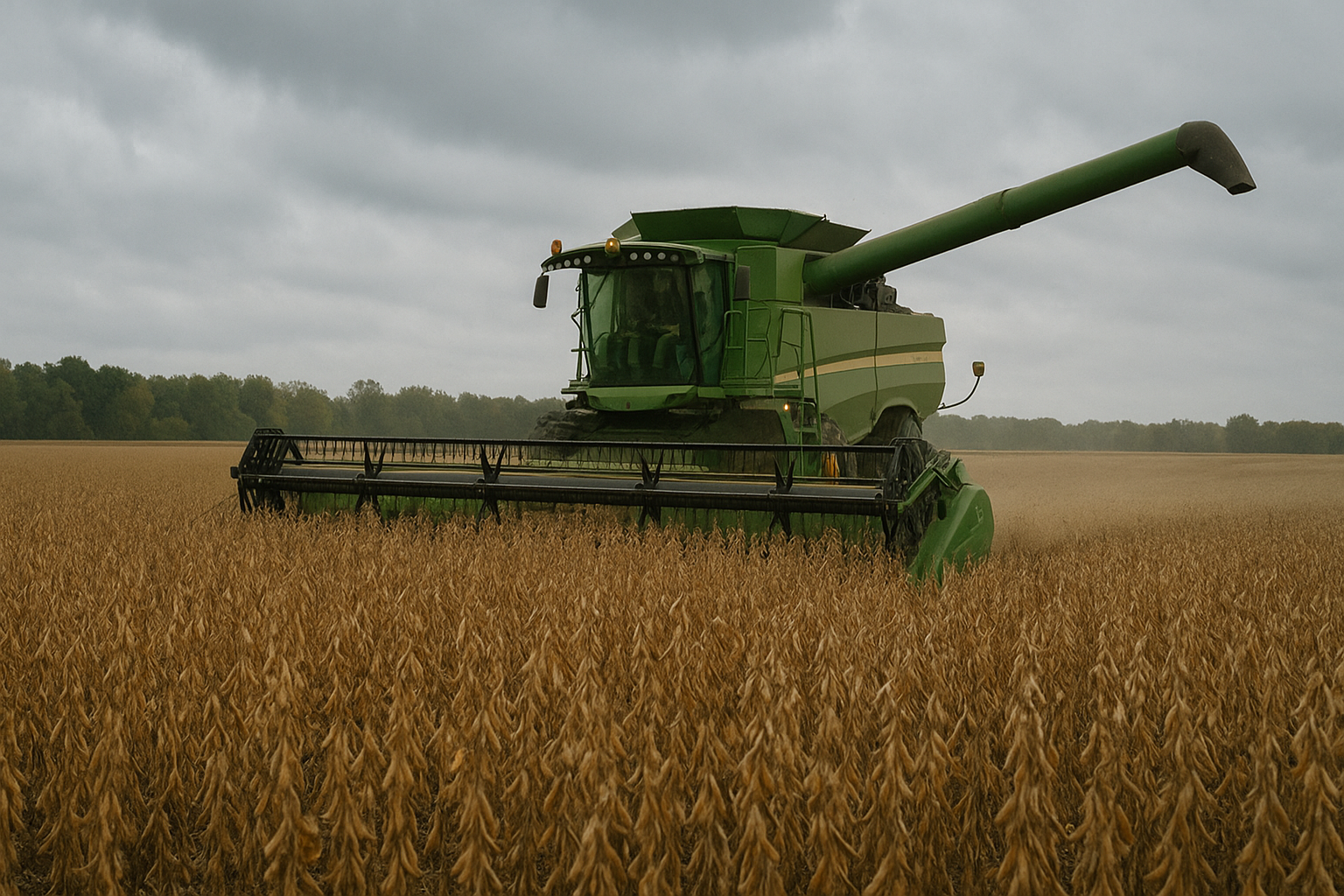
A wave of relentless late-September rainfall and dense cloud cover across key production corridors of the western U.S. Corn Belt has brought the early 2026 soybean harvest to an unexpected and grinding halt, triggering severe spot feedstock shortages across regional processing plants. In major growing regions spanning western Iowa, southern Minnesota, eastern Nebraska, and northern Missouri, saturated topsoils and standing water have rendered farm fields impassable for heavy harvesting machinery, while stubbornly high atmospheric humidity has stalled the natural in-field dry-down process required for combining. Because the commercial soybean supply pipeline entered late September with exceptionally lean old-crop farm and elevator inventories following aggressive summer export clearances and robust domestic crush demand, commercial processing facilities were heavily reliant on an early, continuous influx of newly harvested beans to maintain continuous daily operations. Instead, the abrupt field stall has left large-scale crushing complexes with critically depleted raw grain pits, transforming what was projected to be a smooth, high-volume seasonal transition into an acute localized scramble for immediate physical bushels.
To prevent complete shutdowns and protect contractual delivery commitments, commercial crushers throughout the western Midwest have escalated cash bids to historic levels, posting unprecedented spot delivery premiums over Chicago Board of Trade (CBOT) futures. Major processing facilities, including Cargill's terminal in Sioux City, Iowa, and Bunge's facility in Council Bluffs, have pushed spot delivery incentives as high as $0.65 to $1.00 per bushel above the benchmark November CBOT contract for trucks arriving immediately at plant dump pits. However, because only a tiny fraction of area growers managed to combine early fields prior to the downpours—and commercial on-farm storage bins from the 2025 crop are virtually exhausted—these massive basis premiums have failed to generate sufficient grain volume. As a consequence, several prominent processing plants across Iowa and Minnesota have been compelled to deliberately throttle back their daily daily crush grind rates, shorten receiving shifts, and completely suspend new uncommitted spot offers for soybean meal to avoid overselling production that they cannot physically crush.
This localized physical bottleneck has reverberated aggressively through commodity futures and derivative markets, injecting powerful bullish momentum into vegetable protein complexes heading into the final weekend of September. On the Chicago Board of Trade, the October soybean meal contract surged sharply to set fresh life-of-contract highs, posting single-session gains of $5.80 per ton as commercial shorts scrambled to cover near-term physical delivery exposure against offline or curtailed crush capacity. The market frenzy was further corroborated by the Commodity Futures Trading Commission's (CFTC) Commitments of Traders report released late Friday afternoon, September 25, 2026, which revealed that institutional managed money expanded its already massive net long position in soybean meal to 192,368 contracts. With the U.S. Department of Agriculture (USDA) projecting record annual domestic crush demand of 2.78 billion bushels for the 2026/27 marketing year, the convergence of record speculative length, delayed combining, and idling processing towers has ignited severe near-term basis volatility across the interior cash market.
Why It Matters:
For commercial feed manufacturers, integrated livestock integrators, and independent animal nutritionists, this sudden harvest interruption delivers an immediate, disruptive shock to dietary formulation economics and daily mill throughput. Soybean meal remains the foundational intact protein ingredient across North American livestock rations, supplying dense crude protein (typically 47.5% to 48%) and a balanced essential amino-acid profile vital for monogastric growth. In intensive swine feeding corridors across Iowa and southern Minnesota, as well as expansive broiler and commercial turkey complexes throughout the Midwest and Southeast, feed mills operate on tightly orchestrated just-in-time delivery schedules with minimal on-site ingredient storage. When regional crush plants abruptly withdraw spot meal allocations or declare force majeure delays on outbound bulk shipments, feed manufacturers are abruptly cut off from physical supplies, forcing procurement managers to pay punitive delivered premiums or search out distant, freight-heavy replacement railcars from eastern Corn Belt processors that are not yet affected by severe harvest weather.
Compounding the financial pressure on animal feed operations is the limited availability of synthetic substitution alternatives. While feed formulators typically respond to sharp soybean meal price spikes by lowering dietary crude protein levels and ramping up inclusion rates of synthetic amino acids—most notably crystalline L-lysine, DL-methionine, and L-threonine—that flexibility is currently severely constrained. Recent federal regulatory rulings by the U.S. Department of Commerce and International Trade Commission, which established steep preliminary antidumping and countervailing duties on imported synthetic amino acids from Asian manufacturers, have already driven delivered domestic lysine prices to elevated benchmarks. Furthermore, competing secondary protein co-products like corn distillers dried grains with solubles (DDGS) are experiencing parallel spot price strength as dry-grind ethanol plants capitalize on soaring feed demand. As a result, commercial swine finishers and poultry producers face rising ration manufacturing costs across both intact proteins and micro-ingredients, immediately eroding producer margins during a peak seasonal feeding phase.
What to Watch:
Looking into the upcoming week, feed procurement teams, grain merchandisers, and livestock complex managers must pay strict attention to localized meteorological models and field dry-down rates across the western Corn Belt. The primary catalyst determining whether this spot protein crisis persists or rapidly dissipates is the weather window. The National Weather Service 6-to-10-day outlook suggests a transition toward cooler, drier Canadian air across Iowa, Minnesota, and the Dakotas by mid-week. If sunshine and brisk winds enable combines to re-enter fields en masse, the resulting tidal wave of new-crop soybean deliveries will rapidly replenish processor silos, triggering a sharp, inevitable collapse in the current $1.00 cash basis premiums. Conversely, if persistent morning fogs, cloudy skies, or secondary precipitation events linger into early October, processing plant curtailments will spread eastward, exacerbating meal deficits and forcing feed manufacturers to take emergency physical positions at premium delivered price points.
Simultaneously, agribusiness stakeholders must closely monitor rail freight movements, processor spot meal basis sheets, and alternative feedstuff price relationships across regional distribution nodes. Buyers should watch daily freight performance on Class I railroads—specifically the BNSF Railway and Union Pacific—to track whether dedicated unit-train meal shipments from western crush origins into Southern poultry territories face transit delays or car shortages. In the formulation room, nutritionists must continuously update least-cost shadow pricing, evaluating whether high-protein DDGS, corn gluten meal, or imported canola meal offer viable economic offsets to spot soybean meal without compromising animal performance, gut integrity, or carcass characteristics. Finally, market participants must observe how commercial crushers handle deferred delivery contracts once field operations resume, as processors will likely prioritize satisfying accumulated backlogs of export and bulk domestic commitments before reopening competitive spot truck gates to local feed manufacturers.
The Bottom Line
Torrential late-September rainfall across the western Corn Belt has delivered a sharp supply shock to North American animal feed markets, halting early soybean combining, draining processor grain pits, and compelling regional crushers to post historic $1.00 per bushel cash premiums for immediate deliveries. With prominent processing facilities in Iowa and Minnesota scaling back run rates and suspending spot soybean meal offers just as October futures reach contract highs, commercial feed manufacturers and livestock integrators face immediate physical delivery constraints and surging diet costs. Defending operational margins and maintaining continuous barn feeding schedules over the coming ten days will require procurement executives to balance emergency spot coverage against imminent harvest basis collapse, rigorously track Upper Midwest dry-down conditions, and leverage flexible ration modeling to navigate this volatile autumn protein squeeze.