
The Story:
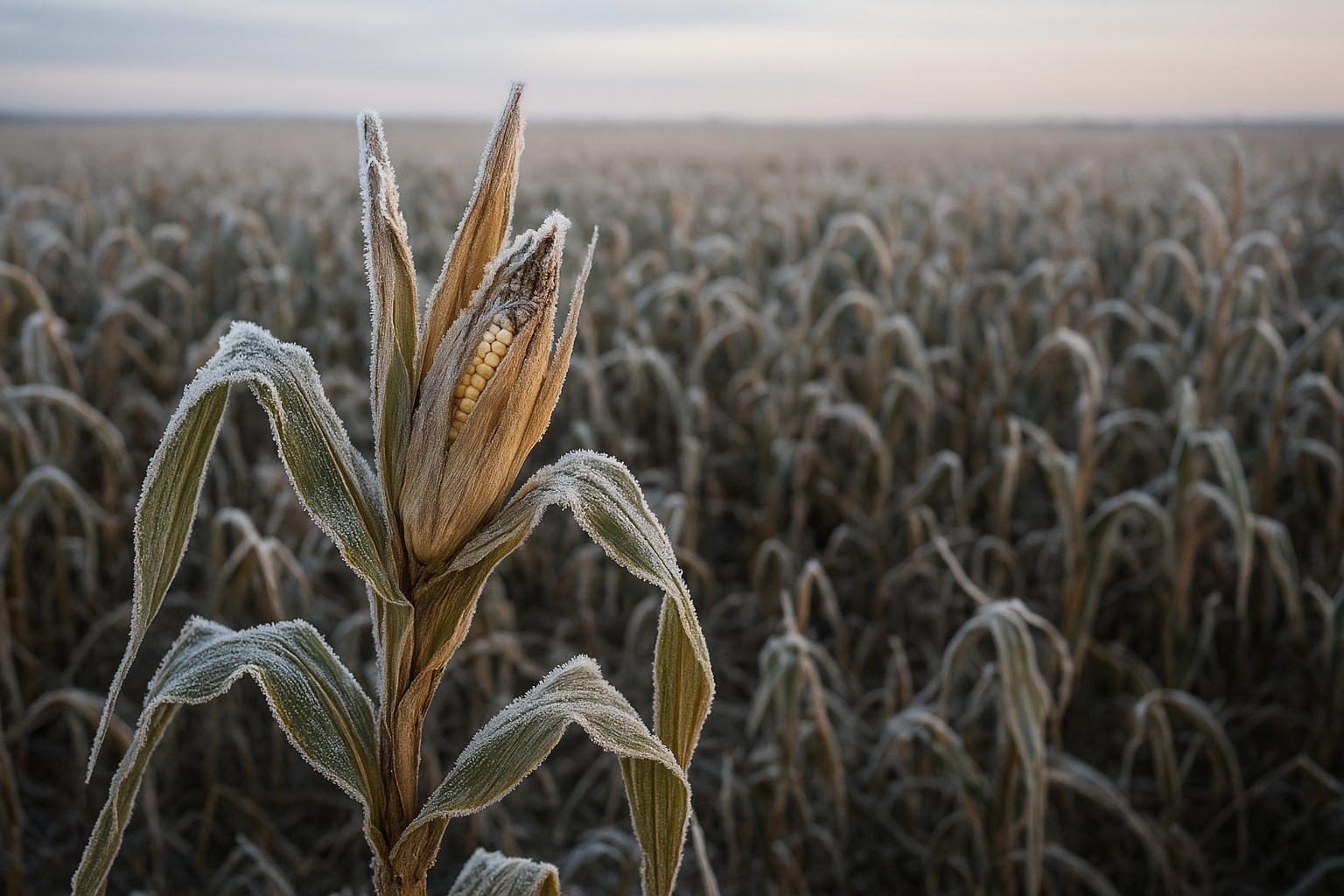
A potent Arctic cold front delivered unseasonably sharp sub-freezing temperatures and hard frost across the northwestern Plains and western Corn Belt on Friday, October 16, and Saturday, October 17, 2026, prompting immediate warnings from the U.S. Department of Agriculture (USDA) regarding widespread physiological risk to late-maturing corn crops. The sudden influx of Canadian polar air dropped overnight low temperatures into the mid-to-upper 20s Fahrenheit across extensive commercial production districts throughout North Dakota, South Dakota, Minnesota, northern Iowa, and Wisconsin, effectively bringing a premature and definitive close to the 2026 growing season across large swaths of the upper Midwest. USDA agricultural meteorologists, World Agricultural Outlook Board specialists, and regional crop condition evaluators emphasized that this freeze arrived while substantial acreages of the late-planted crop had not yet attained full physiological maturity, commonly designated as the black layer stage. With plant vascular bundles and photosynthetic activity abruptly shut down by the hard freeze, natural dry matter accumulation has halted irreversibly, locking in localized yield reductions and setting the stage for severe physical grain quality degradation across regional commercial grain gathering networks.
The primary agronomic and physical consequence of this early freeze is the sudden cessation of starch translocation into immature corn kernels, resulting in notably diminished bulk test weights and severely compromised kernel structural integrity. Agricultural extension agronomists and Federal Grain Inspection Service (FGIS) specialists report that corn frozen during the late dough or early dent stages will yield chaffy, light-test-weight grain ranging from 46 to 52 pounds per bushel, substantially below the 56-pound-per-bushel standard benchmark required for U.S. No. 2 yellow corn. Furthermore, because this Arctic outbreak coincided with persistent soil saturation, standing water, and heavy rainfall accumulations recorded earlier in the week, standing fields exhibit exceptionally high kernel moisture levels often exceeding 28 to 34 percent. In the complete absence of living plant canopy and metabolic respiration to facilitate natural in-field drydown, growers face the daunting operational dilemma of harvesting excessively wet grain under unfavorable soil conditions or risking severe lodging, ear drop, and stalk breakage as frost-damaged plant tissue deteriorates rapidly under prevailing autumn winds.
This sudden weather shock has injected immediate volatility into Midwest cash grain markets and local basis structures, presenting commercial grain elevators, river terminals, and feed mills with complex operational hurdles. Commercial elevator operators across the upper Midwest have begun posting aggressive moisture dockage schedules and steep test-weight discounts, frequently penalizing incoming farmer deliveries by 15 to 45 cents per bushel for grain testing under 52 pounds per bushel. Concurrently, country elevators are confronting surging artificial grain drying costs as commercial propane and natural gas expenses escalate, restricting daily intake throughput and forcing receiving facilities to segregate light-test-weight corn from standard commercial export-grade inventories. While Chicago Board of Trade (CBOT) benchmark December corn futures settled near $4.74 per bushel at Friday's close following earlier WASDE-driven supply revisions, localized cash basis values across the northern feeding belt are fracturing: prime heavy-test-weight corn commands substantial local spot cash premiums, while frost-damaged, high-moisture supplies face deep discounts as growers scramble to secure scarce on-farm bin aeration capacity and commercial drying fuel.
Why It Matters:
For animal feed manufacturers, commercial livestock nutritionists, and ingredient procurement directors, the impending influx of frost-damaged corn necessitates immediate, rigorous recalibrations of least-cost formulation matrices and mill manufacturing protocols. Although light-test-weight corn frequently exhibits a slightly elevated crude protein percentage on an analytical dry-matter basis due to truncated endosperm starch accumulation, its net metabolizable energy (ME) density is significantly reduced. Commercial nutritionists formulating high-performance diets for broiler poultry and growing-finishing swine cannot treat light-test-weight corn as a direct caloric substitute for standard 56-pound grain without inducing caloric deficits, reduced average daily gain (ADG), and poorer biological feed conversion ratios (FCR). To maintain targeted dietary net energy specifications, feed mills must recalibrate volumetric bulk density sensors, adjust hammermill screen sizes and roller mill tolerances to manage abnormal kernel fracturing and excessive flour generation, and incorporate supplemental concentrated energy sources such as choice white grease, feed-grade vegetable oils, or high-fat distillers dried grains with solubles (DDGS) to compensate for lower available starch levels.
Beyond dietary energy deficits, the freeze presents acute operational and biosecurity challenges regarding mycotoxin proliferation, feed shelf-life, and animal health. Corn kernels that freeze prior to physiological maturity develop fractured pericarp seed coats and cracked starch matrices, creating ideal biological entry pathways for opportunistic fungal pathogens including Fusarium, Gibberella, and Aspergillus species as damp autumn weather persists. For commercial swine integrators and modern poultry complexes, feeding grain contaminated with deoxynivalenol (DON/vomitoxin) or zearalenone can trigger catastrophic feed refusal, compromised immune function, and severe reproductive disorders in breeding stock. Feed manufacturing plants across the northern Corn Belt must immediately mandate expanded rapid ELISA test-kit screening protocols at the truck intake pit. Simultaneously, the surge in deeply discounted, high-moisture corn creates strategic operational opportunities for commercial beef cattle feedlots and regional dairy enterprises equipped with bunker silos or steam-flaking mills; ruminant digestive systems utilize low-test-weight and fermented high-moisture corn with superior biological efficiency compared to monogastrics, establishing an invaluable salvage outlet while freeing up sound, heavy dry corn for commercial feed mills.
What to Watch:
Over the next two to three weeks, feed industry procurement desks, grain merchandisers, and livestock risk managers must closely monitor the weekly USDA National Agricultural Statistics Service (NASS) Crop Progress report, specifically tracking the pace of corn harvest progress and the percentage of the northern crop verified at mature status prior to the freeze event. Scrutinizing the precise geographical distribution of harvest delays across Minnesota, the Dakotas, Wisconsin, and northern Iowa will provide critical intelligence on the physical volume of distressed, light-test-weight grain entering commercial supply pipelines. In parallel, merchandisers must track commercial propane distribution logistics and regional retail drying fuel surcharges; if cold, overcast weather lingers across the Midwest, localized bottlenecks in LP gas transportation could throttle elevator drying capacities, forcing commercial handling facilities to temporarily restrict receiving hours or widen cash discounts on wet corn deliveries.
Simultaneously, feed procurement managers and animal nutritionists must monitor regional cash basis spreads between standard No. 2 yellow corn and discounted high-moisture lots, while evaluating the relative pricing and availability of complementary feed ingredients. With CME lean hog margins currently under acute pressure near life-of-contract lows and commercial poultry complexes striving to safeguard operating margins, purchasing desks must evaluate whether discounted frost-damaged corn offers favorable feeding economics when strategically blended with synthetic amino acids—specifically L-lysine HCl, DL-methionine, and L-threonine—alongside supplemental fat sources under rigorous laboratory mycotoxin clearance. Furthermore, procurement teams must track Mississippi River barge draft restrictions and rail car tariff developments, as regional grain quality disparities could redirect sound, high-test-weight corn southward to Gulf export terminals, leaving interior feed mills competing aggressively for quality domestic grain.
The Bottom Line
The October 16–17 Arctic freeze across the Northern Plains and Western Corn Belt marks an abrupt, disruptive conclusion to the 2026 growing season, transforming immature crops into low-test-weight, high-moisture grain that fundamentally reshapes regional feed manufacturing economics. While earlier national USDA WASDE projections highlighted abundant aggregate corn production, localized grain quality degradation introduces severe operational complexities for feed manufacturers, demanding precise dietary energy recalibrations, enhanced mill processing vigilance, and stringent mycotoxin screening. For livestock producers, nutritionists, and ingredient procurement desks, successfully navigating this weather shock hinges on agile nutritional strategy: capitalizing on discounted grain where biologically and economically viable, safeguarding herd health through uncompromised quality assurance, and securing disciplined premium grain coverage to insulate animal performance through the coming winter feeding period.