
The Story:
On the Chicago Mercantile Exchange (CME), benchmark feeder cattle futures surged aggressively on Tuesday, October 27, 2026, driving the front-month November contract across the historic $350-per-hundredweight threshold to settle at a milestone $350.02 per hundredweight ($3.50 per pound), up $1.47 1/2 on the session. Deferred 2027 contracts exhibited parallel strength across the forward curve, with January feeders settling up $1.35 at $348.65 per hundredweight and March contracts advancing to $347.10 per hundredweight, propelled by heavy commercial buying, algorithmic trend-following, and short-covering across livestock derivatives desks. The decisive breakout past the $350 barrier represents a momentous psychological and technical benchmark for the North American beef cattle complex, cementing the highest valuation ever recorded for autumn-placed feeder calves. Livestock market analysts and commodity risk desks emphasized that the afternoon rally was directly catalyzed by an acute intersection of macroeconomic and physical feed dynamics: an escalating scramble among commercial feedyards to secure replacement cattle against an exceptionally tight national calf supply, occurring concurrently with a steep sell-off across the Chicago Board of Trade (CBOT) feed grain and oilseed meal complex that dramatically slashed projected feedlot finishing costs.
The immediate fundamental trigger unlocking Tuesday's feeder cattle advance was the sharp, broad-based retreat across benchmark feed input markets, led by December CBOT corn futures tumbling 6 1/4 cents to settle at $4.48 3/4 per bushel—marking a fresh 3.5-month contract low as an accelerating Midwest harvest overwhelmed interior country elevators, river terminals, and processor storage facilities. Pressure in the grain pits was amplified by a steep downturn in the protein meal complex, where December CBOT soybean meal plunged $5.60 per ton to close at $334.60 per ton, pressured by expanding domestic crush capacity and macroeconomic headwinds from a weakening Brazilian real. Concurrently, regional spot market quotes for dry-mill distillers dried grains with solubles (DDGS) across Iowa, eastern Nebraska, and South Dakota softened by $4.00 to $8.00 per ton, trading into the $138.00 to $145.00 per ton range. Because energy and protein feed inputs represent approximately 65 to 70 percent of a commercial feedlot's variable operating expenses, this synchronized break across corn, soybean meal, and co-products delivered immediate, substantial relief to feedlot ration economics, instantly translating into expanded bidding tolerance for incoming yearling cattle.
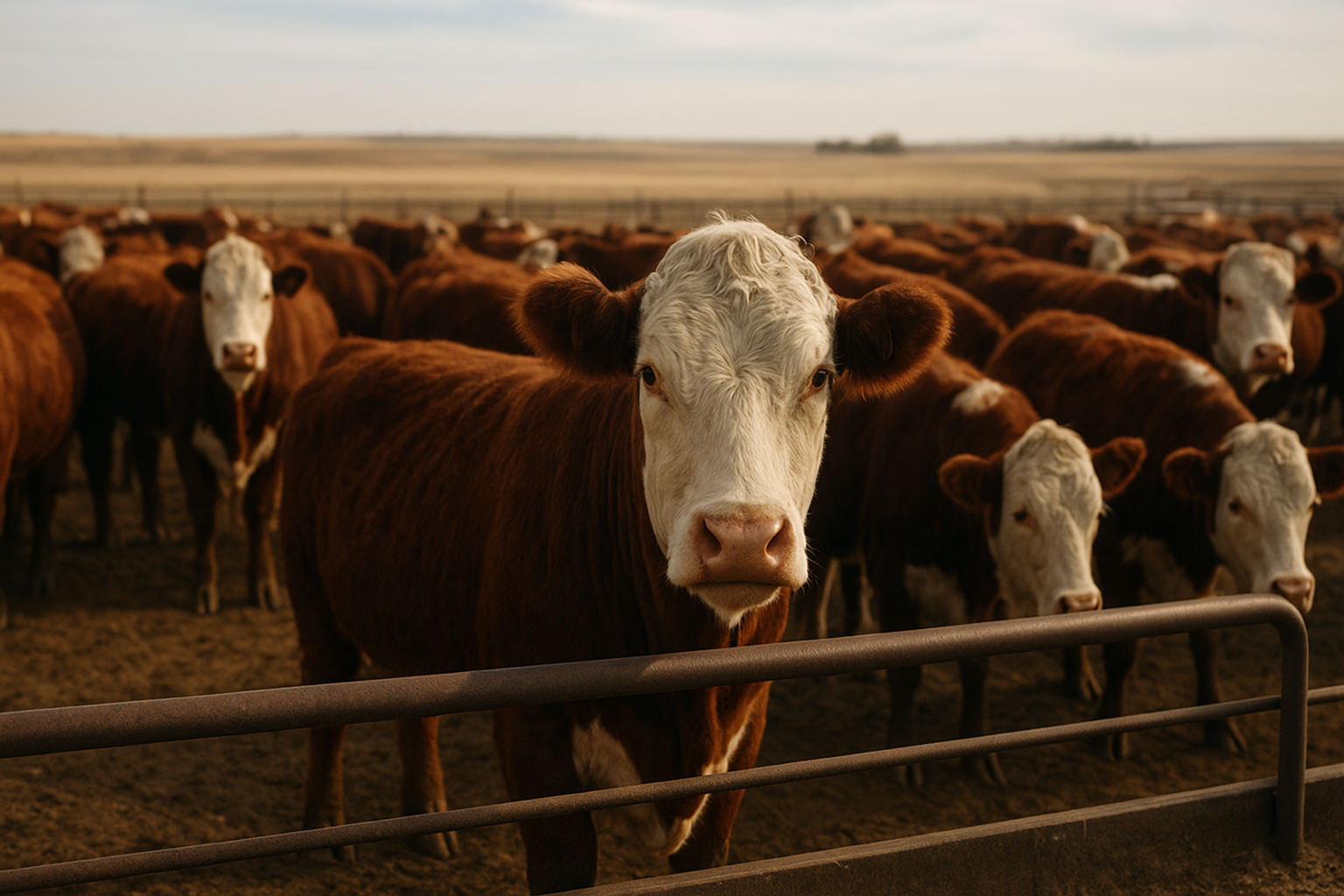
This plummeting cost of feed gain collided directly with an extraordinarily constricted supply of physical feeder cattle across primary High Plains feeding belts, creating an intense bidding war among commercial cattle feeders. The foundational tightness in feeder cattle availability was reinforced by the USDA National Agricultural Statistics Service (NASS) monthly Cattle on Feed report, which revealed that net feedlot placements during September plunged 12 percent year-over-year to 1.78 million head—establishing the lowest September placement volume since modern statistical data collection commenced in 1996. With the total domestic beef cow herd lingering at its lowest numerical inventory in more than seven decades following multi-year droughts and extensive cow culling, commercial feedyards in Texas, Kansas, Nebraska, and Colorado are wrestling with substantial pen vacancies. Confronted with fixed yardage overhead and excess feeding bunk capacity, commercial feedyard managers actively capitalized on cheaper corn and softened basis to aggressively bid up auction receipts across major terminals—including Oklahoma City, Joplin, and Sioux Falls—driving 750- to 850-pound yearling steers above $350.00 per hundredweight to secure bunk inventory ahead of winter feeding operations.
Why It Matters:
For commercial cattle feeders, feed mill operators, and animal nutritionists, Tuesday's surge above $350 per hundredweight fundamentally recalibrates feedyard enterprise budgets, risk management parameters, and least-cost ration formulation. In commercial cattle finishing, feedlot 'cost of gain' (COG) is the primary swing factor determining how aggressively a feeder can procure replacement calves while maintaining operational solvency. With December corn settling down at $4.48 3/4 per bushel and interior basis softening under harvest receipts, feedyard economists calculate that projected cost of gain for winter-fed cattle has dropped from approximately $118.00 to $122.00 per hundredweight down to $108.00 to $112.00 per hundredweight, saving between $45.00 and $60.00 per head in projected total feeding expenses over a 150-day finishing period. However, while lower ration expenses mathematically justify paying higher prices for incoming calves, entering cattle at $350.02 per hundredweight elevates capital acquisition risk to unprecedented levels. With replacement 800-pound steers now requiring an upfront capital outlay exceeding $2,800 per head before entering the bunk, commercial feedyards are operating on razor-thin breakevens, leaving zero financial buffer if finished live cattle futures ($230.85 per hundredweight) experience further consolidation or if seasonal winter blizzards impair average daily gain.
At the feed manufacturing and ingredient compounding level, the influx of historic $350-per-hundredweight feeder calves into commercial yards demands an intensive operational focus on receiving health, feed conversion efficiency, and precision metabolic management. When feedyards invest historically unprecedented sums into incoming cattle, preventing early-stage mortality and managing bovine respiratory disease (BRD) complex become urgent financial imperatives, as losing even a single heavy yearling erases the feeding margin of twenty head. Commercial feed mills and livestock nutritionists are responding by formulating fortified transition and starter rations containing elevated levels of organic trace minerals (zinc, copper, and selenium), high-potency vitamin packages, and ruminal ionophores such as monensin to optimize microbial fermentation and rumen stability. Furthermore, feedyards are optimizing the inclusion of cheaper energy and fiber co-products—taking advantage of softening DDGS and wet distillers grains (WDGS) to partially replace dry rolled corn in receiving rations. By pairing steam-flaked corn with palatable wet co-products and precision pre-mixes, feedyard managers can stimulate rapid dry matter intake (DMI) within the critical first 21 days on feed, mitigating transit shrink and establishing an efficient metabolic trajectory that maximizes feed conversion.
What to Watch:
Over the coming two to four weeks, feedlot executives, livestock risk managers, and feed procurement directors must closely monitor the weekly volume and pricing trends within the USDA Agricultural Marketing Service (AMS) Livestock Mandatory Reporting (LMR) national feeder and stocker cattle summaries. Market participants should observe whether physical auction barns in the Southern Plains and Western Corn Belt validate the CME futures breakout above $350 per hundredweight with sustained cash volume, or whether buyer resistance emerges as commercial lenders enforce stricter credit ceilings on feeder cattle financing. In addition, purchasing desks must track packer procurement patterns and negotiated cash fed cattle prices across five-area feeding regions. Because live cattle futures traded defensively down 35 cents to $230.85 per hundredweight on Tuesday, feedyards must monitor whether wholesale boxed beef cutout values stabilize sufficiently to support finished cash cattle bids near $188.00 to $190.00 per hundredweight, which remains essential to protect feeding margins against record calf procurement costs.
Simultaneously, feed ingredient buyers and commercial grain merchandisers must scrutinize regional corn basis and ethanol plant co-product pricing as the U.S. harvest surpasses the 65 percent mark. Feed mills across the High Plains must track whether interior rail freight rates and elevator basis quotes widen further, presenting feedlot buyers with an advantageous window to lock in winter and spring corn basis coverage before country elevators fill and temporary harvest discounts evaporate. In parallel, market participants should track weekly ethanol output figures and DDGS export commitments; if strong ethanol crush rates persist while international container exports moderate, expanding domestic co-product availability could provide feedlot nutritionists with substantial cost savings through expanded 20-to-25-percent distillers grain inclusion. Finally, livestock managers must watch long-range November weather forecasts across the Plains, as an abrupt arrival of freezing precipitation and mud could quickly undermine feed conversion ratios and inflate days on feed for newly arrived high-dollar calves.
The Bottom Line
November CME feeder cattle futures surging past the historic $350 threshold to settle at a milestone $350.02 per hundredweight highlights an unprecedented clash of market forces across the American livestock economy: historic structural scarcity of feeder calves colliding with a dramatic harvest-driven plunge in feed grain costs, underscored by December corn touching a 3.5-month low of $4.48 3/4 and soybean meal falling to $334.60 per ton. While cheaper grain substantially lowers feedlot cost of gain and expands bunk feeding capacity, procuring replacement yearlings at $350 per hundredweight leaves commercial feeding enterprises with zero operational room for error. For feedlot managers, commercial feed manufacturers, and animal nutritionists, navigating this high-stakes environment requires absolute operational rigor: aggressively locking in harvest basis discounts to cap long-term ration costs, engineering highly palatable receiving rations fortified with precision trace minerals and ionophores to safeguard calf health, and implementing disciplined forward hedging strategies to insulate feedyard balance sheets through the winter of 2026/27.