
The Story:
On Thursday afternoon, November 5, 2026, the Chicago Mercantile Exchange (CME) cattle complex endured severe, aggressive liquidation into the closing bell, with feeder cattle contracts tumbling violently to multi-week lows. Benchmark January 2027 feeder cattle futures plummeted $5.400 per hundredweight (cwt) to settle at $320.325, breaching technical support levels and marking one of the steepest single-day setbacks of the autumn marketing season. Active deferred contracts mirrored the route, with March 2027 feeder cattle sliding $4.925 to settle at $315.925 per cwt, while November 2026 contracts shed $4.150 to close at $328.750. Concurrently, CME live cattle futures absorbed heavy speculative fund selling and commercial hedging pressure: front-month December 2026 live cattle fell $3.600 to finish at $214.400 per cwt, and February 2027 dropped $3.200 to settle at $217.625. The afternoon breakdown was accelerated by broader macroeconomic risk aversion and sharp selloffs across outside equity markets, which prompted commodity index funds to rapidly reduce long exposure across livestock derivatives. The CME Feeder Cattle Index retreated to $346.58 per cwt, confirming that cash feeder values across the High Plains and Western Corn Belt are adjusting downward in direct alignment with tumbling board values.
The primary operational driver behind Thursday's futures slide was an abrupt downturn in physical negotiated cash cattle trade across primary feeding territories. Direct cash negotiations in the Southern Plains broke sharply lower, with the U.S. Department of Agriculture's Agricultural Marketing Service (USDA AMS) reporting light live sales in Kansas and the Texas Panhandle at $188.00 per cwt—a precipitous $6.00 decline compared to trades executed just seven days earlier. In Northern feeding regions, Nebraska and Iowa reported light live transactions near $214.00 per cwt alongside dressed trade at $335.00 to $340.00 per cwt, reflecting significant packer leverage over spot deliveries. In the wholesale boxed beef sector, the USDA afternoon report showed composite Choice carcasses easing $0.85 to $361.56 per cwt, while Select carcasses dropped $4.18 to $352.32 per cwt on light offerings, blowing the Choice/Select spread out to $9.24 per cwt. Commercial meatpackers maintained disciplined processing schedules, with mid-week federally inspected cattle slaughter estimated at 109,000 head and weekly throughput pacing at 320,000 head, enabling packers to manage wholesale inventory without bidding aggressively for market-ready fed steers and heifers.
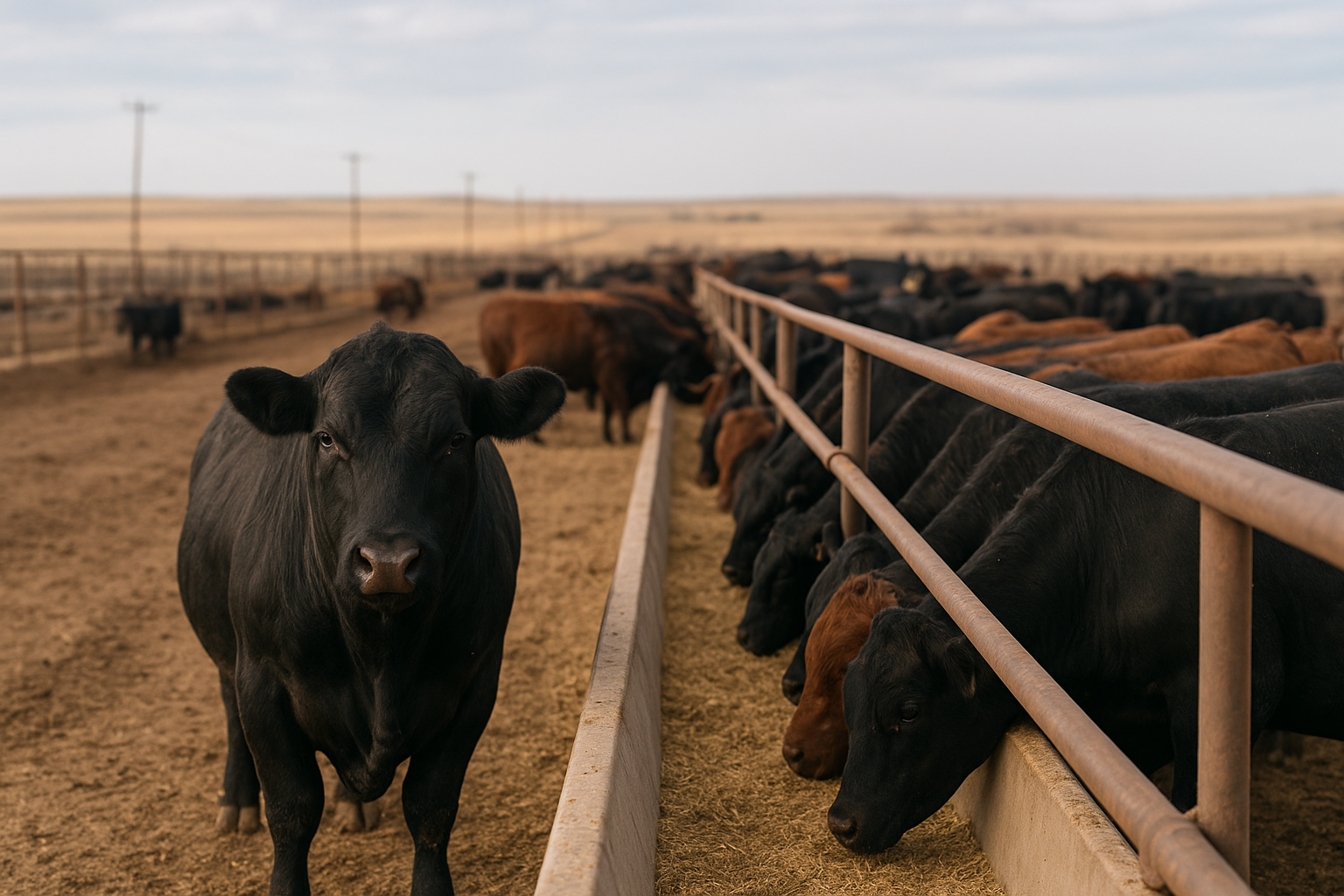
This sudden contraction in live and feeder cattle values coincides with harvest-driven supply expansion across the grain complex, creating a complex economic environment for commercial feed yards. Following StoneX's midday forecast lifting the 2026 U.S. corn harvest to 16.203 billion bushels on an exceptional 183.1 bu/acre yield, Chicago Board of Trade (CBOT) December corn futures broke down 4-1/4 cents on Thursday afternoon to settle at $4.40 per bushel. Simultaneously, benchmark December soybean meal futures dropped $1.40 to close at $317.20 per short ton. While abundant, low-cost feed grain softens baseline daily ration expenses, commercial cattle feedlots across Texas, Kansas, and Nebraska are confronting acute margin compression on unhedged cattle placed during September and October at record replacement prices exceeding $345 to $350 per cwt. With fed cattle cash receipts sliding toward $188 in the South and live cattle futures testing $214, cattle feeders are absorbing severe equity drawdowns on finished pens, forcing feedlot procurement managers to immediately halt aggressive feeder purchasing and demand steep discounts from backgrounders and cow-calf producers.
Why It Matters:
For commercial beef feedlot managers, consulting ruminant nutritionists, and regional feed manufacturers, Thursday's $5.40 plunge in feeder cattle futures to $320.32 represents a long-awaited realignment of animal replacement costs and feeding margin breakevens. Throughout late summer and early fall, extreme feeder cattle scarcity—driven by multi-decade lows in the national beef cow herd—forced cattle feeders to pay unsustainable replacement premiums, elevating animal acquisition costs to over 72 percent of total finished steer value. With incoming feeder prices topping $350 per cwt and baseline cost of gain (COG) hovering near $1.25 to $1.35 per pound, closeouts projected for late winter and spring were showing catastrophic equity deficits of $150 to $200 per head. Thursday's $5.40 break, combined with the $6.00 decline in Southern Plains cash fed cattle, lowers the capital expenditure required to purchase an 800-pound feeder steer by more than $43 per head. This rapid downward repricing allows feed yard procurement teams to recalibrate incoming breakevens toward defensible territory, establishing a more sustainable risk-reward profile ahead of severe winter feeding weather.
At the feed manufacturing console, the combination of tumbling feeder cattle prices, harvest-pressured cash corn settling at $4.40 per bushel, and deeply discounted soybean meal at $317.20 per ton creates an urgent mandate for least-cost ration reformulation. In commercial High Plains feedlots, steam-flaked yellow dent corn constitutes roughly 70 percent of complete finishing rations on a dry-matter basis. Over recent weeks, Midwest distillers dried grains with solubles (DDGS) prices had remained stubbornly elevated between $185 and $195 per ton due to robust export commitments and tight biorefinery supplies, distorting the energy-to-protein price spread. With corn basis softening under relentless harvest combining and soybean meal trading near contract lows, feedlot nutritionists have an economically powerful opportunity to optimize finishing rations. By blending steam-flaked corn with discounted solvent-extracted soybean meal and feed-grade urea to satisfy ruminally degradable protein (RDP) and metabolizable protein requirements, feed mills can trim expensive distillers co-products and reduce total ration cost of gain by 7 to 10 cents per pound. Dropping cost of gain down to $1.08 to $1.15 per pound provides feedlot clients with the operational margin buffer essential to withstand cash cattle volatility through the winter months.
What to Watch:
Over the next several trading days leading into mid-November, agribusiness merchandisers, cattle buyers, and feed mill directors must focus squarely on Friday's negotiated cash cattle trade clean-up and packer procurement behavior. Market participants should monitor whether Southern Plains packers succeed in cementing a lower cash floor at $188 live, or whether feedlot managers with committed inventory can push back against further discounts as wholesale Choice boxed beef attempts to stabilize above $361. Concurrently, livestock risk managers must scrutinize the USDA's upcoming World Agricultural Supply and Demand Estimates (WASDE) and Crop Production reports scheduled for Tuesday, November 10, at 12:00 PM EST. Merchandising desks will closely watch whether federal balance sheet analysts validate StoneX's 16.203-billion-bushel corn harvest forecast and examine adjustments to domestic livestock feed and residual use, which will determine whether low corn prices remain durable through the first quarter of 2027.
Simultaneously, feed procurement managers and feedlot operational directors must track winter logistics, rail freight movements, and secondary protein ingredient pipelines across the Great Plains. Grain procurement desks should monitor Class I rail performance on BNSF and Union Pacific corridors to secure prompt delivery of newly harvested Corn Belt grain into southern feed yards without incurring secondary car premiums. Feed mills should also evaluate spot availability of synthetic amino acids and non-protein nitrogen supplies, as lower crude protein safety margins require absolute precision in supplemental nutrient delivery. With CBOT corn pinned at $4.40 per bushel and soybean meal holding near $317 per ton, feedlot purchasing directors should utilize current market weakness to book physical feed grain and protein commitments covering requirements through February 2027, locking in historically favorable feed costs before seasonal winter storms disrupt regional transport.
The Bottom Line
Thursday afternoon's $5.40 collapse in January CME feeder cattle futures to $320.32 per cwt—amplified by a $6.00 drop in Southern Plains cash cattle to $188, live cattle sinking to $214.40, and wholesale Select beef dropping over $4—delivers a decisive pricing reset for commercial cattle feeders and animal feed manufacturers. While falling fed cattle cash values inflict painful short-term equity losses on unhedged pens, the simultaneous breakdown in replacement feeder costs and CBOT corn slipping to $4.40 per bushel establishes a vital foundation for margin recovery. Agribusiness decision-makers, commercial cattle feedlots, and consulting ruminant nutritionists should act decisively by lowering incoming feeder purchase bids, locking in forward energy and protein feed ingredients through early 2027, and reformulating finishing diets with steam-flaked corn, low-cost soymeal, and precision urea to drive cost of gain down toward $1.10 per pound and insulate feeding enterprises against ongoing market turbulence.