
The Story:
On Wednesday, September 30, 2026, Cal-Maine Foods, Inc. (NASDAQ: CALM), the largest producer and distributor of fresh shell eggs in the United States, released its financial results for the first quarter of fiscal 2027 ended August 29, 2026, revealing the acute financial toll of an industry-wide margin squeeze. The headline results marked a dramatic operational reversal: the Ridgeland, Mississippi-based agricultural powerhouse swung to a quarterly net loss of $58.6 million, or $1.26 per diluted share, compared to a net income of $199.3 million, or $4.12 per diluted share, in the first quarter of fiscal 2026. Consolidated net sales for the thirteen-week period fell 41.5% to $539.6 million from $922.6 million a year earlier, while gross profit collapsed from $311.3 million to just $403,000. Operating performance deteriorated from an operating profit of $249.2 million in the prior-year period to an operating loss of $82.2 million. The severe earnings contraction was precipitated primarily by a cyclical supply imbalance in the conventional shell egg market, where net sales plunged 59.5% to $247.7 million—driven by an abrupt 59.3% drop in average realized selling price per dozen—plunging the conventional egg segment into an operating loss of $71.0 million.
Compounding the severe decline in wholesale egg realizations, the company's cost structure provided zero operational insulation, with farm production and feed ingredient expenditures remaining stubbornly elevated throughout the summer. During the earnings release and investor presentation, President and Chief Executive Officer Sherman Miller highlighted that feed costs increased by 4.3% per dozen produced compared to the first quarter of fiscal 2026. This increase in dietary expenses arrived despite softening national grain futures benchmarks, reflecting sticky local delivery basis, high-cost forward ingredient commitments executed earlier in the calendar year, and firm delivered protein meal premiums across primary Southern and Midwestern production complexes. The Specialty Shell Egg segment was similarly impacted by this cost inflation: despite specialty and prepared foods expanding to represent 54.1% of net sales, specialty segment income dropped by 76.8% from $64.2 million to $14.9 million, driven directly by higher feed and farm production costs combined with a 10.7% decrease in specialty selling prices. Due to the quarterly net loss, Cal-Maine announced it would pay no first-quarter cash dividend under its variable payout formula, noting a cumulative loss threshold of $94.5 million that must be recovered before distributions resume.
The quarterly report and executive commentary provided valuable, transparent insight into the structural mechanics of feed cost pass-through pricing formulas and institutional customer relationships across the poultry layer sector. CEO Sherman Miller explained that under Cal-Maine’s negotiated cost-plus customer contracts, changes in feed ingredient costs—principally ground corn, dehulled soybean meal, and micro-minerals—typically begin flowing through into customer invoice prices with a lag of two weeks to one month, though select long-term institutional agreements operate under rigid quarterly look-back adjustments. However, in an oversupplied spot market where commercial layer flocks are laying at seasonal peaks, uncontracted eggs must be cleared through open wholesale channels at prices far below farm-gate production costs. This dynamic forces commercial egg integrators to fully absorb ingredient inflation while waiting for contractual price adjustments to trigger or for regional grain supplies to physically soften feed mill procurement balance sheets.
Why It Matters:
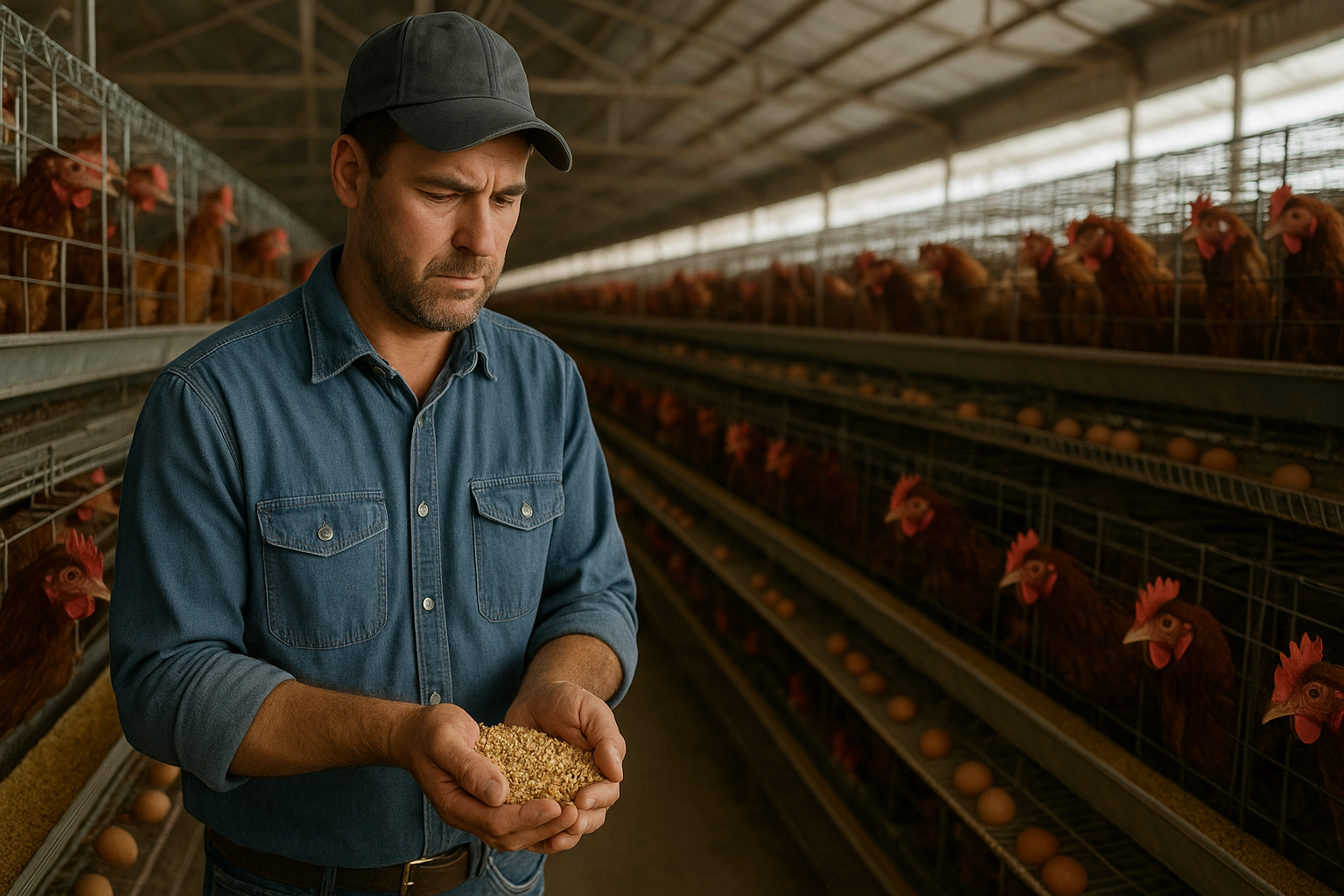
For commercial animal feed manufacturers, poultry nutritionists, and commodity grain merchandisers, Cal-Maine’s financial results demonstrate the intense operational pressure currently bearing down on table-egg feeding complexes. Laying hens represent an uncompromising, non-discretionary nutritional demand base: commercial layers consume approximately 4.0 to 4.2 pounds of complete feed per dozen eggs produced, with total feed expenditures accounting for between 60% and 70% of live farm operating costs. For an integrated operation of Cal-Maine’s magnitude—managing tens of millions of layers across multi-state complexes—a 4.3% uptick in feed cost per dozen translates into tens of millions of dollars in unexpected cash outflow. Layer diets demand rigorous nutritional precision, typically requiring 60% to 65% coarsely ground yellow corn for metabolizable energy, 22% to 26% dehulled soybean meal for crude protein and digestible amino acids, and 8% to 10% coarse calcium carbonate and monocalcium phosphate for skeletal and eggshell integrity. When wholesale egg realizations plummet below $1.15 per dozen while feed ingredient costs remain anchored above $0.75 per dozen produced, operating margins turn intensely negative, forcing nutrition directors to re-examine dietary formulation matrices to protect live production viability.
Beyond direct ration mathematics, the layer sector's margin squeeze highlights the critical gap between national commodity board prices and realized delivered cash costs at rural feed mills. Throughout the summer marketing quarter, while Chicago Board of Trade (CBOT) grain futures appeared moderate on computer screens, commercial egg operations grappled with elevated truck and rail freight rates, river barge draft restrictions, and stiff processor meal basis that kept delivered ingredient invoices elevated. To maintain uninterrupted feed flow to automated barns, large-scale layer integrators rely heavily on forward basis contracts, commercial upright storage, and physical hedging. When wholesale egg markets suddenly collapse faster than input hedges roll over, feed mills are left grinding high-cost ingredient inventories into a depressed wholesale market. This dynamic creates a stark operational contrast with today's midday USDA Grain Stocks report, which revealed a massive 2.095-billion-bushel old-crop corn inventory. While that carryout surplus guarantees future feed cost deflation, Cal-Maine's earnings prove that contractual lags and summer inventory overhead can inflict severe financial damage on livestock integrators before harvest grain physically arrives.
What to Watch:
Over the next 30 to 60 days, feed buyers, poultry complex managers, and agricultural economists must monitor several key market catalysts that will determine whether layer margins stabilize heading into the winter feeding period. Primary among these is the velocity with which the record old-crop corn surplus revealed in today's USDA Grain Stocks report flattens interior cash basis across major layer production corridors in the Midwest, Southeast, and South Central states. If accelerating harvest operations force commercial elevators to aggressively widen basis discounts to clear bin space, layer feed mills will capture immediate per-ton savings of $6.00 to $10.00 on complete mash feeds, substantially compressing farm production costs per dozen. Concurrently, feed procurement teams must track Cal-Maine's ongoing capital investments into value-added prepared foods, which the company aims to expand by more than 60% by the first half of fiscal 2028. This long-term product diversification will alter ingredient procurement profiles, demanding dedicated supplies of non-GMO, cage-free, and organic grains that command unique supply chain premiums.
In parallel, agribusiness merchandisers and flock health directors must closely evaluate flock placement trends, culling activity, and biosecurity exposure as autumn conditions settle across the country. Historically, protracted periods of negative layer margins prompt commercial producers to accelerate flock molting or retire older hens early, which would eventually restrict conventional egg supplies but temporarily reduce daily complete feed disappearance across regional milling networks. Concurrently, with the autumn wild bird migration accelerating, commercial egg facilities must maintain heightened biosecurity defenses against Highly Pathogenic Avian Influenza (HPAI). Because egg complexes house high bird densities in multi-tier housing, a single localized viral introduction can force the depopulation of millions of layers, instantly stranding thousands of tons of contracted feed ingredients. Finally, feed manufacturers should monitor how major food retailers and egg integrators structure upcoming 2027 annual supply agreements, assessing whether feed-indexed cost-plus pricing formulas will be updated to shorten adjustment lag times and reduce producer exposure during volatile commodity cycles.
The Bottom Line
Cal-Maine Foods’ first-quarter financial collapse provides a definitive, real-world case study in the vulnerability of modern livestock integrators to feed cost pass-through lags and cyclical market price shocks. Even as wholesale egg revenues dropped 41.5% and conventional egg prices plummeted 59.3%, a 4.3% increase in feed ingredient expenses erased operating margins, driving an $82.2 million operating loss and triggering the suspension of quarterly dividend payouts. While today’s USDA Grain Stocks report establishes an expansive 2.095-billion-bushel corn carryout that will drive finished feed costs lower in future quarters, Cal-Maine’s experience demonstrates that feed manufacturing efficiency, precision least-cost formulation, and proactive cash basis management remain the critical safeguards separating operational viability from catastrophic margin destruction across the animal protein sector.