
The Story:
On Wednesday morning, November 4, 2026, the U.S. Energy Information Administration (EIA) published its latest weekly petroleum status report for the week ended October 30, 2026, revealing that domestic fuel ethanol production accelerated sharply to average 1.143 million barrels per day (bpd). The weekly output marked a substantial increase of 25,000 barrels per day—or approximately 1.05 million gallons daily—compared to the 1.118 million bpd recorded during the prior week, reflecting a vigorous 4.6 percent expansion (up 50,000 bpd) compared to the identical operational week in 2025. Across the four-week trailing period, national ethanol output averaged 1.127 million bpd, running 23,000 bpd ahead of year-ago paces and confirming that U.S. biorefineries have fully ramped operations following routine autumn maintenance shutdowns. Regionally, the expansion was overwhelmingly concentrated in the Midwest (PADD 2) heartland, where weekly production leaped by 28,000 bpd to reach 1.090 million bpd, representing a year-over-year surge of 58,000 bpd. Concurrently, total domestic fuel ethanol inventories climbed 2.1 percent year-over-year to 24.434 million barrels, providing a robust operational cushion as blending demand and export clearances absorb expanding production across primary distribution corridors.
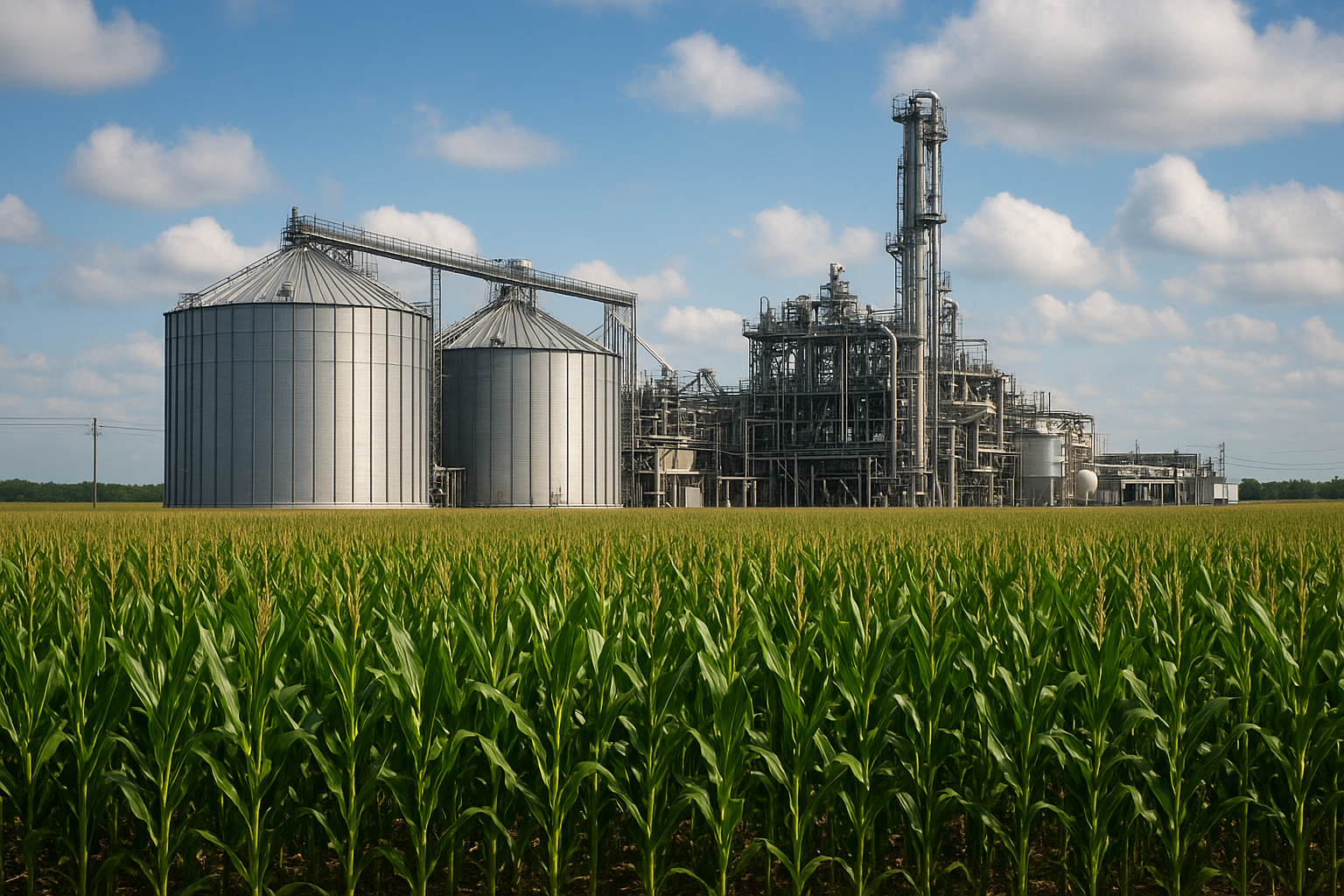
This heavy surge in weekly ethanol manufacturing translates into an enormous operational pull on domestic feed grain supplies and an immediate expansion in animal feed co-product availability. At an operating cadence of 1.143 million barrels per day—equivalent to 48.0 million gallons of fuel ethanol daily—the U.S. dry-mill ethanol sector is grinding more than 17.14 million bushels of yellow corn every single day, representing a staggering weekly processing grind in excess of 120 million bushels. Because modern dry-mill ethanol biorefineries operate as highly efficient dual-stream bio-manufacturing platforms, every 56-pound bushel of processed corn yields approximately 17.5 pounds of distillers dried grains with solubles (DDGS) alongside nearly 0.85 pounds of distillers corn oil (DCO). Consequently, the current national grind rate is generating roughly 150,000 short tons of distillers dried grains per day, funneling more than 1.05 million tons of protein- and energy-rich distillers co-products into commercial feeding channels every week. Furthermore, biorefineries are yielding more than 3.2 million pounds of distillers corn oil daily, which serves as a vital energy ingredient for feed compounders and a prized feedstock for renewable diesel hydrotreaters.
The timing of this refining acceleration directly coincides with the apex of the 2026 U.S. row-crop harvest, creating ideal operational and logistics conditions for Midwest processors. According to the USDA National Agricultural Statistics Service (NASS) Crop Progress report issued earlier this week, national corn harvest advanced swiftly to reach 74 percent complete, funneling an immense volume of newly combined grain into commercial river elevators, terminal warehouses, and processor receiving pits across Iowa, Illinois, Nebraska, and Minnesota. With country elevators heavily saturated and interior cash corn basis reflecting seasonal harvest pressure, ethanol refiners are capturing abundant, competitively priced feedstock at their doorsteps. Positive processing margins—bolstered by consistent wholesale ethanol blending demand, stable natural gas drying costs, and strong distillers corn oil values—have incentivized plant managers to push distillation columns and hammer mills to maximum throughput capacity. This uninterrupted processing run ensures that bulk distillers grains are moving smoothly through railcar and truck loadout facilities, eliminating the localized supply bottlenecks observed during September maintenance periods.
Why It Matters:
For livestock nutritionists, feed mill procurement managers, commercial feedlot operators, and dairy producers across North America, the EIA’s confirmed surge in ethanol production provides tangible relief and expanding volume across the feed ingredient complex. In late September and throughout October, temporary plant turnarounds and regional maintenance outages had restricted prompt distillers grain supplies, driving FOB Midwest spot DDGS prices into the $180 to $195 per ton range across major railheads. With Midwest biorefinery output now vaulting to 1.090 million bpd, the weekly flow of fresh DDGS, modified distillers grains (MDGS), and wet cake (WDGS) into livestock channels has expanded by several tens of thousands of tons. For commercial beef cattle feedyards and backgrounding operations across the High Plains, this surge delivers immediate access to dense, highly digestible rumen-undegradable protein (RUP) and phosphorus-rich energy without paying exorbitant spot delivery premiums. Similarly, Upper Midwest and Great Lakes dairy operations can rely on uninterrupted supplies of high-fat distillers feeds to maintain milk component yields and dietary energy density through the approaching winter feeding season.
At the feed manufacturing desk, this flood of distillers grains arrives at a pivotal juncture, colliding directly with a softening oilseed complex and reshaping least-cost formulation strategies for monogastric species. Earlier this week, benchmark December CBOT soybean meal futures slid to contract lows near $317 per ton following an 88 percent complete soybean harvest, while agribusiness giant ADM reported a massive twenty-four-fold increase in crushing profitability. With both soybean meal and DDGS becoming increasingly abundant across the Midwest, feed formulators for commercial swine and poultry integrators must dynamically recalibrate their ingredient inclusion ratios. While lower soymeal prices naturally encourage higher soybean meal inclusion, plentiful distillers grains present attractive opportunities to capture cost savings in swine grow-finish and broiler diets—provided that nutritionists manage fiber, phosphorus, and mycotoxin constraints. By combining competitive distillers grains with crystalline amino acids such as L-lysine, DL-methionine, L-threonine, and L-tryptophan, feed mills can balance digestible amino acid profiles, avoid excess crude protein, and extract an estimated $4.00 to $8.00 per ton in net finished ration savings compared to early autumn benchmarks.
What to Watch:
Over the next two to four weeks through the remainder of November, feed procurement directors, grain merchandisers, and commodity risk managers must closely monitor weekly EIA production metrics, ethanol storage inventories, and rail freight logistics. Market participants should observe whether Midwest biorefineries sustain weekly production above the 1.13 million bpd mark or whether inventory accumulation—currently at 24.43 million barrels—prompts refiners to temper grind rates if domestic blending and export off-take slow. Concurrently, supply chain managers must track rail performance indicators on primary western and eastern Class I carriers, including Union Pacific (UP), BNSF Railway, and Norfolk Southern. Because distillers grains cannot be stored indefinitely in outdoor piles without degradation, refiners rely on rapid railcar turnarounds to clear storage flat barns. Any localized rail congestion or car shortages could force individual plants to heavily discount prompt truck-load DDGS to prevent grain pileups, presenting nimble regional livestock operations with attractive spot procurement discounts.
Simultaneously, agribusiness executives and feed industry analysts must track critical macroeconomic and federal policy milestones scheduled over the coming days. Foremost among these is the USDA’s World Agricultural Supply and Demand Estimates (WASDE) report on Tuesday, November 10, 2026, where trade analysts will scrutinize whether federal forecasters elevate official 2026/2027 corn grind for ethanol projections above the current 5.45 billion bushel baseline to reflect heavy autumn run rates. Furthermore, industry participants must follow regulatory developments surrounding federal Clean Fuel Production Credits (Section 45Z) and California Low Carbon Fuel Standard (LCFS) carbon-intensity compliance pathways following the national elections. These renewable fuel mandates directly influence processor investments in carbon capture, energy efficiency, and distillers corn oil extraction efficiency, which will fundamentally dictate the lipid and nutritional profiles of commercial distillers feeds entering domestic livestock feeding channels heading into 2027.
The Bottom Line
The EIA’s November 4 report confirming that U.S. fuel ethanol production surged to 1.143 million barrels per day provides unambiguous evidence that domestic biorefineries are operating at peak capacity, converting over 120 million bushels of corn per week and pumping more than 1 million short tons of distillers grains into commercial livestock feed markets. Coming on the heels of a 74 percent complete national corn harvest and coinciding with a multi-month slump in soybean meal prices, this co-product expansion fundamentally improves ingredient availability and alleviates autumn pricing pressure for livestock producers across the Corn Belt and High Plains. Feed mill procurement executives, consulting animal nutritionists, and livestock operations should actively capitalize on this supply abundance by securing favorable forward winter DDGS basis contracts, fine-tuning least-cost dietary formulations with precision amino acid balancing, and leveraging expanding processor throughput to safeguard livestock feeding margins throughout the months ahead.