
The Story:
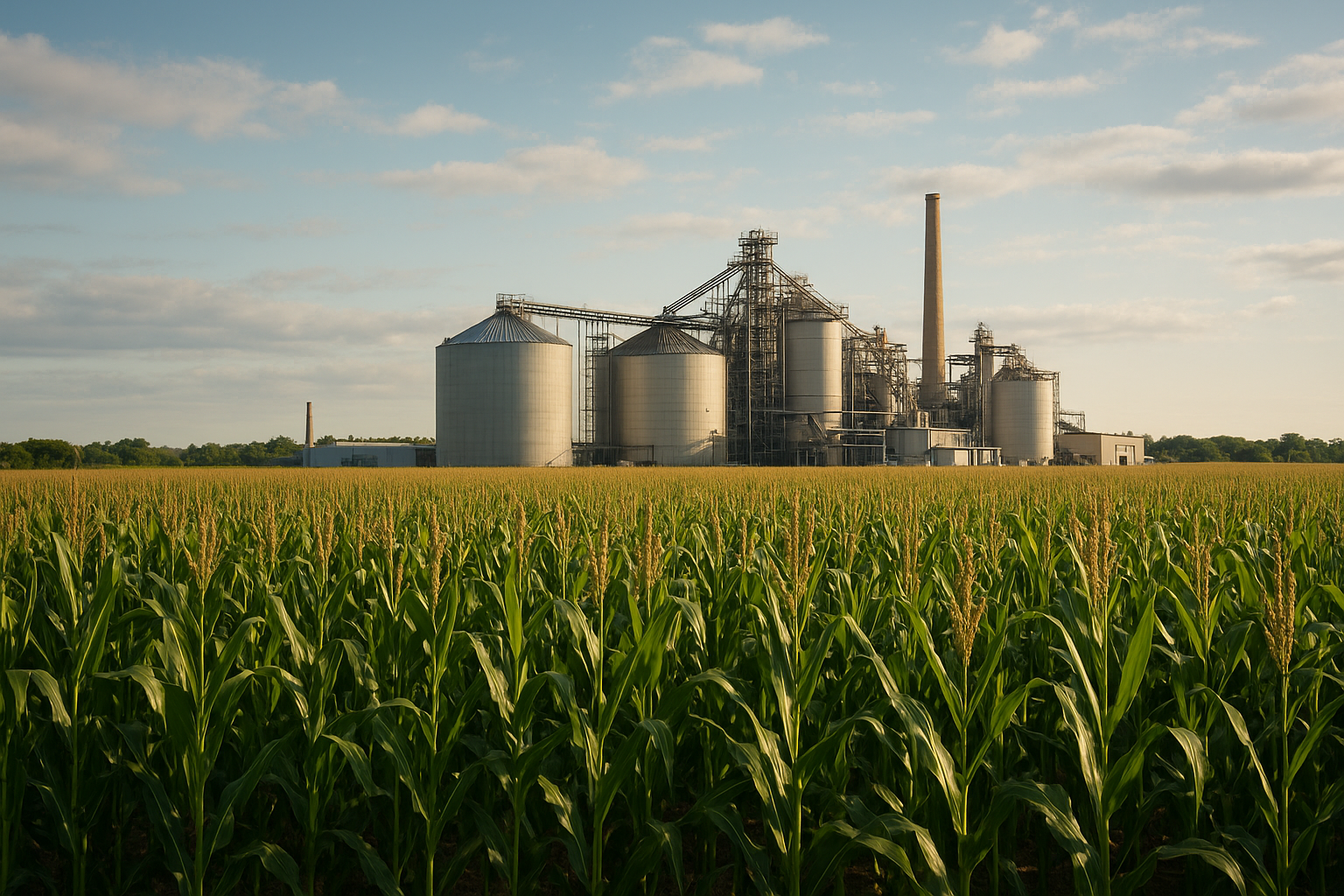
On Wednesday, October 7, 2026, the U.S. Energy Information Administration (EIA) released its Weekly Petroleum Status Report for the week ending October 2, revealing that domestic fuel ethanol production rebounded to an average of 1.053 million barrels per day (bpd). The weekly figure represents a 46,000-bpd increase over the prior week's pace, signaling that commercial biorefineries across the Corn Belt are emerging from scheduled autumn maintenance and accelerating facility throughput. Midwest production—the epicenter of North American ethanol and distillers co-product processing—drove the nationwide surge, climbing by 62,000 bpd to average 1.010 million bpd. Concurrently, national ethanol inventories drew down by 122,000 barrels to settle at 23.73 million barrels, reflecting firm domestic blending and export demand that continues to clear fuel stocks. At a weekly operating run-rate of 1.053 million bpd, domestic dry-grind plants are processing approximately 106.5 million bushels of corn per week, generating roughly 615,000 short tons of distillers co-products weekly and providing commercial feed compounders with renewed physical volume heading into peak autumn livestock feeding.
The weekly production rebound coincides with historic export velocity for distillers dried grains with solubles (DDGS), highlighting a widening divergence between red-hot offshore demand and cautious domestic buying. Official trade statistics compiled by the USDA Foreign Agricultural Service (FAS) and highlighted by the U.S. Grains & BioProducts Council confirm that U.S. distillers grains exports reached 1.30 million metric tons in August 2026—the highest monthly export volume recorded in eleven years. Year-to-date DDGS shipments are running 13 percent ahead of the 2025 pace, propelled by aggressive procurement from major international feeding hubs across Mexico, Indonesia, Vietnam, and South Korea, where elevated delivered soybean meal costs have forced compounders to substitute corn co-products. This relentless export pull has kept river barge and export terminal pricing firm, with prompt CIF New Orleans (NOLA) barge bids quoted at $280 per metric ton and FOB vessel Gulf positions holding near $304 per metric ton, creating intense competition against domestic truck markets for prompt plant allocations.
While export corridors remain voracious, domestic cash markets are navigating a pronounced seasonal transition as biorefineries balance incoming new-crop corn origination against storage logistics. According to DTN market surveys and the USDA Agricultural Marketing Service (AMS) National Weekly Grain Co-Products Report, average domestic spot DDGS values at Midwest processing plants ticked up modestly to $195 per short ton for the week ending October 1. However, plant-level pricing across Iowa, Illinois, Nebraska, and Minnesota exhibits notable regional dispersion based on local logistics and feedlot proximity. With new-crop corn harvest expanding across the central and southern Midwest despite recent weather-related delays, ethanol plant managers are eager to maintain steady co-product movement to prevent warehouse congestion and maximize dryer throughput. The weekly recovery to 1.053 million bpd confirms that plants are securing feedstock supplies and maintaining continuous run-rates, easing localized pinches that emerged during late-September maintenance shutdowns.
Why It Matters:
For commercial feed manufacturers, dairy nutritionists, and cattle feedlot operators, the recovery in ethanol run-rates and subsequent expansion in distillers co-product output carries direct implications for least-cost ration formulation matrices. On a pure protein-equivalent basis, spot DDGS has recently traded at approximately 120 percent of cash corn and soybean meal replacement value, a level that historically suppresses inclusion rates in monogastric swine and poultry feeding programs. Because finishing pigs and broiler flocks require tightly calibrated digestible amino acid profiles—specifically digestible lysine and threonine—an elevated DDGS relative price matrix limits economic inclusion, forcing swine integrators to cap dried distillers grains at 10 to 15 percent of grow-finish rations while leaning on synthetic amino acids and dehulled soybean meal. Conversely, in the ruminant sector, beef feedlots and commercial dairy herds continue to demonstrate inelastic demand for distillers grains due to their high energy concentration, digestible neutral detergent fiber (NDF), and rumen-undegradable protein (RUP) content, which minimizes subacute ruminal acidosis risks in cattle.
Beyond dietary formulation thresholds, the surge in weekly biorefinery grind impacts operational logistics and regional procurement spreads across the feed supply chain. Cattle feeding operations situated within direct trucking radiuses of Midwest ethanol plants are aggressively maximizing intake of wet distillers grains (WDGS, typically 30 to 35 percent dry matter) and modified distillers grains (MDGS, roughly 50 to 55 percent dry matter). Wet co-products trade at a substantial discount to dried meal because biorefineries avoid the natural gas drying expenses of rotary dry kilns, offering regional feedlots an attractive per-unit energy discount of $20 to $35 per dry-matter ton compared to dried DDGS. However, for feed compounders and livestock producers located outside the immediate 100-mile trucking radius, the availability of dried DDGS in covered rail hoppers and bulk pneumatic trailers remains essential. With rail freight rates holding firm and unit-train export programs commanding priority at Class I interchanges, commercial feed mills must closely manage forward delivery contracts to ensure consistent railcar placement.
What to Watch:
Over the coming two to four weeks, feed procurement directors, grain merchandisers, and commercial nutritionists should closely track the pace of Midwest corn harvest progress and its immediate impact on ethanol plant crush margins. As harvest combines accelerate across the Western Corn Belt following late-September rain delays, the influx of freshly harvested, higher-moisture corn will test commercial elevator drying capacity and pressure local spot cash basis. Ethanol biorefineries typically capture some of their most attractive gross operating margins during the October-to-November window by procuring newly harvested grain at historically wide harvest basis discounts. Merchandising desks must monitor whether lower cash feedstock costs and steady fuel ethanol prices incentivize plant operators to maintain weekly production above the 1.05-million-bpd mark or whether rising storage inventories trigger run-rate throttling. If crush margins expand, plants will run at full mechanical capacity, releasing heavy co-product volume onto the domestic market and pressuring Midwest spot DDGS values.
Simultaneously, feed buyers must scrutinize international trade execution and transportation performance across primary export gateways. Procurement managers should monitor weekly export inspections, river navigation conditions on the Mississippi and Illinois rivers, and ocean freight rate adjustments to assess whether foreign demand continues to absorb over 1.2 million tons of distillers grains monthly. If river draft restrictions or shipping bottlenecks emerge at Gulf and Pacific Northwest (PNW) export terminals, offshore buying could temporarily back up into interior rail markets, forcing ethanol plants to redirect stranded DDGS tonnage back into domestic livestock distribution channels at discounted basis levels. In addition, feed formulators should track the upcoming October 9 USDA World Agricultural Supply and Demand Estimates (WASDE) and Crop Production reports for potential revisions to official corn production and feed residual use estimates. By monitoring daily price ratios between DDGS, 48 percent crude protein soybean meal, and synthetic lysine, feed manufacturers can proactively adjust formulation minimums the moment relative co-product values soften.
The Bottom Line
The Energy Information Administration's October 7 report confirming a weekly rebound in U.S. ethanol production to 1.053 million barrels per day provides timely supply relief for distillers co-products just as commercial feed mills and livestock feeding operations enter the peak autumn consumption corridor. While unprecedented export demand has maintained firm price floors on export-grade DDGS, the surge in Midwest biorefinery grind expands physical availability of dried and wet distillers grains across primary domestic feeding belts. For feed manufacturers, dairy operators, and cattle feedlot managers, navigating the coming weeks requires disciplined monitoring of regional harvest basis, rail freight execution, and protein-substitution economics to capture optimal nutritional value from expanding co-product processing streams.