
The Story:
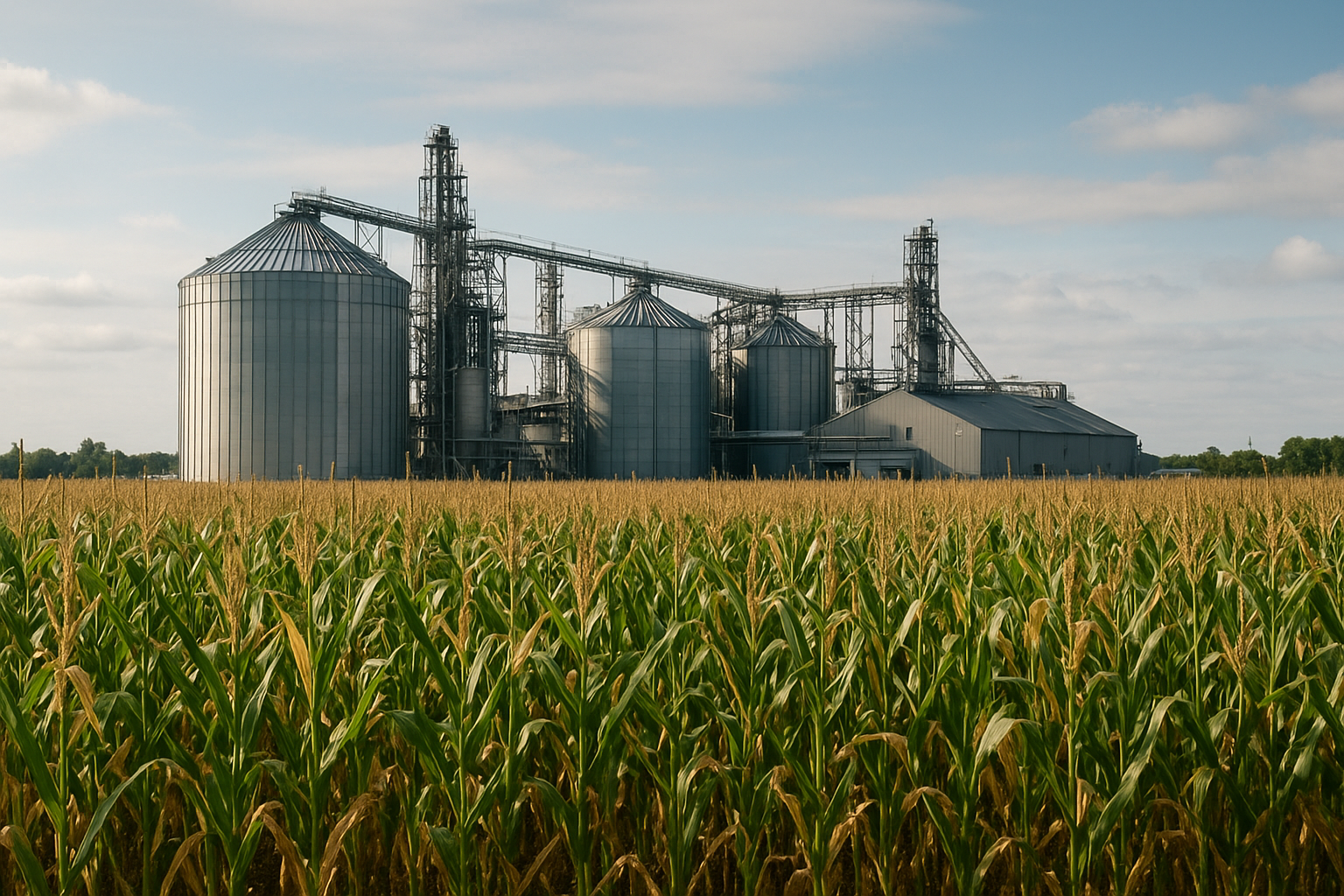
On Wednesday afternoon, October 21, 2026, the U.S. Energy Information Administration (EIA) officially released its Weekly Petroleum Status Report for the week ending October 16, 2026, documenting a sharp acceleration in domestic biofuel processing as weekly fuel ethanol production surged to an average of 1.094 million barrels per day (bpd). The weekly output marks a substantial week-over-week increase of 29,000 bpd compared to the prior week's pace of 1.065 million bpd, confirming that dry-mill ethanol biorefineries throughout the Corn Belt have rapidly concluded seasonal autumn turnaround maintenance and are operating at aggressive run-rates to absorb a deluge of newly harvested grain. The production surge was heavily concentrated in the Midwest (PADD 2)—the primary production corridor for North American commercial ethanol and distillers co-products—where output climbed by 23,000 bpd to reach 1.033 million bpd. Concurrently, national fuel ethanol ending inventories rose by 616,000 barrels to settle at 24.558 million barrels, standing approximately 12 percent above corresponding 2025 inventory benchmarks, while weekly export shipments advanced by 11,000 bpd to average a brisk 132,000 bpd without any reported offshore import volumes.
At a sustained nationwide operating pace of 1.094 million bpd—equivalent to roughly 45.95 million gallons of renewable fuel produced every twenty-four hours—domestic dry-grind biorefineries are consuming approximately 16.1 million bushels of commercial yellow dent corn each day, translating to an aggregate weekly grind exceeding 112.7 million bushels. Because the dry-milling process converts each 56-pound bushel of raw grain into approximately 2.85 gallons of denatured ethanol alongside roughly 17 to 18 pounds of high-value livestock co-products, this elevated throughput is generating more than 137,000 short tons of distillers dried grains with solubles (DDGS) and wet distillers grains (WDGS) every single day, or nearly one million short tons on a weekly basis. With the 2026 U.S. corn harvest progressing rapidly past the halfway mark and interior cash corn values softening to $4.35 to $4.60 per bushel at country elevators, biorefineries are benefiting from historically favorable processing margins, providing processors with powerful economic incentives to maximize daily facility grind and run dryer assets at peak capacity.
The rapid expansion in ethanol processing run-rates directly shapes commercial co-product merchandising and regional basis dynamics as autumn feed compounders build fourth-quarter inventory reserves. While offshore export demand for U.S. distillers grains has established an 11-year high of 1.30 million metric tons per month—anchored by aggressive buying from Mexico, South Korea, Indonesia, and Vietnam—the sheer physical volume of prompt co-product generated across interior processing facilities is overwhelming local loadout capacity and prompting processors to price spot allocations aggressively to prevent dryer bottlenecks. Midwest spot DDGS values have adjusted into the $190 to $195 per short ton range FOB plant, creating an exceptionally competitive pricing dynamic against rival plant-based protein meals and energy feeds. For livestock feeders, commercial feed manufacturers, and procurement directors navigating seasonal basis volatility, the influx of fresh co-product volume provides an abundant, cost-effective physical supply line just as ruminant and monogastric feed demand enters its seasonal peak.
Why It Matters:
For animal feed manufacturers, commercial cattle feedlots, and dairy nutritionists, this surge in ethanol plant throughput delivers immediate, tangible relief to finished ration costs and establishes an extraordinarily favorable ingredient substitution spread against supplemental protein. In commercial beef feedyards across Nebraska, Kansas, Iowa, and Texas, finishing rations represent between 70 and 80 percent of total operating overhead outside of the initial feeder cattle purchase, with finishing cattle consuming between 26 and 32 pounds of dry matter daily. With December CBOT soybean meal trading near $348.70 per short ton and spot Midwest DDGS holding at $190 to $195 per ton, distillers grains currently offer crude protein and net energy for gain (NEg) at a massive per-unit discount relative to oilseed meals. Commercial feedyard consulting nutritionists are aggressively optimizing finishing rations by holding DDGS inclusions at 15 to 20 percent of dry matter (or WDGS at 20 to 25 percent), displacing higher-cost processed soybean meal while capturing 28 to 30 percent crude protein and 7 to 9 percent supplemental corn distillers oil to drive daily gain efficiency and sustain cost-of-gain benchmarks below $1.15 per pound.
At the dairy and swine formulation desks, the influx of distillers co-products provides critical flexibility to manage dietary energy density and co-product inclusion parameters heading into winter. In high-producing lactating dairy herds throughout Wisconsin, Minnesota, Michigan, and Idaho, dairy nutrition directors rely on premium-grade DDGS to supply highly digestible neutral detergent fiber (NDF) alongside exceptional levels of rumen undegradable protein (RUP), which bypasses ruminal degradation to provide essential amino acids directly to the small intestine. At current relative value ratios where DDGS trades at roughly 55 percent of spot soybean meal, dairy compounders can incorporate 10 to 14 percent distillers grains in lactating rations to reduce supplemental protein expense by $0.35 to $0.55 per cow daily without sacrificing milk volume or butterfat components. Similarly, commercial swine operations are utilizing calibrated 10 to 15 percent DDGS inclusion rates in grower-finisher diets, blending competitive co-products with synthetic L-lysine and L-threonine to offset corn meal requirements and optimize net energy intake across expanding nursery complexes.
What to Watch:
Over the coming weeks, feed procurement directors, grain merchandisers, and feed mill managers must closely monitor weekly EIA ethanol production benchmarks to determine whether the 1.094 million bpd run-rate represents a temporary post-maintenance surge or the sustained operating pace of the 2026/27 marketing year. As national ethanol stockpiles climb toward 25 million barrels, industry analysts must watch whether wholesale fuel blending margins face downward pressure, which could eventually prompt selective run-rate trims among higher-cost plants if terminal storage fills. Simultaneously, feed buyers should track interior plant storage logistics across top producing states like Iowa, Illinois, and Indiana; if plants experience railcar turnaround delays or freight pinches, spot DDGS bids could see temporary, sharp local discounts as plant merchandisers discount truck-delivered co-product to prevent storage tank overflows and maintain continuous corn grind schedules.
Concurrently, feed procurement desks and livestock risk management teams must monitor the evolution of regional freight rates and winter logistics corridors ahead of impending freeze restrictions. With Class I railroads recently announcing seasonal tariff adjustments and upper Mississippi River barge navigation entering its final weeks before seasonal winter closure, the cost of moving distillers co-products from interior Midwest processing hubs to destination feed markets in the Southern Plains, Southeast, and Pacific Northwest is poised to increase significantly. Feed manufacturers and feedlot procurement managers should capitalize on current harvest basis softness and abundant plant supplies to execute forward physical DDGS contracts through the first quarter of 2027, securing delivered product guarantees, pre-booking dedicated hopper car capacity, and protecting feed manufacturing margins before winter logistics tighten domestic supply chains.
The Bottom Line
The EIA's report of U.S. fuel ethanol production jumping to 1.094 million barrels per day confirms that domestic biorefineries are running at near-record throughput, processing more than 16.1 million bushels of corn daily and unleashing a torrential supply of distillers co-products exceeding 137,000 short tons each day onto commercial feed markets. For feed manufacturers, cattle feedlot operators, and dairy nutritionists, this co-product wave arrives at an opportune moment, widening the economic incentive to substitute $190 to $195 per ton DDGS against $348.70 per ton soybean meal and substantially trimming total ration overhead. To capture maximum financial advantage, feed buyers and livestock producers should aggressively lock in forward distillers grains coverage through the first quarter of 2027, leverage favorable harvest basis spreads, and formulate dense, cost-effective rations before impending winter freight escalation constrains interior logistics.