
The Story:
On Friday morning, October 23, 2026, research published by CoBank's Knowledge Exchange and authored by lead grain and oilseeds economist Tanner Ehmke detailed a severe structural financial challenge confronting domestic grain elevators and agricultural cooperatives as the nationwide autumn harvest reaches its peak. Aggressive farmer selling during recent price bounces across benchmark Chicago Board of Trade (CBOT) corn and soybean futures has rapidly transferred physical crop ownership into commercial hands far faster and in significantly larger volumes than historical norms. Across primary growing regions throughout the Midwest and Northern Plains, commercial country elevators and regional cooperatives report exiting the heart of harvest holding outright company ownership of approximately 50 percent of the local corn and soybean crop—a dramatic expansion compared to the traditional historical baseline of 35 to 40 percent. This massive influx of elevator-owned physical inventory is colliding directly with persistently elevated commercial interest rates, with agricultural merchandisers facing annual borrowing rates between 7.50 and 7.75 percent on short-term revolving credit facilities, driving inventory financing and carrying charges to the highest levels recorded in modern agribusiness history.
The compounding burden of high borrowing costs, facility maintenance, and massive inventory volume has fundamentally disrupted the traditional economic mechanics of commercial grain storage. According to CoBank's findings, financing expenses alone now represent between 25 and 35 percent of an elevator's total cost of carry, adding an estimated 40 to 50 cents per bushel in annualized carrying charges across stored corn, soybeans, and wheat. Compounding these severe balance-sheet pressures, futures market curves on the CBOT have provided flat to inverted carries, completely failing to offer the commercial storage premiums necessary to cover monthly interest, insurance, shrinkage, and handling overhead. Simultaneously, commercial elevators holding substantial short futures hedges against their ballooning physical inventories face intense liquidity strain and margin-call exposure whenever futures markets experience volatile autumn rallies. Grain merchandisers find themselves trapped in a high-stakes 'hot potato' dilemma: carrying high-value physical grain without futures carry rapidly consumes finite working capital, yet cooperatives remain commercially and competitively bound to accept member deliveries straight off the combine.
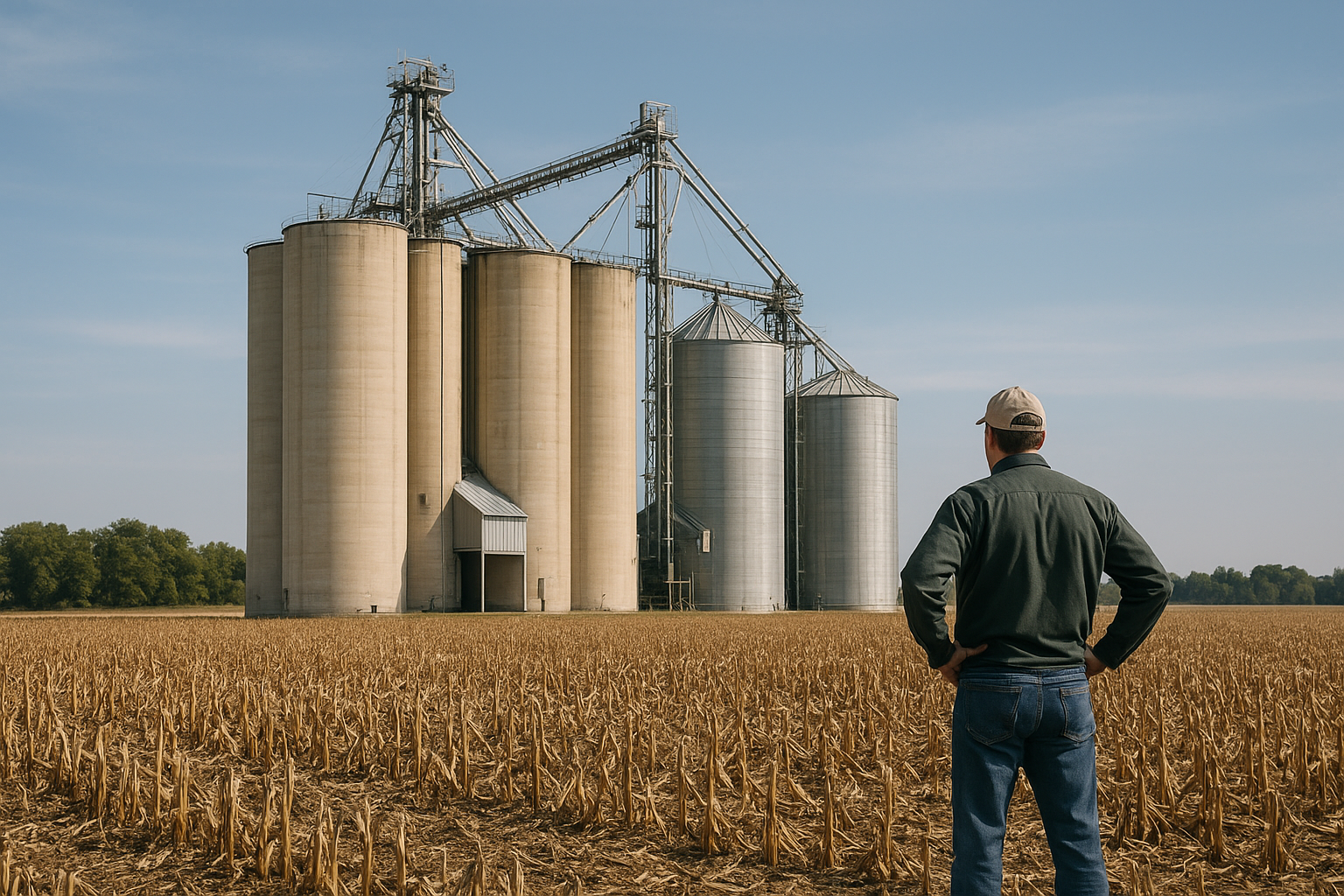
To protect operational margins and alleviate severe pressure on commercial lending limits, country elevators and regional cooperatives across the Corn Belt are aggressively overhauling their daily origination and marketing strategies, triggering notable cash-market dislocations. Merchandisers are systematically widening local basis discounts, lowering cash bids to producers, and escalating service fees on delayed-pricing (DP) and price-later contracts to actively discourage unpriced grain storage. More critically for downstream consumers, elevators are aggressively pushing newly harvested grain out of primary upright concrete silos and temporary outdoor ground bunkers, actively discounting prompt spot shipments to clear rail track space and receiving pits. At major commercial gathering points from Iowa and Illinois to Nebraska and Kansas, elevators are prioritizing rapid physical turnover over storage appreciation, offering discounted delivered freight packages to interior processing plants, export terminals, and livestock feeding corridors to convert heavy grain inventories back into liquid cash before high-interest carrying charges compound further.
Why It Matters:
For commercial animal feed manufacturers, integrated livestock operations, and ingredient procurement directors across the poultry, swine, and beef sectors, this elevator carrying-cost crisis creates an immediate, highly advantageous procurement window. As elevators offload harvest grain into physical channels to escape holding charges, commercial feed mills are capturing sharply discounted cash corn and soybean basis across interior rail and truck corridors. Delivered cash corn bids into primary livestock feeding hubs across the Corn Belt and Southeast have eased back to favorable harvest levels between $4.30 and $4.50 per bushel, providing meaningful short-term ration cost relief for swine finishing barns, broiler complexes, and cattle feedyards. However, feed mill operations managers and nutritionists must avoid the operational trap inherent in this environment: commercial compounders cannot afford to mirror elevator behavior by accumulating excessive forward inventory in mill silos. In an environment of 7.50-percent commercial borrowing, carrying excess physical grain at the mill incurs the exact same crippling 40-to-50-cent-per-bushel carrying penalty, requiring feed manufacturers to maintain disciplined, just-in-time procurement schedules while optimizing synthetic amino acids (such as L-lysine and DL-methionine) and competitive distillers dried grains with solubles (DDGS) trading near $190 to $195 per ton to keep rations flexible.
Furthermore, the acute balance-sheet strain on commercial cooperatives will fundamentally reshape feed ingredient availability and basis behavior as the marketing year advances into the winter months. Because country elevators are aggressively clearing physical inventory at unprecedented speeds rather than storing grain for deferred spring delivery, the traditional post-harvest commercial inventory buffer will be substantially depleted by the start of 2027. Once temporary harvest ground piles are cleared and elevators liquidate their surplus company-owned bushels, commercial merchandisers will have neither the physical reserves nor the working-capital capacity to hold grain in storage for downstream end-users. Consequently, the commercial grain supply chain faces an abrupt transition from autumn basis weakness to severe late-winter basis volatility. Feed mills and livestock feeding complexes situated in grain-deficit feeding regions—including broiler complexes in Georgia and Alabama and commercial cattle feedlots in the Texas Panhandle and Kansas—must prepare for escalating destination basis premiums and secondary freight surcharges as elevators re-establish defensive marketing postures and demand that buyers pay the full carrying freight on remaining grain.
What to Watch:
Over the coming 30 to 60 days, commodity purchasing executives, feed mill managers, and risk management teams must rigorously track regional cash basis movements and commercial elevator delivery incentives through the USDA Agricultural Marketing Service (AMS) weekly grain and feedstuff reports. Procurement desks should monitor whether country elevators continue to widen basis discounts or begin offering secondary transportation allowances to expedite prompt rail shuttle and truck movements into local feeding basins. In addition, feed buyers must closely observe elevator delayed-pricing (DP) fee structures; if commercial elevators raise monthly DP charges above 4 to 5 cents per bushel to penalize farmer storage, producers will be compelled to liquidate remaining harvest grain directly onto the cash market, extending the window of depressed spot feed ingredient prices deep into November. Feed manufacturers should capitalize on this specific window to finalize physical delivery schedules and lock in favorable basis commitments for nearby November and December delivery before storage facilities close their receiving gates.
Concurrently, livestock operations and corporate procurement directors must monitor Class I rail performance, secondary railcar auction premiums, and commercial bank lending standards heading into the first quarter of 2027. If agricultural credit conditions tighten further or benchmark interest rates remain elevated, regional grain cooperatives may face restricted seasonal borrowing capacity, accelerating forced grain liquidation and triggering localized supply disruptions. Feed compounders must work closely with their grain merchandising partners to assess counterparty financial stability, ensuring that forward delivery contracts are backed by financially resilient suppliers capable of navigating elevated margin calls and carrying costs. Commercial nutritionists should also maintain multi-species linear programming models that readily incorporate alternative energy and protein co-products—such as wheat middlings, corn gluten feed, and distillers solubles—ensuring feed mills can swiftly adjust formulations if primary grain basis spikes sharply when the harvest liquidation wave subsides.
The Bottom Line
CoBank's landmark October 2026 report demonstrates that elevated interest rates and unprecedented 50-percent harvest crop ownership have made inventory carrying costs a dominant, disruptive force in North American commodity merchandising. As country elevators face annualized storage and interest expenses reaching 40 to 50 cents per bushel and flat futures carries that fail to reward storage, merchandisers are aggressively unloading physical grain to escape holding the 'hot potato,' providing commercial feed manufacturers, poultry integrators, and hog producers with an exceptional nearby window to purchase spot corn at discounted basis between $4.30 and $4.50 per bushel. Feed purchasing directors and mill operations managers must capitalize on this temporary harvest liquidation by securing physical coverage through year-end, while rigorously resisting the urge to carry expensive forward inventory themselves—balancing disciplined just-in-time grain delivery with high-value DDGS and synthetic amino acids to protect ration margins against the sharp basis spikes and tightening supply conditions looming in early 2027.