
The Story:
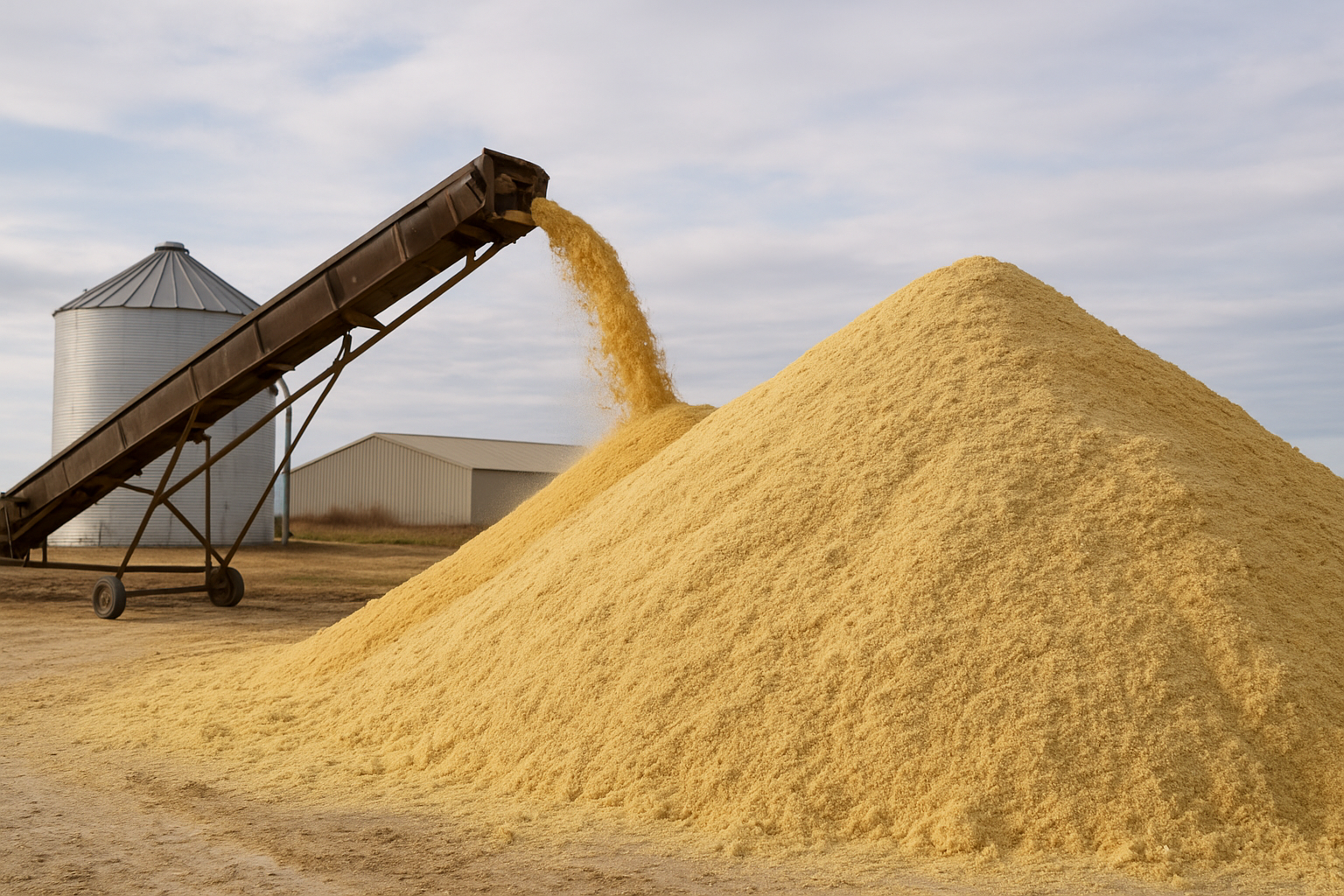
The U.S. Department of Agriculture's Agricultural Marketing Service (USDA AMS) released its benchmark National Grain and Oilseed Processor Feedstuff Report (AMS_3511) for the week ending September 25, 2026, confirming steady pricing across grain co-products that has opened an extraordinary valuation divide against other foundational feedstuffs. Spot truck bids for corn distillers dried grains with solubles (DDGS, 10% moisture) held remarkably stable across primary Corn Belt processing hubs, trading between $170.00 and $176.00 per short ton on a free-on-board (FOB) plant basis in Illinois and averaging $175.00 to $180.00 per ton across Missouri. In Iowa and southern Minnesota, spot processor bids averaged $168.00 to $174.00 per ton, while Nebraska and Kansas values traded between $172.00 and $185.00 per ton to reflect localized feedlot proximity. In the same reporting period, USDA AMS documented 21% protein corn gluten feed pellets trading at a weighted average of $148.83 per ton in the Central United States. These stable quotations stand in stark contrast to parallel USDA reports, notably AMS_3512, which documented spot wheat middlings surging abruptly to $256.67 per ton in Kansas City and $272.00 per ton statewide across Kansas, establishing an unprecedented $80.00 to $95.00 per ton discount for DDGS.
This widening price spread is rooted in resilient physical processing throughput across the domestic dry-mill ethanol manufacturing complex. U.S. ethanol biorefineries have maintained high operating utilization rates, with industry throughput averaging between 1.02 and 1.05 million barrels per day through late September. Favorable cash crush margins—supported by robust domestic motor gasoline blending and solid overseas biofuel shipments—have kept ethanol plant grind floors operating at steady capacity. Because distillers dried grains are generated as an unavoidable co-product of corn starch fermentation, ethanol producers must continuously evacuate bulk meal inventories to prevent on-site storage congestion. This regular physical production has generated reliable spot and forward availability across regional rail corridors and truck loading racks, shielding distillers grains from the severe supply squeezes that recently crippled flour milling co-products, where compressed operating grinds choked off regional wheat middling deliveries.
Simultaneously, commercial feed manufacturers and commercial livestock operations are aggressively capitalizing on this pricing disconnect to contain finished ration inflation. With harvest combining underway across the central Corn Belt, cash corn bids are hovering between $3.95 and $4.20 per bushel ($141.00 to $150.00 per short ton), placing spot DDGS at roughly 118% to 122% of cash corn value. Historically, whenever DDGS trades near or below 120% of cash corn, livestock nutritionists view the ingredient as an exceptional nutritional bargain, delivering 26% to 28% crude protein, 8% to 10% corn oil energy, and highly digestible neutral detergent fiber at a fraction of the cost of alternative concentrates. Concurrently, international demand continues to absorb significant volumes, with cumulative U.S. DDGS export shipments pacing 13% ahead of prior-year volumes behind aggressive containerized and bulk purchases from Mexico, South Korea, and Southeast Asia. This brisk export movement is competing directly against domestic feed mills for railcar allocations, establishing a dynamic floor under Midwest processor prices.
Why It Matters:
For commercial livestock producers, integrated feed mills, and ruminant nutritionists, the $80.00-per-ton value gap between DDGS and wheat middlings provides a powerful operational lever to protect feeding margins against seasonal cost inflation. In beef cattle backgrounding and feedlot finishing diets, nutritionists are pushing distillers grains inclusion rates to maximum allowable thresholds, often between 20% and 30% of total dietary dry matter intake. Because DDGS provides readily digestible fiber without high starch concentrations, it supplies dense net energy for gain while substantially reducing the incidence of subacute ruminal acidosis (SARA) during rapid autumn intake increases. Replacing inflated wheat middlings and high-priced supplemental protein meals with $175.00-per-ton DDGS and $148.83-per-ton corn gluten feed pellets immediately strips $6.00 to $12.00 per ton from finished mixed ration costs, delivering crucial relief for cattle operations navigating record-high feeder calf purchase prices and narrow cattle feeding margins.
Furthermore, this co-product spread is causing extensive restructuring across least-cost formulation matrices in the swine and poultry sectors. With 48% solvent soybean meal commanding $315.00 to $330.00 per ton and rendered meat and bone meal spiking past $480.00 per ton under tight cattle slaughter rates, feed formulators are maximizing distillers grains usage in grow-finish swine and broiler diets up to 10% to 15% inclusion. To overcome the lower concentration and higher variability of digestible lysine inherent in corn co-products, feed mills are combining competitive DDGS with synthetic amino acids, including crystalline L-lysine HCl, L-threonine, and L-tryptophan. This precision substitution strategy enables monogastric integrators to dramatically reduce expensive soybean meal and animal protein meal purchases while maintaining target standardized ileal digestible (SID) amino acid balances, safeguarding animal growth performance at substantially reduced cost.
What to Watch:
Heading into October, agricultural commodity buyers, feed procurement executives, and mill managers must closely monitor regional ethanol production schedules and seasonal harvest basis patterns. As Corn Belt grain elevators receive newly harvested corn, localized cash corn basis is expected to soften, which could alter processor operating margins and prompt subtle adjustments in regional DDGS pricing. Feed buyers should scrutinize weekly Energy Information Administration (EIA) petroleum status reports and plant turnaround announcements, as scheduled autumn maintenance shutdowns at major dry-mill facilities could temporarily constrain local co-product output and tighten spot truck availability. In parallel, procurement teams must track Class I rail carrier performance and secondary freight tariff auctions, where expanding grain harvest shipments could elevate rail freight spreads and complicate timely delivery to High Plains and Southeastern livestock basins.
Simultaneously, commercial feed manufacturers and quality assurance teams must enforce stringent ingredient testing protocols on incoming distillers grains shipments. Elevated DDGS inclusion rates heighten sensitivity to mycotoxin contamination—specifically deoxynivalenol (vomitoxin) and zearalenone—which concentrate threefold during the dry-mill fermentation process. Feed mills must execute rapid testing on incoming loads, particularly in wet harvest zones where ear rot risks are elevated. In swine grow-finish formulations, nutritionists must continuously monitor dietary crude fat and calculated iodine value (IV) product scores to prevent excessive carcass fat softness and defend pork processor carcass grade premiums. Balancing least-cost economic savings against strict finished feed quality parameters will determine formulation success through the fourth quarter.
The Bottom Line
USDA AMS report AMS_3511 confirms a vital pricing buffer for livestock feeding economics as corn distillers dried grains hold firm at $170.00 to $180.00 per ton across the Midwest, establishing an unprecedented $80.00-per-ton discount to surging wheat middlings and offering immense relief against $480.00-per-ton rendered animal proteins. Driven by steady dry-mill ethanol grind throughput and strong export flows, DDGS at roughly 120% of cash corn provides commercial feed manufacturers and livestock producers an exceptional nutritional opportunity to curb diet inflation. Successfully leveraging this spread through the fourth quarter requires procurement directors and nutritionists to aggressively reformulate beef, swine, and poultry diets, deploy synthetic amino acids to balance monogastric rations, and enforce rigorous mycotoxin testing to protect both herd performance and operating profitability.