
The Story:
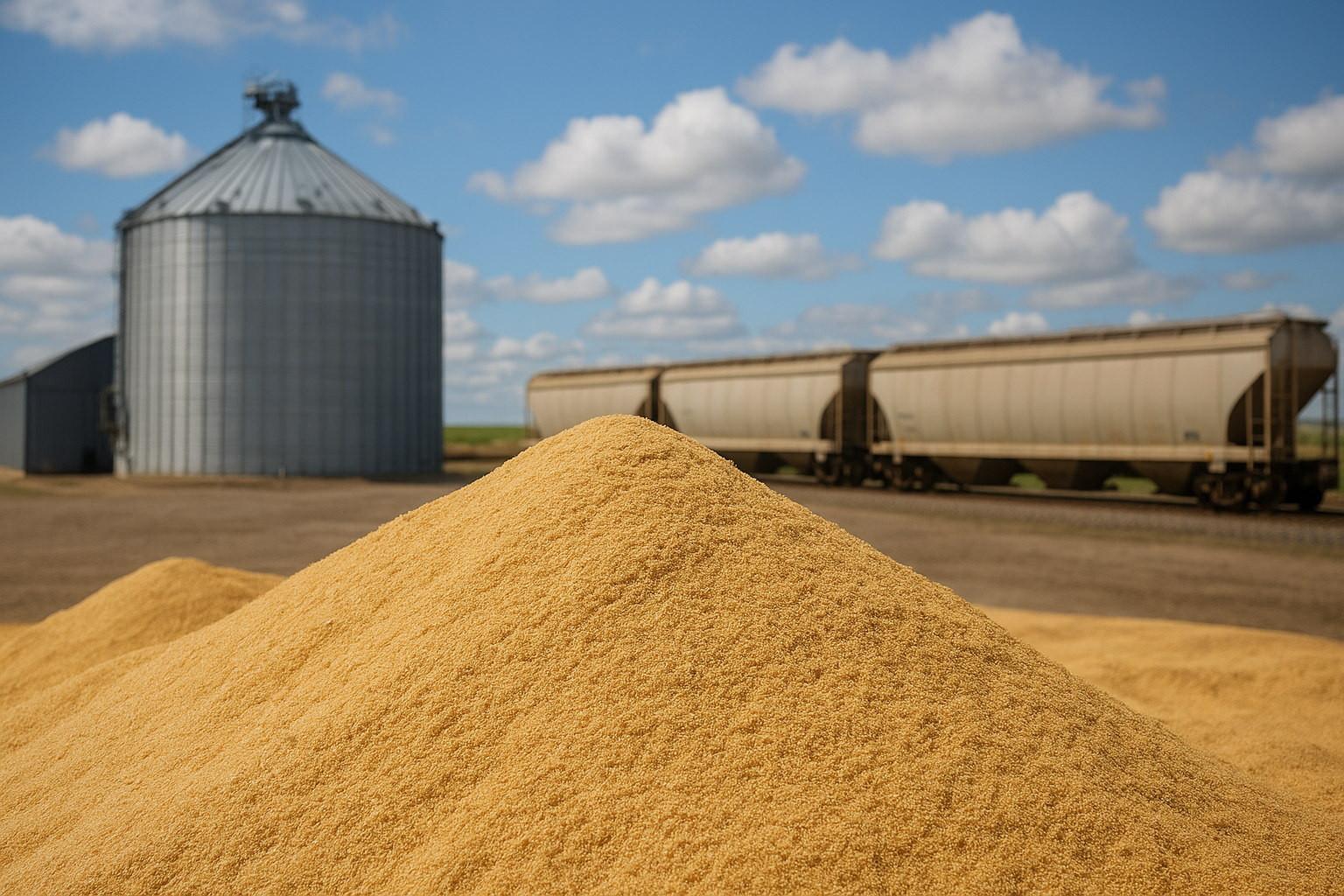
On Friday, October 16, 2026, DTN's weekly co-product market survey across 33 domestic reporting locations confirmed that average spot prices for distillers dried grains (DDG) dropped by $4 per short ton to settle at $193 per ton, breaking a multi-week upward pricing trend. The downward price adjustment arrives as commercial dry-grind ethanol biorefineries across the Midwest complete scheduled autumn maintenance turnarounds and ramp facility operating throughput back to full capacity near 1.05 million barrels per day, steadily rebuilding plant warehouse stocks and rail loading tracks. Concurrently, persistent harvest-time weakness across Chicago Board of Trade (CBOT) benchmark December corn futures—which settled near $4.74 per bushel following recent WASDE yield upgrades—alongside softer spot soybean meal indices has undercut feed co-product pricing power. With domestic cash corn basis softening as combines roll across the central Corn Belt, ethanol processors have proactively lowered asking quotes to maintain fluid physical clearance through plant loadout pits, manage daily grind schedules, and prevent co-product inventory bottlenecks.
More dramatically than interior Midwest truck markets, delivered rail and export co-product values experienced sharp contractions heading into the second half of October. Official price assessments compiled by DTN and highlighted across commercial merchandising channels revealed that rail-delivered DDGS prices into key Western livestock feeding destinations plunged substantially: delivered values to the Pacific Northwest (PNW) dropped by $21 per metric ton to $291 per MT, while rail delivered into central California feeding basins slid by $24 per MT to $286 per MT. Export gateway values mirrored this softening tone, with CIF New Orleans (NOLA) barge bids falling $7 to $262 per metric ton for November positions and FOB vessel Gulf quotes easing $4 to $285 per MT. This sharp deflation in long-haul rail-delivered co-products reflects a combination of moderating secondary railcar freight tariffs, improving railcar cycle velocity on Western Class I rail networks, and disciplined, hand-to-mouth procurement behavior from commercial West Coast cattle feedlots, backgrounding yards, and large-scale commercial dairy operations.
The retreat in spot values has significantly recalibrated the relative nutritional value of distillers grains against foundational commodity feedstuffs, establishing highly compelling procurement economics for feed compounders and livestock producers. DTN's comparative valuation analytics indicate that the domestic DDG price relative to cash corn settled at 113.1 percent, maintaining an attractive feeding relationship for ruminant livestock diets. Even more significantly for commercial monogastric nutritionists, the value of DDGS relative to high-protein soybean meal contracted to 53.64 percent. On an analytical dry-matter basis, this brings the cost per unit of crude protein in DDGS down to $7.15, compared to $7.57 per unit of crude protein for 48 percent crude protein solvent-extracted soybean meal. This widening protein discount provides commercial feed manufacturers with an immediate, quantifiable financial incentive to re-evaluate inclusion minimums in least-cost formulation matrices, marking a decisive shift from the supply-pinched market conditions that characterized late September facility shutdowns.
Why It Matters:
For animal feed manufacturers, commercial livestock nutritionists, and ingredient procurement directors, the drop in DDGS protein costs to $7.15 per unit transforms least-cost feed formulation economics heading into peak late-autumn consumption. In the commercial beef cattle and dairy sectors, where ruminant digestive physiology efficiently utilizes distillers grains' rumen-undegradable protein (RUP) and highly digestible neutral detergent fiber (NDF), the $21 to $24 per MT drop in West Coast rail-delivered pricing delivers immediate margin relief. Commercial feedlot managers operating across Idaho, Washington, and California—who have faced tight feeding margins and high-priced feeder cattle replacements—can aggressively maintain or expand DDGS inclusion rates up to 25 to 35 percent of total ration dry-matter intake without increasing subacute ruminal acidosis risks. For dairy nutritionists formulating for high-producing lactating herds, cheaper DDGS offers an ideal dual-purpose ingredient that helps prevent milk fat depression while displacing higher-cost bypass protein meals and expensive commercial alfalfa hay fractions across total mixed rations (TMR).
For commercial swine integrators and modern poultry complexes, the expanding price discount between DDGS and soybean meal reopens strategic blending opportunities, provided mills operate within rigorous nutritional boundaries. With CME lean hog futures under heavy pressure near life-of-contract lows and wholesale pork cutout values slipping below $78 per hundredweight, pork production enterprises are urgently pursuing finished feed cost reductions of $6.00 to $14.00 per ton. However, monogastric nutritionists cannot elevate DDGS inclusion indiscriminately: higher inclusion rates in late-finishing swine diets introduce polyunsaturated fatty acids from residual corn oil, which can soften belly fat and degrade commercial bacon slicing yields. To capture the $7.15 protein unit cost without compromising carcass specifications, alert swine feed mills are pairing moderate DDGS inclusion rates of 10 to 15 percent with synthetic crystalline amino acids—specifically L-lysine HCl, L-threonine, and supplemental L-tryptophan—effectively replacing expensive solvent-extracted soybean meal while safeguarding dietary net energy, amino acid digestibility, and carcass fat iodine values across packer-bound market hogs.
What to Watch:
Over the next two to four weeks, feed procurement directors, grain merchandisers, and commercial nutritionists should closely track weekly Energy Information Administration (EIA) ethanol production reports and regional biorefinery grind runtimes. If Midwest dry-grind ethanol plants sustain weekly operating runtimes above the 1.05-million-barrel-per-day mark while the U.S. corn harvest advances toward completion, processors will face steadily mounting inventories of dried and modified distillers co-products. Commercial feed buyers should monitor whether processing plants begin offering aggressive truckload basis discounts or guaranteed-delivery spot contracts to clear plant silos ahead of winter weather disruptions. Concurrently, procurement managers must track Class I railroad secondary market freight auctions and locomotive dwell times, verifying whether recent rail transportation savings into Western feeding basins remain intact or face freight rate surcharges as autumn export grain shuttle movements peak across northern rail arteries.
Simultaneously, feed purchasing desks and commodity risk managers must monitor international export commitments and river barge logistics moving toward the Gulf. Procurement teams should track weekly USDA export inspection figures and FAS sales reports, observing whether major international buying hubs—such as Mexico, Vietnam, Indonesia, and South Korea—step in aggressively to take advantage of the $7 to $21 per MT price break. A sudden surge in ocean container or bulk vessel bookings could rapidly absorb interior surplus and firm up CIF NOLA barge values, curbing further domestic price declines. Additionally, nutritionists must evaluate physical quality parameters as biorefineries transition toward new-crop corn: shifts in incoming kernel moisture, corn oil extraction efficiency, and regional mycotoxin concentrations demand expanded rapid laboratory screening at feed mill intake pits to ensure consistent diet density and herd performance.
The Bottom Line
The October 16 retreat in domestic distillers dried grains spot prices to $193 per short ton and the dramatic $21 to $24 per MT drop in West Coast rail-delivered rates mark a timely, welcome turning point for livestock feeding economics across North American commercial production corridors. With Midwest dry-grind ethanol operating rates rebounding to full post-turnaround capacity and DDGS protein costs dropping to an attractive $7.15 per unit versus $7.57 for solvent-extracted soybean meal, commercial feed manufacturers, dairy operators, and beef cattle feedlots hold a decisive operational window to capture meaningful ration cost savings. For procurement directors and animal nutritionists, successfully navigating this co-product slide requires agile execution: locking in favorable fourth-quarter rail and truck basis, fine-tuning crystalline amino acid balancing in monogastric feeds to safeguard carcass quality, and maintaining strict analytical quality assurance as new-crop processing ramps across the Corn Belt.