
The Story:
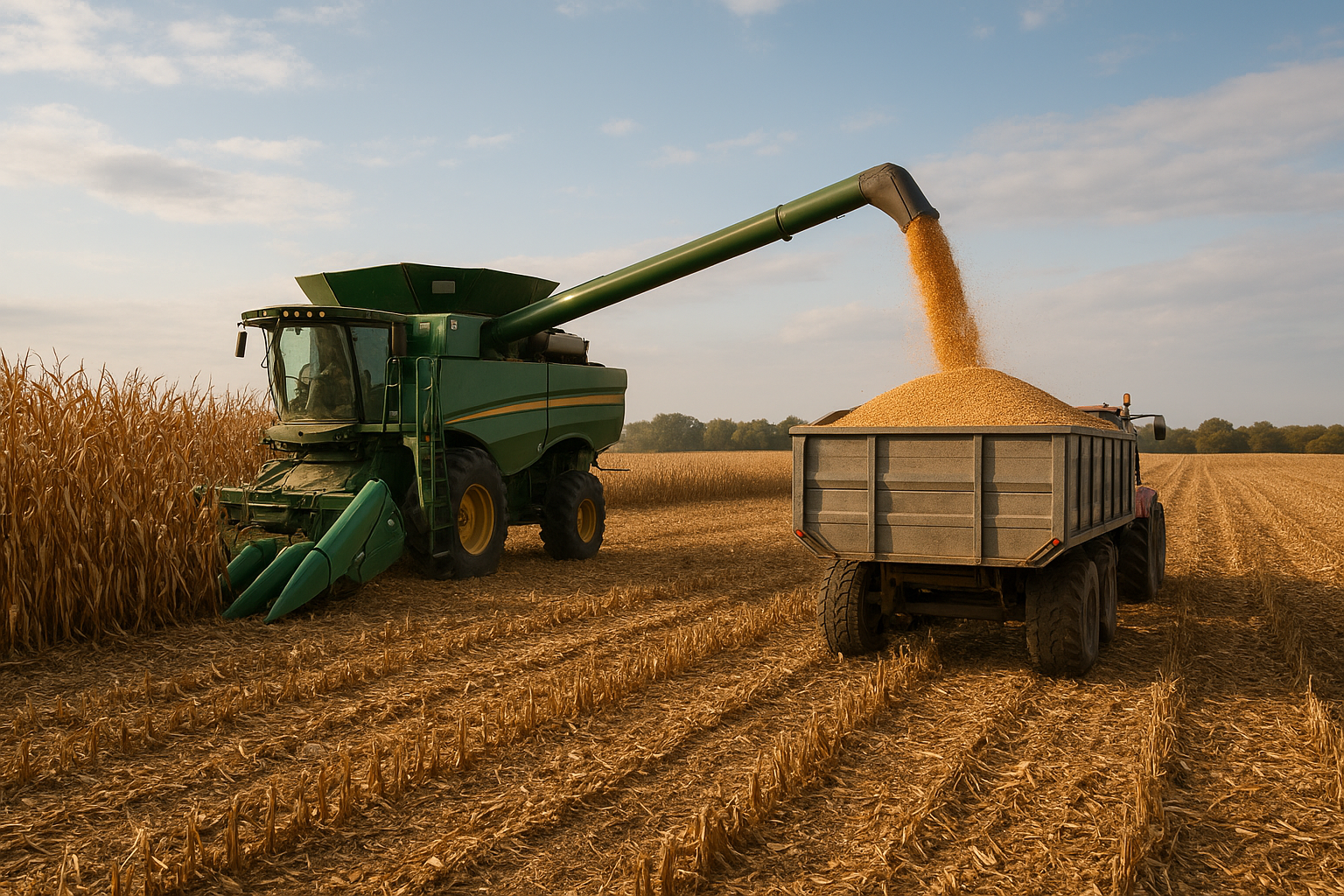
On Monday afternoon, October 26, 2026, the U.S. Department of Agriculture's (USDA) National Agricultural Statistics Service (NASS) released its weekly Crop Progress telemetry for the week ending October 25, revealing an explosive acceleration in row-crop combining across the North American heartland. National corn harvest advanced by an extraordinary 16 percentage points in a single seven-day window to reach 60 percent complete, surging upward from 44 percent reported the prior week. While the national combining pace still slightly trails the five-year historic average of 66 percent due to early-autumn rain delays across localized pockets of the eastern Corn Belt, unseasonably dry and warm mid-autumn weather over the past ten days allowed commercial combining operations throughout primary producing states—including Iowa, Illinois, Minnesota, Nebraska, and Indiana—to operate virtually non-stop from early morning until late at night. Concurrently, NASS announced that because national corn harvest has surpassed the critical 50 percent threshold, it has officially published its final weekly national crop condition rating of the 2026 growing season, pegging the remaining standing corn crop at 56 percent good-to-excellent (with 26 percent rated fair and 18 percent poor-to-very-poor), firmly cementing an exceptional production baseline that supports the agency's benchmark 16.0-billion-bushel national crop projection.
The rapid fieldwork momentum was even more aggressive across national oilseed belts, where U.S. soybean combining vaulted 15 percentage points over the week to reach 79 percent complete—climbing from 64 percent the prior week and overtaking the five-year average pace of 77 percent. Several key agricultural powerhouses, including Iowa, Minnesota, South Dakota, and North Dakota, are now reporting soybean harvest progress approaching or exceeding the 85 to 90 percent completion mark, effectively signaling the concluding phase of the 2026 domestic oilseed harvest. Across the central and southern Plains, winter wheat producers took full advantage of open field windows to advance autumn drilling to 76 percent complete, with 53 percent of the crop already emerged under favorable soil moisture conditions, while national grain sorghum harvesting advanced steadily to 68 percent complete. However, the unprecedented speed of this dual corn and soybean harvest sprint has unleashed a massive, concentrated influx of physical grain directly into interior commercial marketing channels, inundating regional country grain elevators, filling permanent concrete silo complexes to capacity, and forcing commercial elevator aggregators to establish massive emergency outdoor ground piles and bunker storage across the Midwest.
Crucially, this 16-point harvest deluge arrives at the precise operational juncture when the primary maritime export relief valves of the domestic grain system remain severely obstructed. As confirmed in Monday midday USDA export inspections data, Lower Mississippi River low-water restrictions and draft reductions have curbed weekly corn export shipments to just 24.6 million bushels—a three-year low—as deep-water Gulf export terminals prioritize high-margin soybean vessel commitments over feed grains. Furthermore, with the Brazilian Real plunging more than 1.8 percent following weekend political developments, cheapening South American FOB export offers and intensifying global export competition, commercial grain handlers cannot easily liquidate interior harvest grain volumes into international shipping lanes. Facing saturated elevator bin capacity, steep short-term commercial borrowing interest rates of 7.5 to 8.0 percent to carry uncommitted inventory, and mounting elevator insurance premiums on exposed outdoor piles, interior grain merchandisers have widened cash basis bids aggressively. Spot basis discounts ranging from 45 to 68 cents under December CBOT futures are now widespread across major river loading points and rail shuttle facilities in Iowa, Illinois, and southern Minnesota, driving flat cash corn prices down into the deeply discounted $4.05 to $4.20 per bushel range.
Why It Matters:
For commercial animal feed manufacturers, integrated poultry operations, commercial swine production systems, and High Plains cattle feedyards, the USDA's confirmation that corn harvest has crossed 60 percent complete marks the definitive seasonal climax in domestic physical supply pressure. The convergence of an explosive 16-point combining surge, a record-yielding 16.0-billion-bushel national crop, and persistent low-water barge constraints along the Mississippi River navigation network has effectively trapped tremendous volumes of high-energy yellow dent corn within the domestic interior. Commercial grain elevator operators who absorbed heavy spot farmer truck receipts over the weekend are acutely motivated to move physical bushels into domestic feeding and processing channels rather than incur punishing commercial storage carry charges and potential weather shrinkage on outdoor ground piles. For feed procurement executives and livestock nutrition directors who maintained a patient, hand-to-mouth buying strategy through early autumn, this afternoon's report signals an optimal operational window to scale into aggressive forward delivered-mill basis contracts for November through February, locking in foundational dietary energy supplies at multi-year cost discounts.
At the same time, animal nutritionists and feed mill formulation managers must dynamically exploit the simultaneous pricing retreat across feed grains and oilseed meals. With spot cash corn trading near $4.10 per bushel and benchmark December soybean meal tumbling $5.90 today to settle at $340.20 per short ton, finished feed manufacturing costs have dropped by $18 to $26 per finished ton across broiler, swine, and dairy diets compared to late-summer baselines. To maximize margin performance, nutritionists across swine and poultry operations should strategically balance discounted corn starch with economical dry-mill distillers dried grains with solubles (DDGS)—which continue to trade favorably between $180 and $188 per ton across the Midwest as ethanol plants maintain high grind rates—and precision synthetic amino acid supplementation. By boosting dietary inclusion rates of feed-grade L-lysine hydrochloride, DL-methionine, L-threonine, and supplemental L-tryptophan, feed formulators can safely lower dietary crude protein inclusion targets by 1.5 to 2.0 percentage points without compromising standardized ileal digestible (SID) amino acid balances. This targeted formulation approach preserves broiler feed conversion ratios (FCR), maintains nursery and finishing pig average daily gain (ADG), and fortifies livestock enterprise operating margins against macroeconomic volatility.
What to Watch:
Over the next seven to fourteen days, feed procurement directors, commercial grain originators, and livestock risk managers must closely monitor regional meteorological forecasts across the central Corn Belt alongside the National Oceanic and Atmospheric Administration's (NOAA) short-term quantitative precipitation models. Agribusiness professionals should track whether an approaching late-autumn cold front delivers significant rain or wet snow across the Upper Midwest, which would temporarily stall remaining field combining, or whether dry conditions persist, enabling commercial growers to push national corn harvest past 75 to 80 percent by early November. Simultaneously, logistics managers must monitor hydrological telemetry at Cairo, Illinois, and Memphis, Tennessee, evaluating whether any projected precipitation delivers meaningful river stage recovery or whether persistent low water forces the U.S. Coast Guard and commercial barge operators to maintain strict 11-foot-6-inch draft limits, which would continue to divert agricultural freight onto regional Class I rail lines and sustain elevated freight tariffs across BNSF and Union Pacific routes.
Concurrently, livestock operations directors and commodity trading desks must evaluate commercial farmer selling behavior as harvest enters its final stages, cross-referencing market liquidity with Thursday morning's weekly USDA Foreign Agricultural Service (FAS) Export Sales summary. Market participants should observe whether domestic growers, discouraged by wide interior basis discounts and flat cash prices below $4.20 per bushel, abruptly halt commercial deliveries and aggressively lock remaining grain into on-farm steel bins, which would quickly choke off spot commercial pipeline receipts and establish a durable seasonal floor under interior basis. In addition, feed buyers should scrutinize whether managed-money speculative funds continue to liquidate long positions across agricultural futures or whether low board pricing triggers a renewed wave of international tender buying, providing key tactical signals for timing final first-quarter 2027 feed ingredient coverage.
The Bottom Line
The USDA's Monday afternoon Crop Progress report—headlined by a massive 16-point surge that propelled national corn harvest to 60 percent complete and pushed soybeans to 79 percent—confirms that the 2026 harvest supply crest has fully arrived across interior marketing channels. With river export bottlenecks and foreign currency devaluations trapping historic row-crop volumes within the domestic interior, commercial grain handlers are under intense pressure to cycle inventory, driving cash basis discounts to their widest levels of the season. For commercial feed compounders, livestock integrators, and animal nutritionists, this confluence of rapid harvest progress, full country elevators, and depressed cash grain prices creates a premier forward procurement window. By locking in delivered grain energy through the winter months, maximizing cost-effective DDGS co-products, and optimizing diets with synthetic amino acids, livestock enterprises can dramatically lower ration costs, insulate operations against winter freight volatility, and anchor long-term production profitability heading into 2027.