
The Story:
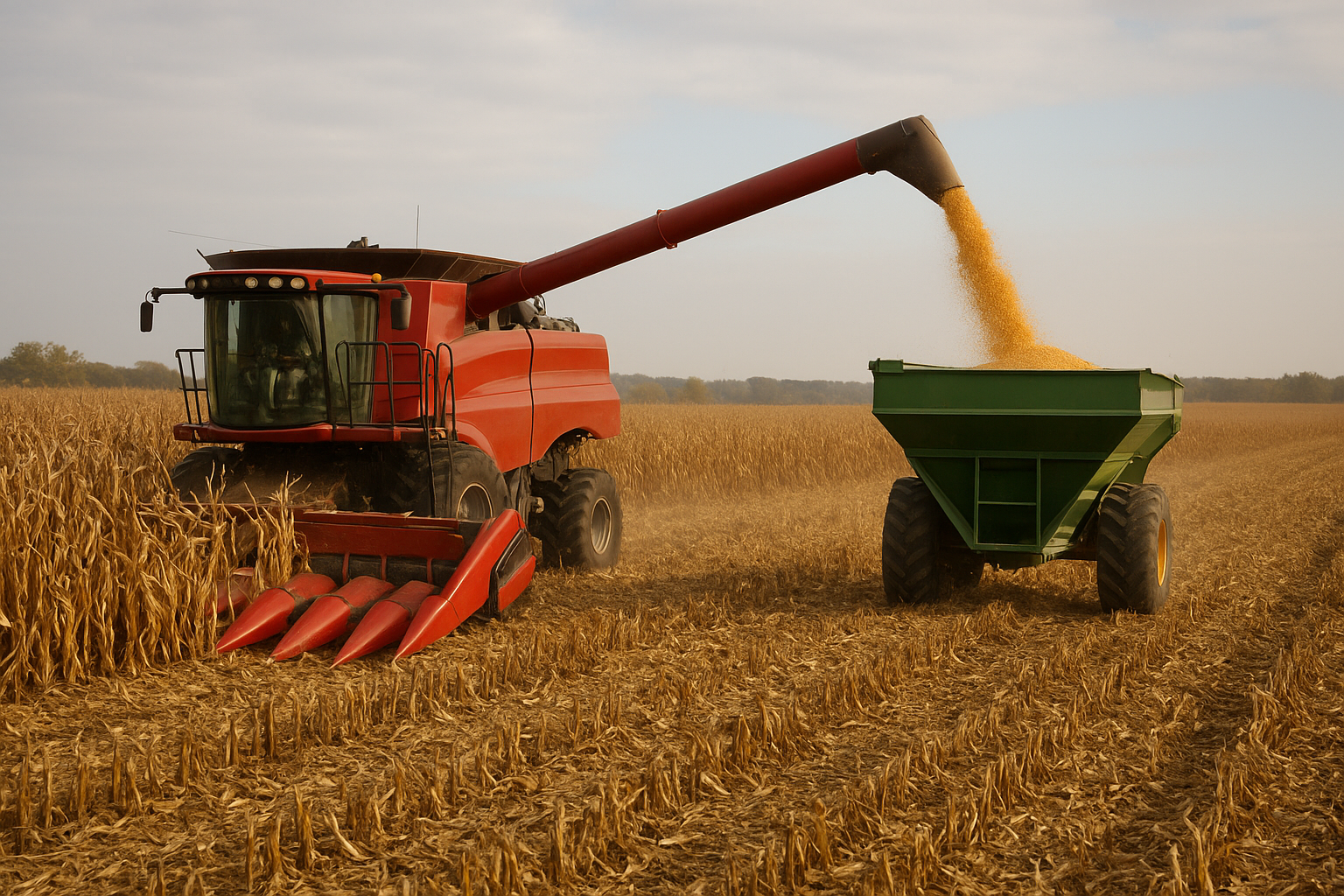
On Monday afternoon, November 2, 2026, at 4:00 PM Eastern, the U.S. Department of Agriculture’s National Agricultural Statistics Service (USDA NASS) officially published its weekly national Crop Progress telemetry for the week ending November 1, confirming that an aggressive late-autumn combining sprint swept across the primary North American grain belt. Nationwide corn harvest jumped 14 percentage points in a single seven-day window to reach 74 percent complete, surging upward from 60 percent reported the prior week and outperforming pre-report industry expectations that had centered around 71 to 72 percent. Although the national harvest pace remains narrowly behind the five-year historical average of 77 percent due to early-autumn rain delays in pockets of the Eastern Corn Belt, unseasonably dry conditions and unencumbered field access enabled commercial combining fleets across primary producing states to operate extended shifts ahead of an approaching cold front and rain system. Major producing states posted substantial weekly advances: Illinois reached 86 percent harvested, Missouri reached 86 percent, Kansas reached 86 percent, and Minnesota surged 17 percentage points in seven days to reach 82 percent complete. Across the Western Corn Belt, Iowa and Nebraska both advanced to 66 percent complete, while southern production zones concluded fieldwork, with Tennessee officially becoming the first monitored state to reach 100 percent harvest completion.
Fieldwork velocity was equally commanding across the domestic oilseed complex, where U.S. soybean combining vaulted 9 percentage points over the week to reach 88 percent complete nationwide, climbing from 79 percent the prior week and pacing comfortably ahead of the five-year historical average of 84 percent. The sprint brings the 2026 domestic soybean harvest into its final operational stages, with top-tier crushing states reporting near-total field clearance: Iowa reached 90 percent complete, Minnesota reached 98 percent, and several Upper Midwest and Plains states crossed 95 percent completion. Simultaneously, winter wheat producers advanced autumn seeding to 87 percent complete across the Southern and Central Plains, with 66 percent of the crop already emerged, although lingering soil moisture deficits in western Kansas and Oklahoma continue to monitor emergence vigor. Concurrently, national grain sorghum harvesting crossed 78 percent completion. The concentrated influx of physical grain over the past ten days has inundated country marketing channels, pushing regional commercial elevators, river terminals, and cooperative flat-storage facilities to maximum storage capacity, with emergency outdoor ground bunkers and aerated grain piles expanding across Iowa, Illinois, and Minnesota.
This rapid 14-point corn harvest expansion arrives at a pivotal juncture for domestic grain origination, cross-border export logistics, and river transport. On the logistics front, Monday's concurrent USDA Export Inspections report confirmed that weekly U.S. corn export shipments rebounded 39 percent week-over-week to 884,766 metric tons (34.8 million bushels)—led decisively by 520,923 metric tons destined for Mexico—while soybean inspections posted a staggering 2.44 million metric tons, including 1.52 million tons bound for China. The massive physical pull into international corridors coincides with historic bilateral demand, following Monday's USDA announcement of private export flash sales of 1,729,740 metric tons of corn to Mexico, supplemented Tuesday morning by an additional 315,000 metric tons to Mexico and 136,000 metric tons to South Korea. While interior grain terminals have faced localized railcar turnaround lags and ongoing navigation draft restrictions on the Lower Mississippi River system, this aggressive foreign export demand, coupled with steady domestic ethanol grind consuming over 100 million bushels weekly, is actively soaking up the harvest glut. Consequently, country elevator spot bids, which briefly sank under peak delivery pressure, have begun finding solid footing as commercial handlers transition from absorbing distressed harvest flow to securing long-term inventory.
Why It Matters:
For commercial animal feed manufacturers, livestock integrators, and independent feed mills across the United States, the USDA’s confirmation that the national corn harvest has reached 74 percent complete signals the definitive beginning of the end for peak seasonal harvest basis weakness. Whole yellow dent corn constitutes between 50 and 70 percent of total complete feed volume across domestic broiler, turkey, swine, and beef cattle diets. Over the past three weeks, commercial feed procurement desks have enjoyed favorable interior basis discounts, taking advantage of overflowing elevator bins, heavy spot farmer truck lines, and temporary space deficits that forced commercial handlers to post deep basis discounts ranging from 40 to 65 cents under December CBOT futures. However, as harvest crosses the three-quarters threshold and field activity halts due to widespread November rains, farmer selling is abruptly contracting. Having placed their initial harvest bushels into commercial debt-settlement channels, Midwest grain producers are locking remaining unpriced bushels into on-farm steel bins, refusing to sell at depressed flat cash prices below $4.20 per bushel. For feed compounders that deferred forward booking in hopes of post-harvest basis collapses, the operational window to secure cheap spot cash grain is rapidly closing.
Simultaneously, the near-completion of the soybean harvest at 88 percent—coupled with Monday's USDA Grain Crushings report showing September soybean crushings at 199 million bushels and monthly dry-mill DDGS production down 8 percent to 1.70 million tons—forces commercial nutritionists to execute dynamic least-cost formulation adjustments. With soybean meal futures trading under pressure near $319 to $322 per short ton and spot DDGS values firming due to tighter post-maintenance biorefinery inventories, the relative nutritional economics between supplemental protein sources have fundamentally shifted. Rather than relying heavily on elevated co-product inclusion rates that demand complex mycotoxin binder management and risk digestible amino acid variability, feed formulators have an immediate economic opportunity to maximize high-protein soybean meal inclusion in swine and broiler rations. To balance these rations efficiently and mitigate excess dietary nitrogen excretion, nutrition desks must aggressively deploy synthetic amino acids, notably crystalline L-lysine, DL-methionine, L-threonine, and L-tryptophan. By pairing cost-competitive new-crop soybean meal and spot corn with precision amino acid fortification, feed mills can safely reduce crude protein thresholds by 1.5 to 2.0 percentage points while maintaining optimum Feed Conversion Ratios (FCR) and protecting fourth-quarter livestock production margins.
What to Watch:
Over the coming two to three weeks through mid-November, feed procurement directors, grain merchandisers, and livestock operations managers must closely track Midwest weather patterns, farmer holding behavior, and interior cash basis spreads across major rail and trucking corridors. Agribusiness professionals should monitor the National Oceanic and Atmospheric Administration’s (NOAA) short-term precipitation maps as an expansive storm system sweeps through the Western Corn Belt, tracking how many field days are lost to mud and whether harvest restarts smoothly in Iowa, Nebraska, and northern Illinois to complete the remaining 26 percent of the corn crop. Concurrently, feed buyers must evaluate whether commercial country elevators begin pulling basis bids higher to entice farmers out of on-farm storage or whether commercial handlers utilize secondary rail shuttles to satisfy prompt commitments. Procurement desks should specifically monitor delivered-mill basis sheets across key interior feeding territories—including the Western Corn Belt cattle belts, North Carolina swine pyramids, and Delmarva broiler corridors—to determine whether freight surcharges and tight railcar supplies will widen regional delivery premiums heading into winter.
In parallel, nutrition executives and quality assurance teams must scrutinize new-crop grain physical characteristics, moisture profiles, and the impending USDA World Agricultural Supply and Demand Estimates (WASDE) report scheduled for release on November 8. As newly combined corn enters feed mill receiving pits, quality control laboratories must rigorously screen incoming loads for test weight variability, moisture condensation in bulk silos, and mycotoxin risks—particularly vomitoxin (DON) and zearalenone—which often emerge when harvest slows under wet conditions. Furthermore, market participants should watch whether USDA balance sheet analysts make material revisions to official 2026/2027 U.S. corn production, yield, or export projections in the upcoming WASDE release. An upward adjustment to national export demand reflecting massive recent bilateral flash sales could tighten domestic ending stock cushions, providing technical support to CBOT futures and altering feed cost forecasts for the first quarter of 2027.
The Bottom Line
The USDA’s November 2 Crop Progress report confirms that a decisive 14-point harvest surge has driven national corn combining to 74 percent complete while soybean harvest reaches 88 percent, marking the apex of North American harvest delivery pressure and initiating the seasonal transition toward tightening interior basis. While the massive harvest sprint filled commercial elevators and created temporary spot basis bargains, the combination of incoming November rains, expanding on-farm producer storage, massive international export commitments to Mexico and Asia, and tight DDGS co-product supplies means that harvest-time cash discounts will not persist. For commercial feed compounders, livestock integrators, and feed procurement executives, the priority now shifts from waiting for lower prices to locking in foundational grain and soybean meal coverage through the winter months, fine-tuning least-cost diets with precision synthetic amino acids, and testing incoming new-crop bushels to safeguard livestock performance and operational margins heading into 2027.