
The Story:
During a scheduled press briefing in Beijing on Thursday morning, November 5, 2026, China's Ministry of Commerce (MOFCOM) formally addressed the trajectory of U.S. agricultural trade, stating unequivocally that any expansion of commercial farm purchases remains strictly conditional upon Washington executing agreed-upon reciprocal tariff rollbacks. Speaking on behalf of the ministry, spokesperson Huang Ling emphasized that while Beijing remains prepared to facilitate expanded purchases of American agricultural commodities, full commercial implementation cannot proceed without the simultaneous lowering of existing trade duties under the landmark bilateral framework established between President Donald Trump and President Xi Jinping. The executive arrangement, which covers approximately $60 billion in two-way trade—apportioning $30 billion in reciprocal tariff relief from each nation—is engineered to reduce import duties on more than 90 percent of covered product categories to standard Most-Favored-Nation (MFN) tariff schedules once domestic legal and administrative procedures are completed. The approved agricultural relief package encompasses primary feed grains including U.S. yellow dent corn, grain sorghum, and feed barley, alongside value-added animal feed co-products such as solvent-extracted soybean meal, distillers dried grains with solubles (DDGS), and wholesale commercial cuts of pork, beef, and dairy. However, with legal codification still pending, MOFCOM affirmed that Chinese commercial trading houses and state-backed entities cannot realistically scale non-soybean agricultural bookings without active tariff adjustments.
The Ministry of Commerce's diplomatic stance directly impacts the proposed agricultural procurement targets established under the White House trade framework, which outlined an ambitious baseline for China to purchase $17 billion annually in U.S. agricultural goods, excluding raw soybeans, starting in calendar year 2026. A stark divergence has materialized between whole oilseeds and the broader coarse grain and livestock protein complex over the first three quarters of the year. While Chinese state-owned trading entities Sinograin and COFCO have maintained active procurement schedules for raw U.S. soybeans—surpassing 12 million metric tons under official bilateral commitments, reinforced by USDA Foreign Agricultural Service data confirming another 873,900 metric tons booked in this morning's weekly export report—private Chinese feed compounders and livestock conglomerates have severely curtailed purchases of U.S. feed corn, grain sorghum, DDGS, and animal proteins. Because non-soy commodities continue to face punitive retaliatory duties and import tariffs ranging between 10 and 25 percent in the absence of finalized MFN implementation, U.S. feed grains remain commercially uncompetitive against duty-free corn supplies from Brazil and domestic Chinese grain reserves, causing non-soy U.S. agricultural export commitments to China to lag far behind targeted annualized rates.
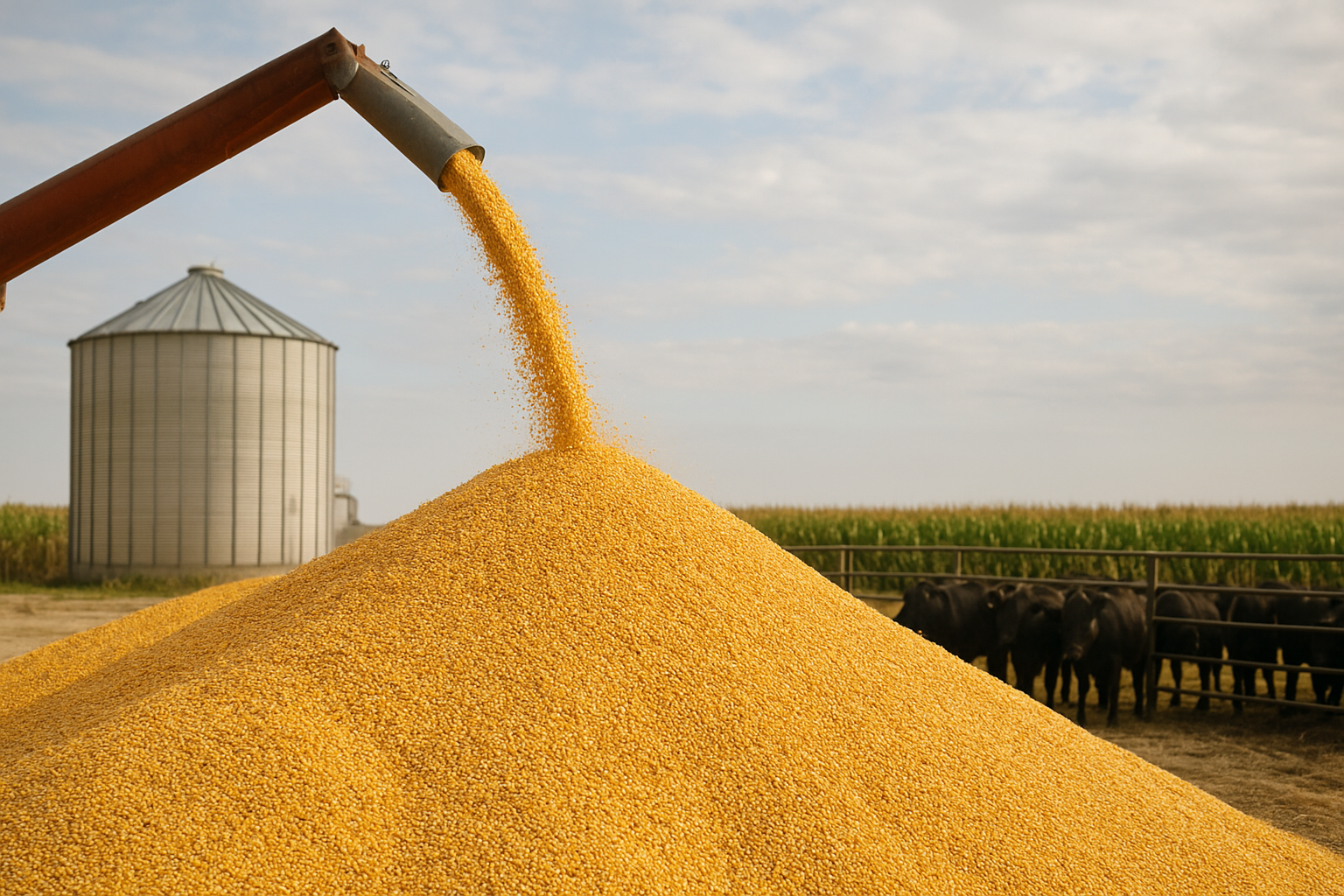
This trade policy standstill converges with peak seasonal harvest pressure across the North American grain belt, creating acute origination challenges for interior grain elevators, river terminals, and commercial grain merchandisers. Telemetry from the USDA National Agricultural Statistics Service (NASS) confirms that the national corn harvest reached 74 percent completion this week, flooding Midwest commercial storage channels, shuttle-train loading hubs, and Mississippi River barge networks with newly combined grain. In a standard trade environment, robust early-winter export vessel loading at Pacific Northwest (PNW) and U.S. Gulf terminals provides a vital logistical relief valve that rapidly clears interior elevator receiving pits and supports local basis. With Chinese buyers holding back on large-scale feed grain commitments pending tariff resolution, bulk grain is accumulating in interior handling facilities, keeping Chicago Board of Trade (CBOT) benchmark December corn futures pinned near $4.44 to $4.46 per bushel and weakening country elevator spot basis bids across Iowa, Illinois, and Nebraska. Rather than capturing traditional export demand premiums, commercial grain handlers are actively competing for domestic feed mill demand, reshaping physical commodity flows throughout the Midwest.
Why It Matters:
For North American commercial animal feed manufacturers, poultry integrators, commercial swine production systems, and beef cattle feedyards, MOFCOM's tariff precondition reinforces an exceptionally favorable ingredient procurement environment while simultaneously injecting severe commercial volatility into livestock balance sheets. On the feed ingredient ledger, the absence of aggressive Chinese export buying ensures that domestic supplies of yellow dent corn, grain sorghum, and processed co-products will remain abundant and heavily insulated against sudden export-driven price spikes throughout the fourth quarter of 2026 and into early 2027. Commercial feed compounders across the Western Corn Belt and High Plains feeding regions can capitalize on soft interior grain basis, securing physical energy feed ingredients at delivered values significantly below historical averages. However, on the livestock revenue side of the ledger, the failure to activate Chinese import channels for commercial pork and beef severely compounds domestic processing gluts. With weekly U.S. hog slaughter running at elevated autumn rates, CME December lean hog futures sank to life-of-contract lows of 57.40 cents per pound yesterday, while wholesale pork cutout values softened to $72.81 per hundredweight. Without robust international meat clearances into East Asia to absorb record slaughter throughput, integrated pork and poultry operations face intense margin compression that threatens to erase the operational benefits gained from discounted feed ingredients.
At the feed formulation desk, the convergence of abundant, low-cost domestic corn with deeply discounted oilseed meal creates a powerful economic catalyst for least-cost ration optimization across broiler, turkey, swine, and dairy diets. The oilseed processing complex is running flat-out, as demonstrated by Archer-Daniels-Midland Company's blowout third-quarter crushing operating profit of $311 million, which has flooded interior marketing channels with prompt high-protein soybean meal and driven CBOT benchmark meal futures down toward $317 to $320 per short ton. With domestic corn holding steady near $4.45 per bushel and spot distillers dried grains with solubles (DDGS) remaining comparatively expensive at $180 to $195 per ton due to tighter biorefinery supplies, linear programming formulation matrices strongly favor maximizing domestic corn and soybean meal inclusion while dialing back fibrous co-products. Maximizing high-protein soybean meal eliminates dietary variability and mycotoxin contamination risks associated with distillers grains while delivering superior amino acid digestibility. Nutritionists can further leverage this pricing alignment by dynamically calibrating crystalline amino acid supplementation—specifically L-lysine HCl, DL-methionine, L-threonine, and L-tryptophan—allowing feed compounders to satisfy standardized ileal digestible (SID) amino acid requirements with reduced crude protein safety margins, capturing immediate manufacturing cost savings ranging between $6.00 and $10.00 per ton of finished feed.
What to Watch:
Over the next two to four weeks through late November, agribusiness merchandisers, feed purchasing directors, and livestock risk managers must closely track bilateral diplomatic communications between the Office of the U.S. Trade Representative (USTR) and China's Ministry of Commerce. Procurement desks should monitor whether bilateral trade working groups establish a definitive timeline for completing the statutory legal reviews required to trigger the reciprocal tariff rollbacks under the $60 billion framework before the current trade truce milestone on January 10, 2027. In the near term, feed grain buyers should watch for whether Beijing issues targeted tariff-rate quota (TRQ) duty waivers or selective import tax rebates to state-backed and private crushers to facilitate prompt vessel bookings of U.S. grain sorghum and corn. Any surprise announcement of bilateral tariff implementation will immediately unleash pent-up Chinese import demand, driving sharp relief rallies in CBOT corn futures and sparking aggressive basis spikes at Pacific Northwest and Gulf export terminals, rapidly closing the window of depressed interior grain prices.
Concurrently, agricultural market participants must evaluate critical macroeconomic catalysts, headlined by the USDA's upcoming World Agricultural Supply and Demand Estimates (WASDE) and Crop Production reports scheduled for release on Tuesday, November 10, 2026. Merchandising desks will closely scrutinize whether federal balance sheet analysts lower official 2026/2027 U.S. corn and pork export projections to reflect sluggish Chinese procurement velocities, a move that would expand projected ending stocks and reinforce long-term domestic supply pressure. In parallel, logistics coordinators and mill procurement managers must monitor Class I railroad velocity, secondary railcar auction premiums on BNSF and Union Pacific routes, and downbound Mississippi River barge freight rates, which have settled near $23.63 per ton out of St. Louis. As harvest operations conclude across the northern Corn Belt, feed mills should exploit temporary freight fluidities and interior elevator storage congestion to lock in physical corn and soybean meal contracts through the first quarter of 2027, establishing price protection ahead of potential post-holiday trade policy shifts.
The Bottom Line
China's November 5 press briefing declaring that expanded purchases of U.S. feed grains, meat, and co-products remain strictly dependent on reciprocal tariff rollbacks under the $60 billion trade agreement underscores the complex interplay between international trade diplomacy and domestic animal nutrition economics. While the absence of immediate Chinese export demand confines abundant new-crop corn and soybean meal within domestic boundaries—providing commercial feed mills, integrated poultry producers, and swine operations with exceptionally low ingredient costs—it simultaneously threatens livestock margins by stalling export clearances needed to absorb peak domestic slaughter. Feed procurement executives and consulting nutritionists should capitalize on this domestic supply surplus by securing forward physical feed grain and meal commitments at favorable basis levels, reformulating complete feeds with high-inclusion soybean meal and precision crystalline amino acids, and maintaining active risk management strategies to defend feeding margins against abrupt trade policy breakthroughs heading into 2027.