
The Story:
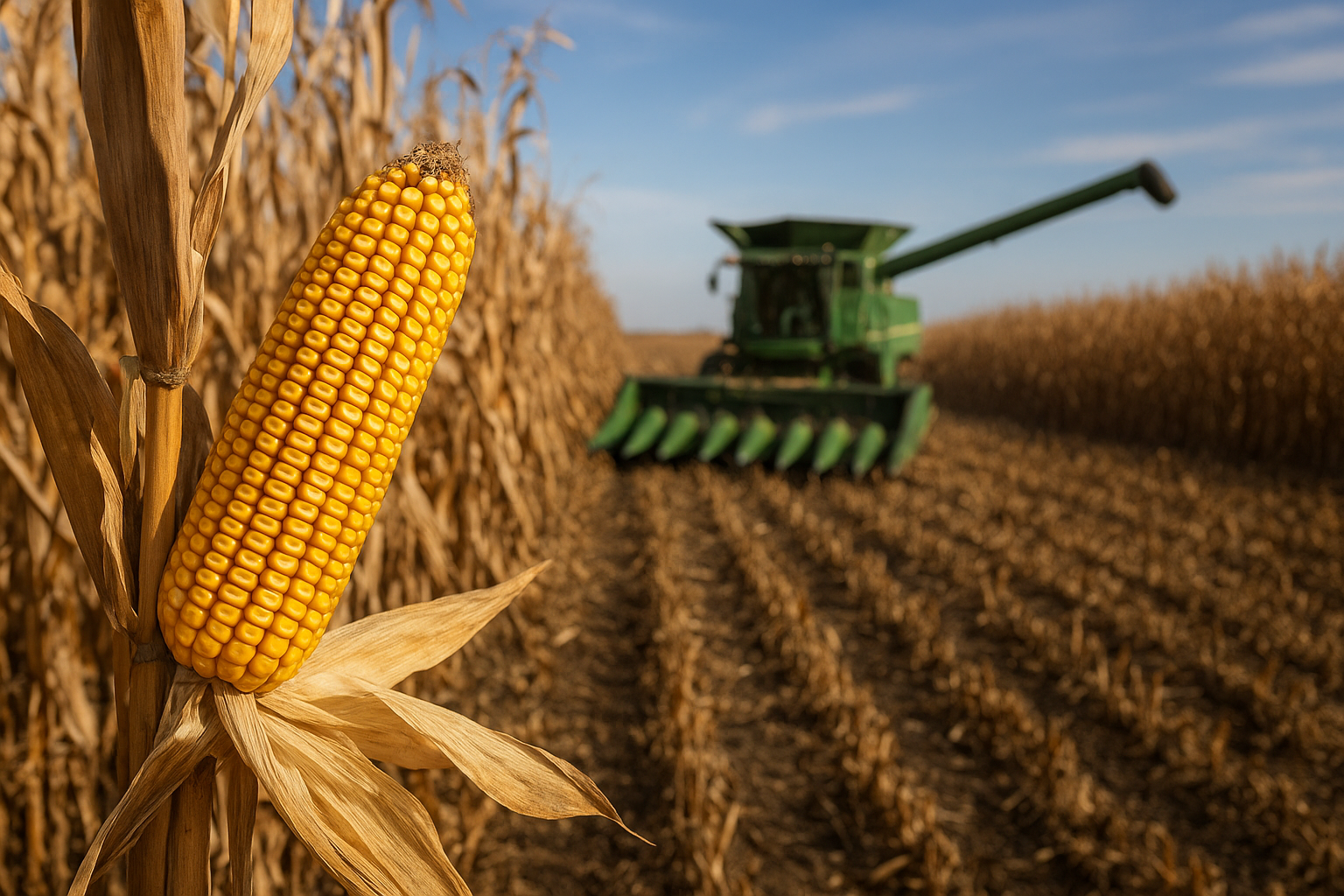
Following the weekend dissipation of last week's localized frost and freeze advisories across the upper Midwest, a broad ridge of high pressure ushered in dry, sunny, and unusually mild conditions on Monday morning, October 19, 2026, unleashing combines across the primary production regions of Illinois, Iowa, Indiana, Nebraska, and Minnesota. The sudden acceleration in field activity has rapidly pushed nationwide corn harvest progress past the 45 percent completion threshold, heading toward 50 percent and swiftly narrowing the early season harvest lag caused by September rains. On the Chicago Board of Trade (CBOT), the physical onslaught of freshly combined grain triggered immediate speculative and commercial selling, sending benchmark December 2026 corn futures down 3.50 to 3.75 cents to open the week trading between $4.69 and $4.74 per bushel. Monday morning’s technical slide underscores a market struggling to absorb the reality of the U.S. Department of Agriculture’s (USDA) record crop projection: a national average yield of 181.2 bushels per acre delivering a massive 16.034-billion-bushel domestic harvest and pushing projected 2026/27 ending stocks to 1.849 billion bushels—an 18 percent year-over-year inventory expansion that continues to cap commercial price rallies.
The market impact of this harvesting surge is felt most acutely across the interior cash grain complex, where country elevators, river terminals, and commercial grain processors have experienced an overwhelming influx of commercial truck deliveries. With commercial storage capacity filling rapidly and grain drying queues lengthening at local receiving pits, interior cash bids have plummeted even more sharply than the board, driving the national average cash corn price down to $4.35 per bushel on Monday morning. Across Western and Eastern Corn Belt river collection points along the Mississippi and Illinois waterways, interior spot basis has weakened substantially, widening out to 35 to 45 cents under the December futures contract. While recently reduced Mississippi River barge freight rates—which tumbled 29 percent late last week to $28.86 per ton—have provided modest logistical relief for export-bound volume, interior ethanol plants and wet-milling facilities have responded to the local supply deluge by slashing posted cash bids. In several heavy-producing counties where commercial flat storage and temporary outdoor bunkers are already being activated, merchandisers have widened moisture discount schedules, penalizing wet grain receipts and forcing cash-strapped producers lacking on-farm bin capacity into aggressive commercial spot sales.
For animal feed manufacturers, livestock producers, and ingredient merchandisers, this harvest-induced cash corn collapse is magnified by a striking commodity divergence against the protein complex. While corn futures and cash bids have steadily weakened under seasonal weight, December soybean meal futures on the Chicago Mercantile Exchange (CME) have demonstrated remarkable resilience, holding firm near $359.50 to $370.00 per short ton and ticking up $1.90 on Monday morning amid steady domestic crush margins and recent flash export sales to China. Consequently, the soybean-meal-to-corn price ratio has blown out to nearly 2.2:1 on a per-ton basis, creating an extreme valuation spread between dietary energy and dietary protein. With cash corn available at equivalent per-ton prices near $155.00 alongside discounted distillers dried grains with solubles (DDGS) trading around $193.00 per ton, the cost of dietary starch and metabolizable energy has fallen to multi-year lows. This dramatic price disparity is upending standard feed formulation baselines across North American swine, broiler, and turkey operations, forcing consulting nutritionists to immediately reassess least-cost diet specifications to capture emerging margin opportunities.
Why It Matters:
For commercial feed mills, integrated swine systems, and commercial poultry complexes across the Corn Belt and Southeast, the widening spread between $4.35/bushel cash corn and $360/ton soybean meal demands an immediate, disciplined reformulation of least-cost feeding matrices. Commercial swine and broiler nutritionists are moving aggressively to maximize dietary corn energy density while systematically paring back soybean meal inclusion by 2 to 4 percentage points across grow-finish and late-stage rations. To safely reduce intact soybean meal volume without compromising crude protein minimums, standardized ileal digestible (SID) amino acid balances, or animal lean-gain kinetics, feed formulators are significantly increasing supplemental synthetic amino acids. By expanding the dietary inclusion of crystalline L-lysine hydrochloride, L-threonine, DL-methionine, and L-tryptophan, swine feed manufacturers are able to offset lower soybean meal levels while achieving immediate net ration savings of $4.50 to $7.25 per finished ton of complete feed. Concurrently, ruminant feedlot managers and commercial dairies are pairing depressed cash corn with discounted DDGS to manufacture high-energy, low-cost finishing rations that dilute steep feeder cattle acquisition costs.
For feed mill procurement executives, grain purchasing directors, and elevator merchandisers, this harvest basis collapse opens a decisive 10-to-14-day commercial procurement window. Commercial feed mills and livestock feeding operations with available on-site bin capacity or contracted private space are capitalizing on distressed harvest-time selling by locking in physical cash corn at basis levels of 40 to 45 cents under December futures. Procurement managers are actively deploying basis-only contracts and rolling forward financial hedges to secure physical grain coverage through the fourth quarter of 2026 and the first quarter of 2027. Locking in physical corn at harvest-compressed basis levels protects feed manufacturers against the inevitable post-harvest basis rebound that typically occurs once combines leave the fields, elevator storage space stabilizes, and Midwest farmers lock their bins to await post-New Year tax management. Commercial feed mills that execute proactive grain purchasing strategies during this seasonal basis flush will establish an enduring structural cost advantage over competitors forced to buy spot grain in a tighter winter cash environment.
What to Watch:
Over the next 48 to 72 hours, feed grain procurement directors, commodity merchandisers, and livestock risk managers must closely evaluate the USDA National Agricultural Statistics Service (NASS) weekly Crop Progress report, due for release on Monday afternoon. Industry analysts will scrutinize whether national harvest progress meets trade expectations of 45 to 50 percent completion, paying special attention to state-by-state harvesting velocities across key feed deficit boundaries. In tandem with federal crop progress metrics, market participants must monitor Midwest 7-to-10-day weather forecasts; continued dry, unseasonably warm weather will sustain harvesting momentum and maintain heavy pressure on interior cash basis, whereas any sudden rain fronts moving through the central Corn Belt later this week could abruptly stall field operations, creating temporary delivery pauses that could prompt country elevators to quickly firm their spot cash bids.
Simultaneously, feed ingredient buyers and formulators must track secondary processing data and global amino acid supply chain indicators. Procurement teams should monitor weekly ethanol production and corn grind figures from the Energy Information Administration (EIA) to evaluate whether Midwest ethanol biorefineries increase operating rates to capitalize on $4.35 corn, which would further expand local supplies of distillers grains and put additional downward pressure on regional DDGS values. Concurrently, feed purchasing executives must monitor international logistics, container freight rates, and lead times for imported crystalline amino acids originating from Asian fermentation facilities. As U.S. swine and poultry mills collectively increase synthetic lysine, threonine, and methionine inclusion to displace expensive soybean meal, domestic spot supplies of synthetic amino acids will tighten, making proactive contract commitments and forward buffer stocks vital to prevent costly diet disruptions or operational delays at commercial feed blending plants.
The Bottom Line
The rapid acceleration of the U.S. corn harvest on Monday morning, October 19, 2026, has driven country elevator cash corn bids down to a national average of $4.35 per bushel and blown interior basis out to 45 cents under futures, delivering a powerful cost-reduction opportunity to animal feed manufacturers and livestock producers nationwide. With cheap cash corn and discounted $193/ton DDGS widening the price spread against resilient $360/ton soybean meal, feed industry professionals must execute a coordinated operational strategy: consulting nutritionists should immediately recalibrate least-cost diets by optimizing corn inclusion and deploying synthetic amino acid matrices to displace high-cost intact protein, while procurement teams must aggressively secure physical harvest-basis coverage and forward supply contracts before seasonal storage constraints ease, post-harvest holding patterns solidify, and winter logistics firm interior grain markets.