
The Story:
On Wednesday afternoon, October 28, 2026, the U.S. Department of Agriculture's National Agricultural Statistics Service (USDA NASS) officially released its weekly Broiler Hatchery report for the week ending October 24, 2026, confirming that commercial hatcheries across the primary 19-state weekly reporting program set 246 million broiler-type eggs in incubators. This substantial weekly volume marks a steady expansion compared to corresponding year-ago benchmarks, demonstrating that integrated commercial poultry processors are aggressively maintaining high-capacity setter throughput heading into the late autumn feeding season. Across the nationwide hatchery network, average hatchability for chicks hatched during the week held firm at 79.5 percent, calculated by dividing the total volume of hatched broiler chicks by the quantity of eggs set three weeks prior. The sustained 246-million-egg incubator pipeline underscores widespread operational discipline across major integrated broiler complexes, where hatchery managers are running automated setter cabinets at high utilization rates to preserve seamless poultry processing schedules, optimize nursery infrastructure, and avoid costly plant downtime across commercial poultry processing facilities and slaughter operations through the final months of 2026.
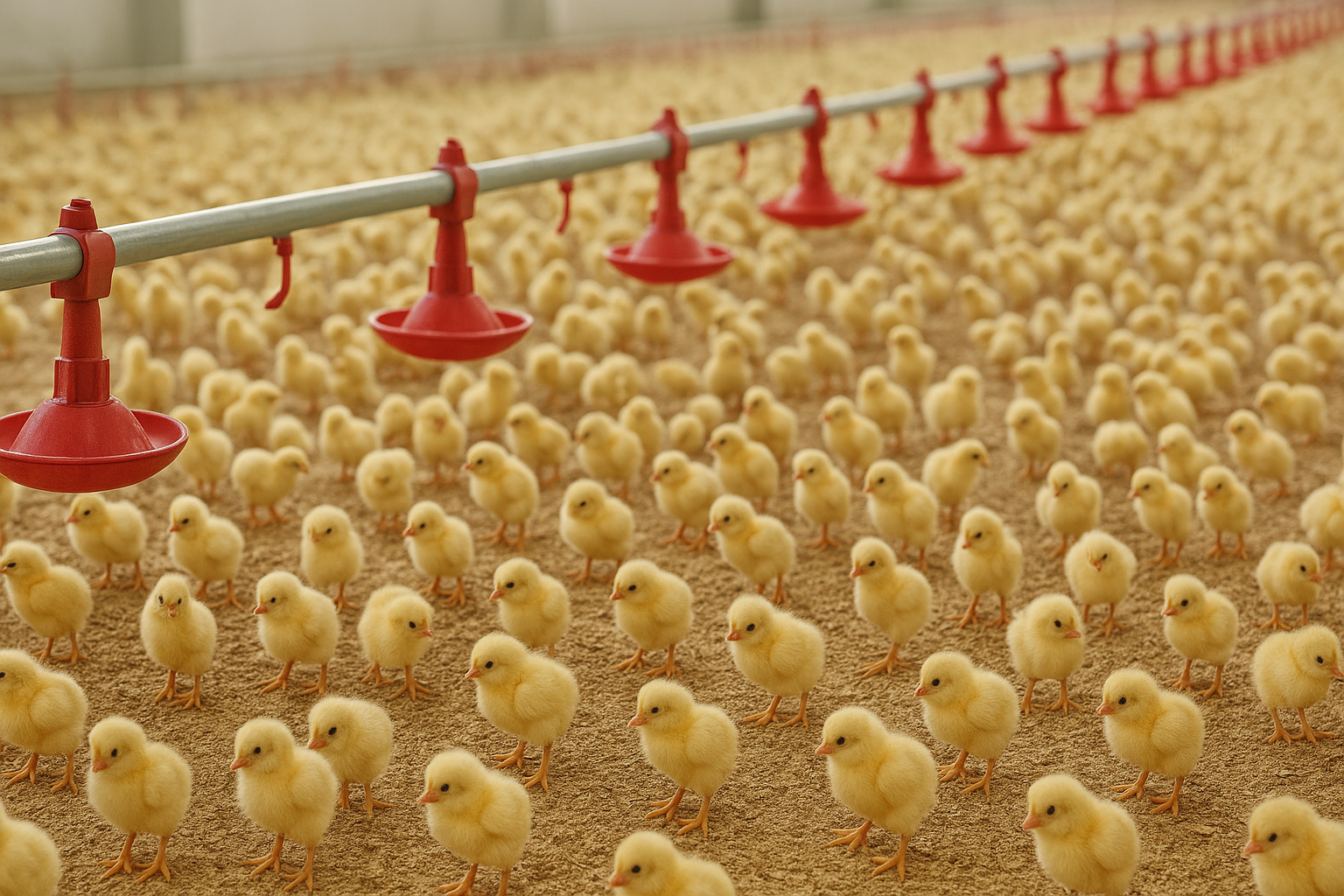
In parallel with elevated incubator volume, commercial broiler integrators placed 188 million broiler chicks for meat production across domestic growout facilities during the week ending October 24, 2026, also reflecting a steady year-over-year increase across key southeastern and south-central production corridors. Leading broiler-producing states continued to anchor national throughput, led by Georgia setting over 34.5 million eggs and placing approximately 26 million chicks, followed by heavy regional contributions across Alabama, Arkansas, North Carolina, Mississippi, and Texas. On a cumulative marketing-year basis, total domestic chick placements from January 10, 2026, through October 24, 2026, climbed to an aggregate of 8.21 billion head, sustaining a solid 2 percent expansion pace relative to the identical 42-week timeframe recorded in 2025. This enduring 2 percent cumulative placement expansion confirms that integrated broiler companies are successfully monetizing favorable wholesale meat margins, responding to strong consumer retail demand for affordable white-meat proteins relative to historically expensive beef cuts, and leveraging modern genetic flock gains to drive consistent live-bird performance and exceptional flock livability across commercial growing barns.
The physical realities of maintaining 246 million eggs in incubation and placing 188 million chicks every seven days establish an immutable biological demand curve that directly dictates commercial feed mill operations across North America through the remainder of the calendar year. Because commercial broiler production operates on a rigorous six-to-eight-week growout cycle from hatchery placement to target market slaughter weights of 6.2 to 6.8 pounds, the 188 million chicks placed during late October will enter their highest-intake grower and finisher dietary phases between late November and mid-December 2026. Across commercial feeding complexes, this placement cadence represents an immediate, non-negotiable manufacturing requirement exceeding 820,000 metric tons of complete poultry feed every single week. With hatchery managers reporting consistent breeder flock egg laying rates, steady hen inventory fertility, and climate-controlled incubation rooms operating without disruption, integrated poultry firms are fully committing their finishing barn networks to sustained fourth-quarter output, providing regional grain merchandisers, commercial feed compounders, and ingredient suppliers with exceptionally transparent forward volume baselines.
Why It Matters:
For commercial animal feed manufacturers, ingredient purchasing directors, and poultry nutrition teams, this steady placement pace carries enormous economic consequences for bulk raw material origination, mill batching schedules, and local basis values. Broiler manufacturing represents the single largest consumer of formulated feed in the United States, consuming approximately 56 million tons of complete feed annually and generating continuous, uninterrupted demand for commercial yellow dent corn, high-protein soybean meal, distillers co-products, and specialized micro-ingredients. Weekly chick placements of 188 million head require approximately 500,000 tons of feed grain and roughly 210,000 to 245,000 tons of 48-percent solvent-extracted soybean meal weekly. With the U.S. corn harvest advancing past 60 percent completion and domestic soybean crushers operating at intense runtimes, integrated poultry feed mills in northern Georgia, northern Alabama, and the Delmarva peninsula must actively defend spot and forward delivery bids against export terminals and river loading docks to guarantee continuous physical arrivals into mill receiving pits, ensuring uninterrupted batching at high-capacity feed mills.
At formulation desks and ingredient procurement offices, maintaining cost efficiency across this 8.21-billion-bird cumulative flock demands aggressive, precision feed optimization. Broiler feeding programs rely on phased nutritional regimens, transitioning broilers from high-protein starter diets containing 22 to 23 percent crude protein to nutrient-dense grower and withdrawal rations balanced for digestible amino acids and net energy. With Wednesday's Energy Information Administration report confirming domestic fuel ethanol production surged to 1.118 million barrels per day, feed compounders are capturing attractive ingredient substitution opportunities by blending competitively priced Midwest distillers dried grains with solubles (DDGS) at 6 to 10 percent dietary inclusion rates. Concurrently, feed formulators are maximizing supplemental crystalline amino acids—specifically DL-methionine, L-lysine HCl, and L-threonine—alongside high-potency phytase and protease enzymes, allowing mills to reduce expensive crude protein margins, improve nitrogen utilization, and protect feed conversion ratios below 1.80 pounds of feed per pound of live gain amidst tight operating spreads across processing networks.
What to Watch:
Over the next two to four weeks, feed procurement directors, grain originators, and poultry production executives must monitor forthcoming weekly USDA NASS Broiler Hatchery reports to evaluate whether weekly incubator egg sets maintain the 246-million-unit benchmark as integrators finalize year-end processing schedules. Concurrently, technical specialists and hatchery directors must closely track hatchability metrics; with national averages holding at 79.5 percent, any slight drop below the 79-percent line would force integrators to expand egg sets further to sustain weekly slaughter headcounts, amplifying parent breeder flock feed requirements. In addition, feed merchandising teams must rigorously audit Class I railroad freight schedules and secondary railcar auction values along CSX and Norfolk Southern corridors, verifying that shuttle trains carrying Midwest corn and meal maintain swift dwell times through southeastern interchange hubs without incurring secondary freight congestion surcharges or transit delays.
Simultaneously, live production directors, flock supervisors, and feed mill biosecurity managers must maintain strict sanitation standards as seasonal wild waterfowl migration expands across the Atlantic and Mississippi migratory flyways. The persistent background risk of Highly Pathogenic Avian Influenza (HPAI) demands uncompromising biosecurity protocols for all feed delivery bulk trucks, pneumatic tankers, and ingredient delivery vehicles entering farm perimeters. At purchasing desks, commodity risk managers should leverage current harvest basis softening to secure extended forward coverage on high-protein soybean meal, corn distillers co-products, and supplemental amino acids through the first quarter of 2027, locking in predictable ration economics and safeguarding integrated growout operations from unpredictable winter logistics disruptions across key rail and highway transport routes.
The Bottom Line
The October 28 USDA NASS Broiler Hatchery report confirming 246 million eggs set, 188 million weekly chick placements, and cumulative placements of 8.21 billion head reinforces a vigorous, structurally expanding production posture across the U.S. poultry industry heading into the final stretch of 2026. For animal feed manufacturers, commercial nutritionists, and commodity merchandisers, this unbroken biological throughput guarantees massive weekly feed mill grind, anchors intense domestic demand for corn and soybean meal, and elevates the strategic necessity of precision amino acid formulation. Operations that proactively secure interior ingredient pipeline deliveries, capture favorable DDGS substitution spreads, balance crystalline amino acids, and maintain stringent biosecurity controls across feed manufacturing assets will effectively insulate operating margins and sustain superior production efficiencies well into the coming year.