
The Story:
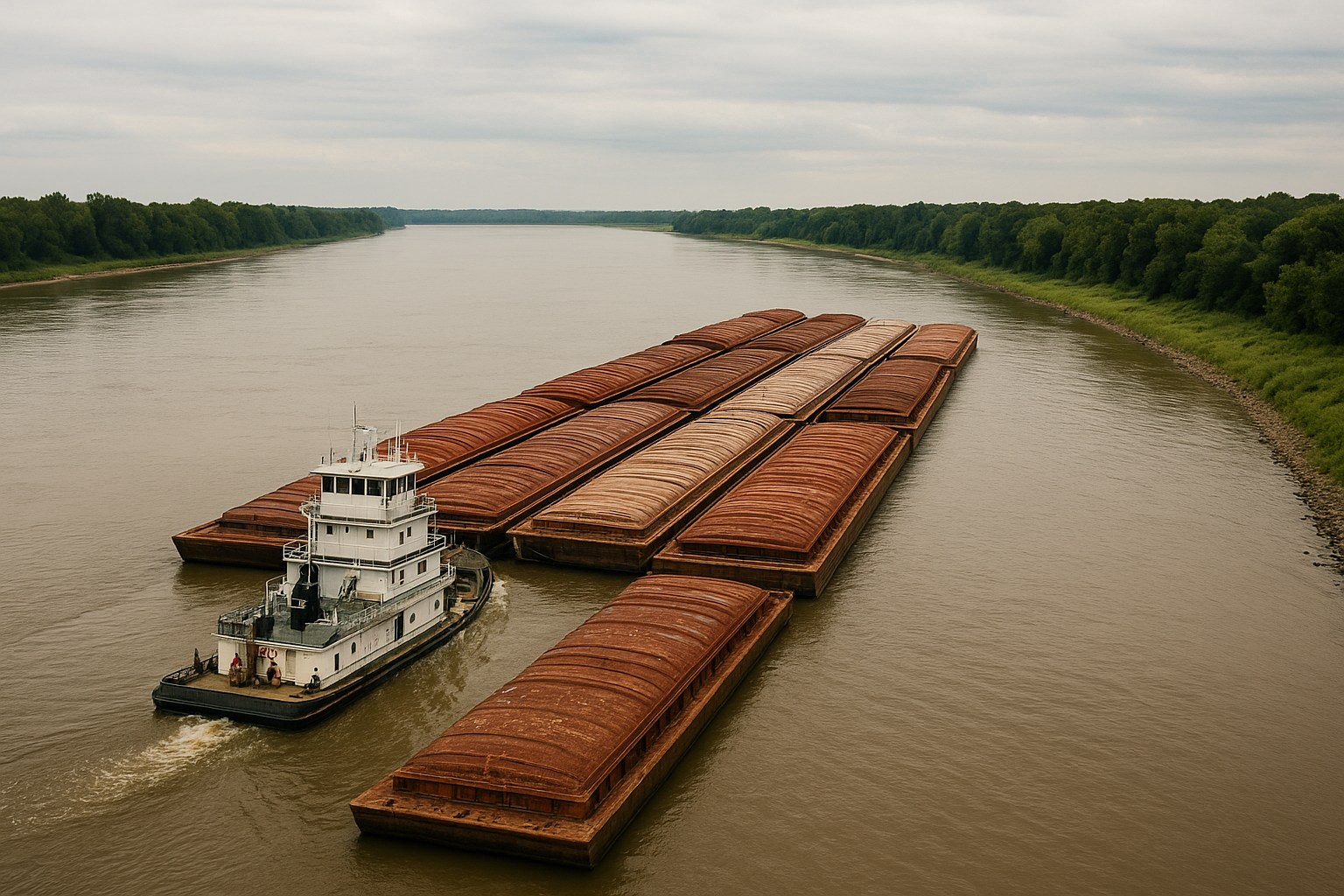
A severe logistical bottleneck is tightening across North America's premier agricultural transportation corridor as unrelenting autumn dryness drives water levels across the Mississippi River system toward critical operating minimums. In response to rapidly dropping river stages, major inland waterway carriers—including American Commercial Barge Line (ACBL) and Ingram Marine Group—alongside maritime authorities have officially triggered low-water operating protocols throughout the Lower and Middle Mississippi basins. The primary river gauge at Memphis has once again descended below the psychological zero-foot threshold, forcing the U.S. Coast Guard (USCG) and regional navigation safety committees to issue strict navigation advisories. Under these active directives, maximum allowable barge drafts for southbound grain movements between Lower Mississippi River mile markers 953 and 303 have been forcibly restricted from the standard 12-foot commercial draft down to 11 feet 6 inches, with certain chronically shallow reaches enforcing draft limits as shallow as 10 feet. Concurrently, maritime regulators have mandated tow size reductions of 13% to 20%, cutting maximum tow configurations from traditional 30-to-36-barge flotillas down to 25 or fewer vessels. These operational curbs sharply restrict navigation lane widths and force commercial towboats to maneuver with heightened caution to prevent disastrous vessel groundings and complete waterway closures.
The physical and financial toll of these navigation restrictions translates into an immediate contraction of inland bulk carrying capacity. In commercial grain barging, every single inch of lost vessel draft deprives a standard hopper barge of approximately 17 to 20 tons of cargo capacity. Under current federal draft restrictions of 11 feet 6 inches—representing an average loss of 6 to 12 inches of depth—shippers are forced to short-load each barge by 150 to 240 short tons. This mandatory lightening eliminates roughly 5,000 to 8,500 bushels of corn or soybeans per barge that would otherwise move seamlessly to export elevators. Compounding this loss of vessel payload, the mandated reduction in tow sizes means that every single towboat transiting downriver carries between 3,000 and 7,500 fewer total tons of agricultural commodities per voyage. To keep critical shipping channels navigable, the U.S. Army Corps of Engineers has deployed emergency mechanical and hydraulic cutterhead dredges at high-risk shoal locations, including Upper Mississippi Mile 125.7 and Lower Mississippi Mile 457 near Madison Parish Port. These 24-hour dredging operations require mariners to coordinate one-way transit queues, generating substantial fleet delays, elevating barge turnaround times, and triggering mandatory carrier low-water surcharges across spot and contractual freight contracts.
The timing of this inland waterway crisis could hardly be more precarious for the broader agricultural economy, as it collides directly with the accelerating pace of the 2026 U.S. autumn crop harvest. According to the National Agricultural Statistics Service (USDA NASS) in its latest national Crop Progress report, the U.S. corn harvest has rapidly advanced to 13% completion, pacing two percentage points ahead of the five-year historical average, while the domestic soybean harvest has reached 12% completion. Across the Western and Central Corn Belt, favorable field conditions have enabled combines to harvest massive crop volumes at breakneck speed, flooding country elevators, interior terminals, and river loading docks with fresh grain. However, because the Mississippi River system serves as the foundational transit artery responsible for transporting approximately 60% of all U.S. grain and oilseed export volumes destined for the Center Gulf terminal complex, the sudden strangulation of barge throughput leaves elevators facing severe warehouse congestion. With export terminals unable to receive contracted volume on schedule, the flow of newly harvested crops is backing up into interior distribution networks, trapping vast supplies within local production regions.
Why It Matters:
For commercial feed manufacturers, livestock integrators, and grain merchandisers, this severe disruption to river logistics instantly fractures domestic market pricing and unleashes dramatic regional basis divergence across the United States. In the inland grain marketing architecture, when barge freight rates spike and export terminals implement delivery quotas, river-based commercial elevators protect their operational margins by aggressively widening local cash basis bids. Elevators along the Illinois, Upper Mississippi, and Ohio rivers have heavily discounted their cash purchasing bids, dropping interior farmgate prices well below Chicago Board of Trade (CBOT) futures benchmarks. For integrated swine and poultry feed mills situated directly within Midwestern production bastions—such as Iowa, southern Minnesota, Illinois, and Indiana—this freight bottleneck creates an immediate cash commodity surplus. Local feed mills and regional processors are capturing exceptionally cheap whole corn and unprocessed soybeans at wide basis discounts, driving immediate physical feed manufacturing costs lower at the plant gate. However, for livestock and poultry operations located in consumption-deficit zones—most notably large-scale broiler integrators across Georgia, Alabama, and the Carolinas, as well as commercial cattle feedlots in the Texas Panhandle—the market dynamic is entirely inverted. Because waterborne grain and soybean meal cannot efficiently clear down the river system, delivered basis values at Southeastern and Southern processing mills have rallied sharply, turning what should be a harvest-season cost reprieve into an expensive procurement headache.
Furthermore, this logistical bottleneck exerts immediate structural pressure on daily least-cost feed formulation matrices and supplemental amino-acid economics. Feed formulators and livestock nutritionists operating in feed-deficit regions are navigating a sudden cost spike for bulk intact proteins, including 48% crude-protein soybean meal and distillers dried grains with solubles (DDGS). Attempting to circumvent the choked river network by diverting bulk ingredient movements to rail offers little economic respite, as domestic rail fuel surcharges remain pinned near historic highs of $0.48 per mile per car, representing an exorbitant 153% year-over-year inflation rate. When delivered soybean meal costs escalate due to combined rail premiums and river basis dislocation, commercial nutritionists across the poultry and swine sectors are compelled to re-evaluate intact protein inclusion thresholds. In monogastric finishing rations, formulators can safely lower dietary crude protein by two to three percentage points by substituting intact meals with concentrated synthetic amino acids—specifically crystalline L-lysine monohydrochloride, DL-methionine, L-threonine, and L-tryptophan. This precision formulation protocol displaces between 50 and 100 pounds of expensive intact soybean meal per finished ton. However, with recent federal trade duties simultaneously raising synthetic lysine costs, nutritionists face a highly intricate balancing act, wherein formulation software must continuously arbitrate between elevated delivered vegetable proteins and protected micro-ingredient values to preserve bird and hog finishing margins.
What to Watch:
Looking forward into the pivotal fourth quarter of 2026, agricultural procurement directors, feed-mill managers, and commodity traders must closely track meteorological patterns and river stage projections across the entire Mississippi drainage basin. Stakeholders must scrutinize weekly hydrological forecasts from the National Oceanic and Atmospheric Administration (NOAA) and the National Weather Service (NWS) Ohio and Lower Mississippi River Forecast Centers. Without substantial, sustained rainfall across the Ohio and Missouri river valleys to recharge depleted tributary flows, river stages will deteriorate further as seasonal autumn temperatures cool. Industry participants should monitor the weekly Grain Transportation Report published by the USDA Agricultural Marketing Service (AMS), tracking benchmark barge freight rates across key loading segments including the Twin Cities, Mid-Mississippi, Illinois River, and St. Louis. If barge freight rates surge past 700% to 800% of benchmark tariff—as occurred during historical low-water crises—the economic penalty on delivered feedstuffs will intensify, forcing export elevators to reject additional barge arrivals and stranding even greater grain volumes within interior storage facilities.
Commercial feed buyers and livestock producers must also evaluate secondary intermodal transportation capacity and establish robust contractual protections to prevent costly plant downtime. Merchandisers should monitor secondary railcar freight auction spreads on the Surface Transportation Board (STB) and commercial exchange platforms, as agricultural shippers compete aggressively against industrial bulk shippers for limited freight locomotive power and grain car availability. Concurrently, procurement teams must review existing forward basis contracts with suppliers, verifying force majeure clauses, guaranteed delivery schedules, and origin shipment allowances. Feed manufacturers must ensure that mill ingredient storage bins maintain sufficient buffer stocks of macro-ingredients, as extended transit times on both water and rail threaten delivery schedules. On the nutritional front, feed formulation teams must execute frequent laboratory quality analyses on incoming corn and co-products; during harvest bottlenecks, grain held in temporary outdoor ground piles or delayed transit faces heightened risk of moisture migration, heating, and mycotoxin development, demanding rigorous quality control before entering high-performance swine and poultry rations.
The Bottom Line
Persistent low-water restrictions across the Mississippi River system have created an acute logistical bottleneck that fundamentally bifurcates North American feed economics at the height of the 2026 harvest season. While mandatory barge draft cuts and reduced tow sizes depress interior cash grain basis and provide substantial, localized cost relief for feed mills operating near Midwestern production centers, they simultaneously trigger severe delivered cost inflation and supply anxiety for livestock and poultry operations located throughout feed-deficit consumption regions. To safeguard operational continuity and defend tightening meat and poultry production margins against escalating logistics costs, commercial feed manufacturers must aggressively diversify transport commitments, secure forward ingredient delivery channels, and leverage precision least-cost formulation strategies that optimize synthetic amino acids against volatile delivered protein markets.